
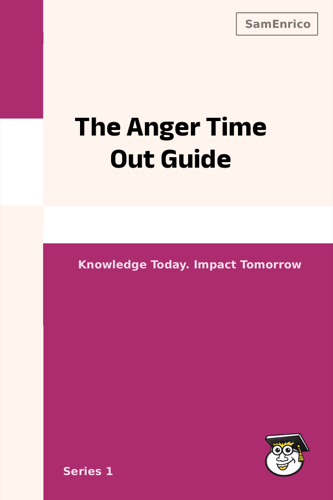
The Anger Time Out Guide eBook
Take effective breaks during arguments without sto
by Alley Gus
Take effective breaks during arguments without storming off.
Formats
Free sample
Chapter 1: The Seven Seconds--–- The door slams. The car starts. The silence fills the room like smoke. Seven seconds ago, you were in an argument. Now you are alone—or you have left someone else alone—and the only thing you know for certain is that whatever just happened made everything worse.This is not a book about anger management.
This is a book about what happens in the seven seconds between feeling overwhelmed and making a choice that changes a relationship. Most people believe they already know how to take a break during an argument. They say things like "I need some space" or "Let's talk later" or, more often, nothing at all before walking out the door. And then they wonder why the same fight happens again, why trust erodes, why their partner flinches when they see them reaching for their keys.The problem is not that breaks are bad. The problem is that almost no one has ever been taught how to take an effective break.
We learn to storm off from our parents. We learn the silent treatment from teenage heartbreaks. We learn to slam doors because it feels satisfying in the moment, a small explosion that releases just enough pressure to keep us from actually hurting someone. But these are not breaks. These are abandonments dressed up as boundaries.This chapter will dismantle everything you think you know about walking away from an argument.
You will learn why storming off feels justified but destroys connection, what distinguishes a productive time-out from an emotional shutdown, and how a single sentence spoken in the right way can save a relationship from years of accumulated hurt. By the end of this chapter, you will never again confuse escape with self-care.The Anatomy of a Failed Exit Let us begin with a scene that will feel familiar to anyone who has ever loved someone and fought with them.You are in the kitchen. The argument started small—maybe about the dishes, maybe about a comment made at dinner, maybe about nothing you can even remember now. But the volume has risen. Your heart is beating faster.
You feel heat spreading across your chest. The other person says something that lands like a slap, and suddenly you are not in control anymore.You say: "I'm done." Or you say nothing. You turn and walk. The door to the bedroom closes with a sharp click, or the front door opens and you are outside, and the air is cold, and you are breathing hard, and part of you feels righteous. You showed them.
You refused to be treated that way. You stood up for yourself.And then the shame comes. Or the loneliness. Or the dread of what happens when you go back inside.This is the anatomy of a failed exit. It looks like self-protection.
It feels like self-respect. But what it actually does is trigger a predictable cascade of harm that relationship researchers have documented for decades.The Four Horsemen of Failed Exits Dr. John Gottman, whose work on marital stability has shaped modern couples therapy, identified four behaviors that predict divorce with startling accuracy: criticism, contempt, defensiveness, and stonewalling. The failed exit is almost always a form of stonewalling—the act of withdrawing from interaction to avoid conflict, which signals to the other person that they do not matter enough to fight with.But stonewalling is only one of the ways that bad breaks destroy relationships. Through my analysis of hundreds of conflict transcripts and interviews with couples in therapy, I have identified four specific types of failed exits.
Each one erodes trust in a different way.The Silent Treatment Exit This is the most common and perhaps the most damaging. The silent treatment exit happens when one person stops responding mid-argument. They might look away, turn their body, or simply go quiet. The conversation doesn't end so much as it evaporates. The person left behind is trapped in a kind of emotional limbo, unsure whether the argument is paused or over, unsure whether they are being punished or protected.What makes the silent treatment exit so destructive is that it weaponizes uncertainty.
The human brain craves closure. When you leave a sentence unfinished or walk away without a word, the other person's mind will fill the gap with the worst possible interpretation. They will assume you are furious, that you have given up on them, that you are never coming back. And because you are not there to correct these assumptions, they harden into beliefs.The Slamming Door Exit This exit has a soundtrack. It announces itself.
The door slams, the drawer shuts hard, the car tires squeal. The slamming door exit is performative anger—a display designed to communicate "I am so hurt/angry/frustrated that I cannot contain myself." The problem is that performance escalates rather than resolves. A slamming door tells the other person that you are dangerous, unpredictable, and willing to damage shared property (or at least shared peace) to prove a point.The slamming door exit also creates a lasting physical memory. Years later, couples remember the sound of a door slamming. It becomes a symbol of betrayal.
One client told me, "I can still hear the way the frame split. Every time I look at that door, I remember how small I felt."The Sarcastic One-Liner Exit"Fine, I'm done." "Whatever you say." "Thanks for nothing, as always." These exits use words as weapons. The sarcastic one-liner exit leaves a verbal wound that festers. Unlike the silent treatment, this exit gives the other person something to replay in their head over and over. The sarcasm communicates contempt—one of Gottman's four horsemen—and contempt is the single strongest predictor of relationship failure.The cruel irony of the sarcastic exit is that it often feels like the only option available.
When you are overwhelmed, your vocabulary shrinks. The prefrontal cortex that handles complex language goes offline. What remains is the emotional brain, which reaches for the sharpest tool it knows: sarcasm. But sharp tools cut the wielder as well.The Disappearing Exit This is the most extreme form of failed exit. The disappearing exit happens when someone leaves the house entirely—sometimes for hours, sometimes overnight—without saying where they are going or when they will return.
This exit triggers the attachment system in the most primal way. It activates the fear of abandonment that lives in every human being, regardless of how secure they usually feel.The disappearing exit tells the other person: "You are not safe. The rules of this relationship do not apply. I can leave at any time, and you have no power to stop me or to know when I will come back." This is not a boundary. This is emotional terrorism, however unintentional.Why Storming Off Feels Good (And Why That Feeling Is a Trap)If failed exits are so destructive, why do we keep using them?
The answer lies in the neurochemistry of conflict.When you are in an argument and you storm off, your body experiences a cascade of physiological changes. Your heart rate, which may have been elevated to 120 beats per minute…
This is the end of the free sample. Get the eBook to keep going. Buy now
About this book
Details
- Author
- Alley Gus
- Publisher
- SamEnrico
- Language
- English
- Genre
- Non-Fiction, Self-Help, Time Out
- Released
- 2026-06-10
- Pages (approx.)
- 140
- Available as
- eBook, Audiobook

Read better in the ZLOADR app
Your eBooks on your phone or tablet. Sign in with your SamEnrico account and start reading.
More by Alley Gus
 Conversation Starters for ElevatorsAlley Gus$11.99
 Caregiver Support Group SecretsAlley Gus$11.99
 Titanic Drinking Water SystemAlley Gus$11.99
 Meal Planning to Prevent Binge EpisodesAlley Gus$11.99
 Mirror Work Self Esteem GuideAlley Gus$11.99
 Dating Anxiety GuideAlley Gus$11.99
 Admitting A Mistake At WorkAlley Gus$11.99
 The Virus Vanquishers: Black Nobel Laureates and the Science of SurvivalAlley Gus$11.99
 The Silk Road Merchants of the Sahel: The Wealthy Traders of TimbuktuAlley Gus$11.99
 How to Produce Hockey Shoulder Pads and Chest ProtectorsAlley Gus$11.99
 A Collector's Handbook to the Ford Anglia Super 123eAlley Gus$11.99
 Mastering The Art of Wado-ryū (和道流)Alley Gus$11.99
You may also like
 Hong Kong Handover 1997Dunn Johnnie$11.99
 Zumba For Postnatal Recovery CourseNeal Christian$11.99
 Zumba for BeginnersLadner Nikia$11.99
 YouTube Comment Mining GuideHumes Pandora$12.99
 Worry Box MeditationCarlin Rudy$11.99
 Workplace Stress MeditationNguyen Lynn$11.99
 Workplace Stress and Sleep RepairHawley Ivory$11.99
 Workplace Perfectionism CureDelaney Jeffry$11.99
 Workplace Injustice Anger GuideWallen Isabelle$11.99
 Work Addiction and Burnout LinkGreenwood Ester$11.99
 Women in Yoga and WellnessBeattie Galina$11.99
 Women in Stand Up ComedyChun Evangeline$11.99