
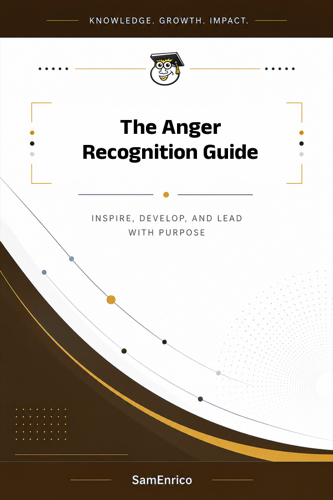
The Anger Recognition Guide eBook
Differentiates irritation, frustration, rage, and
Differentiates irritation, frustration, rage, and resentment.
Formats
Free sample
Chapter 1: The Umbrella Lie--–- You are about to discover something that will change how you see every argument, every irritation, every quiet resentment you have ever carried. But first, imagine this scene.A woman sits in rush-hour traffic. Her phone buzzes—her partner asking what she wants for dinner. She types back, “Whatever,” and immediately feels a tightness in her chest. She is not sure why.
The car in front of her brakes too slowly. She mutters something unkind. Twenty minutes later, she walks through the front door, and when her partner asks if something is wrong, she says, “I’m just angry.”That statement is not false. But it is also not useful. It is the emotional equivalent of a doctor saying, “You are sick,” and then walking out of the room.
Sick with what? A virus? A broken bone? A vitamin deficiency? The treatment for each is entirely different.
Yet when it comes to anger, we have been trained to stop at the first word. We say “I am angry” as if that single syllable explains anything at all.It does not. And that is precisely why so many people feel trapped in cycles of conflict they cannot name, cannot escape, and cannot seem to resolve no matter how many breathing exercises they try.This chapter is not about calming down. It is not about counting to ten or punching a pillow or “letting go.” Those interventions have their place, but they come later. First, you need to understand a truth that most best-selling anger management books gloss over in a single paragraph: Anger is not one thing.
It is an umbrella.And under that umbrella live four distinct, biologically different, psychologically separate states that require completely different responses. Confuse them, and you will spend years applying the wrong medicine to the wrong condition. Recognize them, and you gain something most people never achieve: surgical precision over your own emotional life.The Cost of a Single Word Let us be honest about what the word “angry” costs us. When a parent yells at a child for spilling milk and calls that “anger,” they have just lumped together a sensory irritation (the mess), a possible frustration (the child did not listen), and perhaps a residue of resentment from a long day of feeling unseen. The child hears only one thing: “I am bad.” The parent feels only one thing: shame afterward.
No one learns anything about what actually happened.When a couple argues about dishes in the sink and both say “I am angry,” one of them might be experiencing irritation at the visual clutter. The other might be experiencing resentment from six months of feeling like the only adult in the house. One needs a boundary. The other needs a narrative rewrite. These are not the same conversation.
But because both people say the same word, they talk past each other for hours, sometimes years.And when a person explodes at a coworker over a missed deadline and later says, “I don’t know why I got so angry,” what they are really saying is, “I cannot tell the difference between frustration and rage.” Frustration wants a solution. Rage wants an exit. Treating rage like frustration—trying to problem-solve in the middle of a biological hijack—is like trying to teach calculus during a fire alarm. It will not work. It has never worked.
And yet millions of people try it every single day.The umbrella lie is not a harmless simplification. It is the primary reason that anger management fails for so many people.The Recognition Principle Here is the foundational idea of this entire book, stated simply enough to remember and deep enough to change your life:You cannot regulate what you cannot name.Not “calm down.” Not “let it go.” Not “take a deep breath.” Those are strategies. But strategies without diagnosis are guesses. And guesses fail.If you name irritation as frustration, you will try to solve a problem that does not exist—and you will become more irritated because you cannot find a solution. If you name rage as frustration, you will attempt to reason with a brain that has temporarily shut down its reasoning centers—and you will fail, then feel ashamed.
If you name resentment as irritation, you will try to “get over it” or “ignore it”—and the resentment will fester because you never addressed the story beneath it. If you name frustration as resentment, you will blame a person for an impersonal obstacle—and poison a relationship over a problem that was never personal.Every single one of these mismatches happens daily, in homes and offices and marriages and parenting moments, because we have been given one word to describe four different experiences.The Recognition Principle demands more from you. It asks that you become fluent in the language of your own distress. Not so you can eliminate anger—that would be a life without boundaries or passion—but so you can respond to each visitor appropriately. Irritation needs sensory withdrawal.
Frustration needs a new strategy. Rage needs time and silence. Resentment needs either a debt calculation or a grief ritual.Recognize first. Then respond. That is the entire architecture of this book.The Four Pillars of Distress Before we introduce the diagnostic tool that will tell you where you currently stand, you need to meet the four characters in your internal drama.
Each has a distinct face, a distinct voice, and a distinct set of needs.Irritation is the sensory alarm bell. It lives in the present moment and wants one thing: for a specific stimulus to stop. A noise. A texture. A repetitive motion.
An interruption. Irritation has no goals beyond termination. It does not ask “Why?” It does not seek justice. It simply says, “Make this stop.” When you feel your jaw tighten at the sound of someone chewing, that is irritation. When you snap at your child for asking “Why?” for the tenth time, that is irritation—not because the question is bad, but because the repetition has become a sensory intrusion.
Irritation is low-energy and short-duration. It passes quickly if addressed, but if ignored, it becomes Annoyance (a state we will explore in later chapters).Frustration is the barrier emotion. Unlike irritation, frustration has a clear goal. You are trying to get somewhere, achieve something, complete a task—and something is in your way. Frustration wants to solve.
It is cognitive, goal-oriented, and potentially productive. When you cannot get the printer to work, that is frustration. When you are stuck in traffic and late for a meeting, that is frustration. When a student studies for hours but fails the exam, that is frustration. The critical distinction—and you will hear this throughout the book—is that frustration is productive when directed at impersonal obstacles but dangerous when directed at people.
Frustration with a broken machine leads to creative problem-solving. Frustration with a partner leads to blame and escalation.Rage is a biological hijack. It is not “big anger.” It is a survival response. Rage bypasses the prefrontal cortex—the part of your brain responsible for logic, planning, and impulse control—and activates the amygdala, the ancient…
This is the end of the free sample. Get the eBook to keep going. Buy now
About this book
Details
- Author
- Brinson Rosendo
- Publisher
- SamEnrico
- Language
- English
- Genre
- Non-Fiction, Self-Help, Anger
- Released
- 2026-06-06
- Pages (approx.)
- 150
- Available as
- eBook, Audiobook

Read better in the ZLOADR app
Your eBooks on your phone or tablet. Sign in with your SamEnrico account and start reading.
More by Brinson Rosendo
 The True Crime Podcast EffectBrinson Rosendo$11.99
 Affirmation Celebration PracticeBrinson Rosendo$11.99
 Laci Peterson Habeas CorpusBrinson Rosendo$11.99
 CrossFit Row Erg MasteryBrinson Rosendo$11.99
 The Celestial Navigators: The Black Astronomers Who Mapped the CosmosBrinson Rosendo$11.99
 Canada SUV Settlement FundsBrinson Rosendo$12.99
 How to Start a NiCad Batteries Business (Beginners Guide)Brinson Rosendo$11.99
 Understanding Viral Hemorrhagic FeverBrinson Rosendo$17.99
 Partnerships ExecutiveBrinson Rosendo$11.99
You may also like
 Hong Kong Handover 1997Dunn Johnnie$11.99
 Zumba For Postnatal Recovery CourseNeal Christian$11.99
 Zumba for BeginnersLadner Nikia$11.99
 YouTube Comment Mining GuideHumes Pandora$12.99
 Worry Box MeditationCarlin Rudy$11.99
 Workplace Stress MeditationNguyen Lynn$11.99
 Workplace Stress and Sleep RepairHawley Ivory$11.99
 Workplace Perfectionism CureDelaney Jeffry$11.99
 Workplace Injustice Anger GuideWallen Isabelle$11.99
 Work Addiction and Burnout LinkGreenwood Ester$11.99
 Women in Yoga and WellnessBeattie Galina$11.99
 Women in Stand Up ComedyChun Evangeline$11.99