
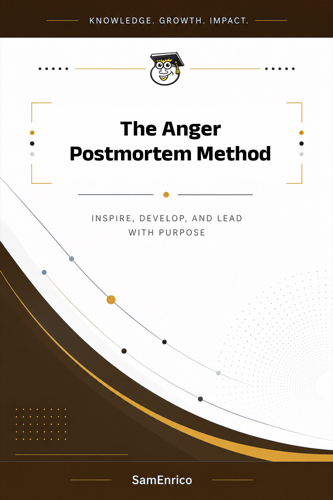
The Anger Postmortem Method eBook
Provides a structured post-fight analysis for coup
by Block Livia
Provides a structured post-fight analysis for couples to learn from each explosion without blame.
Formats
Free sample
Chapter 1: The Calculus Trap--–- The fight lasted eleven minutes. By the end, a ceramic mug was in pieces on the kitchen floor, the bedroom door had a new dent in it, and two people who had promised to love each other “for better or worse” were standing on opposite sides of the house, breathing hard, wondering if the “worse” had finally won.They had started the conversation reasonably enough. She had asked, “Can we talk about the credit card bill?” He had sighed—a small sound, less than a second long. She had heard the sigh as “You are a nagging, financially irresponsible burden.” He had heard her next sentence as “You are a failure who cannot provide.” Within three minutes, they were arguing not about money but about a vacation they had taken four years ago, a promotion he did not get, and a text message she had sent to her sister that he had read over her shoulder. By minute nine, neither one could remember what the original question had been.
By minute eleven, they were not speaking at all.That night, they did what most couples do. They went to bed angry, woke up exhausted, and spent the next three days in a state of polite, frosty coexistence—neither fighting nor forgiving, just waiting for the next explosion. They told themselves they had “communicated poorly.” They resolved to “talk it out next time.” And when the next time came, exactly the same thing happened.If you are reading this book, you know this scene. Maybe your version involves a different prop—a slammed laptop, a car door, a glass of water thrown into a sink. Maybe your fight lasts thirty minutes or three hours.
Maybe you are the sigher or the sighee. But the architecture is the same: a small disagreement escalates into a catastrophe, and afterward, you are left holding the debris, asking yourself the same useless question: What just happened?The answer, which this chapter will lay out in unsparing detail, is that you were trying to do calculus during a fire drill. And until you understand why that never works, no amount of “communication tips” or “conflict resolution strategies” will save you.The Most Expensive Mistake Couples Make We have been taught a beautiful lie. The lie is that when conflict erupts, the loving, mature, adult thing to do is to “talk it through.” Stay at the table. Don’t go to bed angry.
Use your words. This advice appears in wedding toasts, self-help books, magazine articles, and the whispered counsel of friends who have no idea what they are talking about.The lie is beautiful because it contains a grain of truth. Yes, couples who can discuss difficult topics without destroying each other tend to stay together. Yes, avoidance and stonewalling are relationship toxins. But here is the part the advice columnists leave out: You cannot talk through a fight while you are still on fire.The moment an argument triggers your nervous system’s threat response, your ability to “talk it through” vanishes.
Not diminishes. Not becomes difficult. Vanishes. The parts of your brain responsible for logic, empathy, impulse control, and creative problem-solving go offline. What remains is a ancient, elegant, and completely useless-for-relationships survival machine designed to do exactly three things: fight, flee, or freeze.Think about that for a moment.
Your partner says something that lands like a punch. Within one second, your body has decided that you are in danger. Within three seconds, your prefrontal cortex—the part of your brain that could say, “Wait, maybe they didn’t mean it that way”—has been overridden. Within ten seconds, you are no longer a loving partner. You are an animal in a trap, and the only thing your animal brain knows how to do is bite.This is not a character flaw.
This is not a failure of love or commitment. This is neuroscience. And until you accept it—really accept it, not just nod along while secretly believing that you are the exception—every fight you have will follow the same script. Escalation, explosion, exhaustion, estrangement. Rinse.
Repeat.The couples who survive—who not only survive but grow stronger through conflict—are not the ones who “communicate better” during the fire. They are the ones who learned to stop trying to communicate during the fire. They learned to pause. They learned to separate the fight from the postmortem. They learned that the worst time to solve a problem is when you are in the middle of it.That is what this book is about.
Not how to fight. How to stop fighting the same fight twice. How to turn the explosion into data. How to perform an anger postmortem.But first, you have to understand why everything you have been taught about “talking it out” is not just unhelpful but actively destructive.The Neuroscience of Losing Your Mind Let us get specific. The human brain has evolved over millions of years to prioritize survival over happiness, safety over connection, and speed over accuracy.
When your nervous system detects a threat—and yes, your partner’s sigh, eye roll, or critical tone can register as a threat—a cascade of physiological events is triggered that is almost impossible to override in real time.The amygdala, two small almond-shaped clusters deep in the brain, acts as your smoke alarm. Its job is to detect danger and sound the alarm before you have time to think. The amygdala does not distinguish between a tiger charging at you in the jungle and your partner saying “You never listen.” To the amygdala, both are threats. Both require immediate action.Once the amygdala sounds the alarm, it hijacks the rest of the brain. The prefrontal cortex—the part of the brain responsible for executive functions like impulse control, emotional regulation, reasoning, and empathy—is effectively put on hold.
Blood flow is redirected away from the prefrontal cortex and toward the muscles and survival centers. This is why, in the middle of a fight, you cannot find the right words, you cannot see your partner’s perspective, and you cannot stop yourself from saying something you will regret ten minutes later. The hardware for those abilities is literally underpowered.Meanwhile, your body is preparing for battle. Your adrenal glands release cortisol and adrenaline. Your heart rate accelerates.
Your breathing becomes shallow and rapid. Your pupils dilate. Your digestion slows or stops. Blood moves from your internal organs to your large muscle groups, preparing you to fight or flee. Your hearing becomes more sensitive to sharp sounds (like a voice rising) and less sensitive to soft tones (like an apology).
Your field of vision narrows to a tunnel, focused on the threat, blocking out context and peripheral information—including, often, the rest of your partner’s face.This collection of responses has a name: Diffuse Physiological Arousal, or DPA. When DPA is active, you are in a state of high physiological arousal that makes calm conversation biologically impossible. You can no longer process complex language, read subtle emotional cues, or inhibit impulsive reactions. You are, for all practical purposes, temporarily stupid. Not intellectually stupid—your IQ is unchanged—but relationally…
This is the end of the free sample. Get the eBook to keep going. Buy now
About this book
Details
- Author
- Block Livia
- Publisher
- SamEnrico
- Language
- English
- Genre
- Non-Fiction, Self-Help, After-Action Review
- Released
- 2026-06-10
- Pages (approx.)
- 135
- Available as
- eBook, Audiobook

Read better in the ZLOADR app
Your eBooks on your phone or tablet. Sign in with your SamEnrico account and start reading.
More by Block Livia
 Self Hypnosis For Pain Management WorkbookBlock Livia$11.99
 Chunking for Data AnalysisBlock Livia$11.99
 Exercise Focus Protection GuideBlock Livia$11.99
 Recurring Dream Interpretation GuideBlock Livia$11.99
 Hops & Hustle: The Untold Story of the Beer Barons Who Built AmericaBlock Livia$11.99
 Codex of the Forgotten: The AI ArchaeologistBlock Livia$11.99
 Redbubble Trending DesignsBlock Livia$12.99
 Shape Up Kanban for BasecampBlock Livia$12.99
 Understanding Endomyocardial FibroelastosisBlock Livia$17.99
 How to Start a Prefabricated Buildings or Elements Thereof Made of Wood Business (Beginners Guide)Block Livia$11.99
 Fulfillment Department ManagerBlock Livia$11.99