
Non-FictionSelf-HelpAnalytical Thinking
The Analytical Mind Creative Guide eBook
Shows how data driven people can generate novel so
by Conyers Tory
Shows how data driven people can generate novel solutions.
Formats
Free sample
Chapter 1: The Assumption Audit–- Sarah had spent six months building the perfect dashboard. Every metric, every filter, every visualization was optimized. She presented it to leadership with confidence. The CEO nodded, then asked a question that froze her: "What problem does this solve that we didn't know we had?"She had no answer. Not because the dashboard was bad—it was beautiful—but because she had never asked that question.
She had assumed the problem. She had assumed the stakeholders knew what they wanted. She had assumed that more data was always better. Six months of assumptions, none of them tested, all of them invisible to her until that moment.This chapter is about learning to see your assumptions before they cost you six months.The Invisible Prison Every problem you have ever tried to solve came with a set of invisible walls. You did not build these walls.
They were built by your industry, your training, your company's history, and the last ten solutions that sort-of-worked. These walls are called assumptions, and they are the single biggest barrier to novel solutions—not because they are always wrong, but because you cannot see them.Think about the last time you were stuck on a problem. You probably tried harder. You gathered more data. You ran more analyses.
You worked longer hours. What you almost certainly did not do was ask: "What am I assuming that might be false?"This is not your fault. Analytical training rewards assumption-free thinking—but there is no such thing. Every model, every forecast, every decision rests on a foundation of unstated beliefs. The difference between average analysts and analytical creatives is not that one has fewer assumptions.
It is that one has learned to see them.Consider the following invisible walls that trap most analytical thinkers:The Data Completeness Assumption: The belief that the data you have is the data you need. In reality, the most important variables are often the hardest to measure—and therefore absent from your spreadsheets.The Historical Continuity Assumption: The belief that the future will resemble the past. This is how Blockbuster ignored Netflix, how Kodak ignored digital, and how your industry will ignore its disruptor.The Constraint Certainty Assumption: The belief that your constraints (budget, timeline, resources) are fixed and non-negotiable. In reality, most constraints are inherited assumptions from someone else's decision years ago.The Solution Primacy Assumption: The belief that you already know what kind of solution you are looking for. This is the dashboard fallacy: building the answer before understanding the question.These assumptions are not stupid.
They are efficient. Your brain uses them to avoid re-thinking reality from scratch every morning. But efficiency is the enemy of novelty. To generate a truly novel solution, you must temporarily suspend the assumptions that make your thinking efficient—and that requires a systematic process, not willpower.The First Principles Audit The most powerful tool for surfacing hidden assumptions comes from an unlikely source: physics. When Elon Musk wanted to build a rocket, he did not ask "How much does NASA's rocket cost?" That would have imported all of NASA's assumptions about suppliers, materials, and manufacturing processes.
Instead, he asked: "What is a rocket made of? Aluminum, copper, titanium. What is the market price of those materials on the London Metal Exchange? A fraction of what NASA pays. How do we assemble them?
Not the way NASA does—from scratch."This is First Principles thinking. You strip a problem down to its fundamental truths—the things you know are absolutely true, independent of any industry convention—then rebuild from there. Everything else is an assumption, and every assumption is optional.The First Principles Audit is a structured process for doing this. It consists of four questions, applied in sequence, with a specific mindset shift at each step.Question One: What Do We Know Is Absolutely True?This is the hardest question to answer, because "absolutely true" is a brutal standard. Gravity is absolutely true.
The laws of thermodynamics are absolutely true. Customer psychology? Not absolutely true—it shifts with culture, context, and individual difference. Market dynamics? Not absolutely true—they change with competitors, regulation, and technology.Most of what you think you know is actually probabilistic, contextual, or borrowed authority.
The First Principles Audit forces you to separate bedrock from sand.Example: A logistics company assumed that delivery drivers needed to return to the depot each night. When asked "What do we know is absolutely true?" the team realized: nothing requires drivers to return. The depot was a convenience, not a physical law. This assumption had been inherited from a previous CEO and never questioned. By dropping it, the company redesigned their entire network, saving millions.Exercise: Take your current problem.
Write down ten things you believe are absolutely true. Then cross out any that rely on unstated conditions ("assuming no regulation change," "assuming current technology," "assuming our competitors don't react"). What remains? That is your foundation.Question Two: What Do We Assume Is True (But Cannot Prove)?This is where most hidden assumptions live. They feel like facts because everyone believes them, but no one has ever tested them.Common examples:"Customers want faster delivery" (Maybe they want cheaper delivery or more reliable delivery or more predictable delivery—speed is one variable among many)"Our main competitor is Company X" (Maybe your real competitor is the customer doing nothing, or a non-obvious substitute)"We need a minimum of three engineers to build this feature" (Maybe one engineer with better tooling could do it, or none if you outsource, or ten if you want it faster)Example: A software team assumed they needed a full-time data scientist to build recommendation algorithms.
When challenged, they admitted they had never tested this assumption. They hired a consultant for two weeks, built a minimal version, and discovered that a simple rules-based system achieved 80% of the value at 5% of the cost. The full-time hire would have been wasted money.Exercise: List everything you are acting as if it is true but could not prove to a skeptical outsider. Put a star next to the assumption that, if wrong, would completely change your approach. That is your highest-leverage assumption to test.Question Three: What Would This Look Like If We Had Zero Budget?Zero budget is a liberating constraint.
It forces you to strip away everything that depends on spending money—which is almost always a proxy for "someone else's assumption about what is necessary."When you have zero budget, you cannot buy software, hire consultants, run paid ads, or outsource. What can you do? You can think. You can talk to customers. You can run manual processes.
You can use free tools. You can beg, borrow, or barter. You can build relationships.Example: A nonprofit wanted to launch a mentoring program. Their initial plan required $50,000 for software, training, and marketing. The zero-budget question forced them to realize: mentoring happens between humans.
They started with a shared spreadsheet, a free group chat, and a single volunteer. Within six months, they had fifty mentors and zero dollars spent. The software would have been a distraction, not an enabler.Exercise: Redesign your solution with zero budget. What…
This is the end of the free sample. Get the eBook to keep going. Buy now
About this book
Details
- Author
- Conyers Tory
- Publisher
- SamEnrico
- Language
- English
- Genre
- Non-Fiction, Self-Help, Analytical Thinking
- Released
- 2026-06-05
- Pages (approx.)
- 132
- Available as
- eBook, Audiobook

Read better in the ZLOADR app
Your eBooks on your phone or tablet. Sign in with your SamEnrico account and start reading.
More by Conyers Tory
 Beginner Mindfulness for Needle PhobiaConyers Tory$11.99
 Retention After Hire StudyConyers Tory$11.99
 The Complicated Grief and SleepConyers Tory$11.99
 Andrew Murray Pastor MysticConyers Tory$11.99
 The Dragon and the Cartel: The Rise and Fall of Asia's Drug KingpinsConyers Tory$11.99
 Organic Fruit Export GuideConyers Tory$12.99
 Technology Obsolescence FactorsConyers Tory$12.99
 Understanding Succinyl-coa Acetoacetate Transferase DeficiencyConyers Tory$17.99
 Director of MaintenanceConyers Tory$11.99
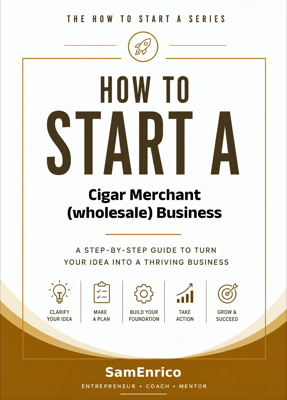 How to Start a Cigar Merchant (wholesale) Business (Beginners Guide)Conyers Tory$11.99
You may also like
 Hong Kong Handover 1997Dunn Johnnie$11.99
 Zumba For Postnatal Recovery CourseNeal Christian$11.99
 Zumba for BeginnersLadner Nikia$11.99
 YouTube Comment Mining GuideHumes Pandora$12.99
 Worry Box MeditationCarlin Rudy$11.99
 Workplace Stress MeditationNguyen Lynn$11.99
 Workplace Stress and Sleep RepairHawley Ivory$11.99
 Workplace Perfectionism CureDelaney Jeffry$11.99
 Workplace Injustice Anger GuideWallen Isabelle$11.99
 Work Addiction and Burnout LinkGreenwood Ester$11.99
 Women in Yoga and WellnessBeattie Galina$11.99
 Women in Stand Up ComedyChun Evangeline$11.99