
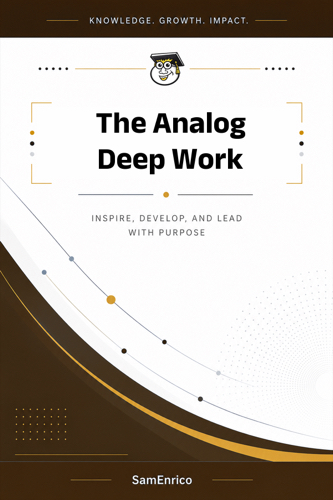
Non-FictionBusiness BriefAnalog
The Analog Deep Work eBook
Go screen free for maximum cognitive depth.
by Reaves Ha
Go screen free for maximum cognitive depth.
Formats
Free sample
Chapter 1: The Exhaustion Paradox--–- It begins, as it always does, with a notification.Not a loud one. Not an urgent one. Just a soft buzz against your thigh, or a red badge appearing on an icon, or the subtle vibration of a smartwatch reminding you that someone, somewhere, has acknowledged your existence. You are halfway through drafting an email that requires genuine concentration—the kind where you are holding three variables in your head at once, weighing nuance, choosing words carefully. Then: buzz.
You glance. It is a like on a social media post you forgot you made. Two seconds, maybe three. You return to your email. But something has changed.
The thread is frayed. The variables have scattered. You spend the next ninety seconds reorienting yourself, retracing your mental steps, reconstructing what you were about to say.This is not a personal failing. It is not a lack of discipline or willpower. It is the cost of living inside a machine that was designed, from the ground up, to prevent you from thinking deeply.And yet, here is the paradox that defines our age: we have never owned more tools that promise to save us time, and we have never felt more exhausted.
The smartphone—that miraculous device that puts the sum of human knowledge in your pocket—has coincided with a dramatic decline in the average knowledge worker's ability to focus on a single task for more than three minutes. The collaboration software that was supposed to free us from the tyranny of the office has instead chained us to an always-on expectation of responsiveness. The very technologies that were marketed as productivity accelerators have become the primary obstacles to productive depth.This chapter is about that paradox. I call it the Exhaustion Paradox: the uncomfortable truth that our digital tools, at this precise moment in their evolution, are making us busier without making us better. We are working more hours, switching between more tasks, and producing more output—and yet, by nearly every meaningful measure of cognitive depth, we are achieving less.Before we can build an analog solution, we must understand the shape of the digital problem.
And the shape, as we are about to see, is not a bug. It is a feature.The Great Miscalculation Let us rewind thirty years. In the early 1990s, the commercial internet was still a novelty. Email existed but was not yet ubiquitous. The idea of carrying a powerful computer in your pocket was science fiction.
And the prevailing wisdom among futurists and productivity gurus was delightfully optimistic: technology would eliminate drudgery, automate repetitive tasks, and free human beings to do what we do best—think creatively, solve complex problems, and connect meaningfully with one another.It was a beautiful vision. It was also catastrophically wrong.What actually happened is that the marginal cost of interruption dropped to nearly zero. In the analog office of 1990, interrupting a colleague required getting up from your desk, walking across the room, and initiating a conversation. There was social friction. There was physical effort.
There was a threshold. Today, interrupting a colleague requires clicking a Slack channel and typing three words. The friction is gone. And when the cost of an action drops to zero, the quantity of that action approaches infinity.We now live in what Cal Newport, in his book A World Without Email, calls the "Hyperactive Hive Mind." This is a workflow where every question, every update, every piece of information is broadcast in real time to everyone who might possibly need it—and to many who do not. The result is a constant hum of low-grade interruption that feels urgent but produces little of value.
We have mistaken connectivity for productivity. We have confused responsiveness for effectiveness.Consider a simple experiment that you can conduct yourself. Take a sheet of paper—analog, for now—and draw a vertical line down the middle. On the left side, list every task you completed yesterday that required sustained, uninterrupted concentration for at least thirty minutes. On the right side, list every task that involved switching between apps, responding to messages, or performing quick, low-cognition actions.
Most knowledge workers fill the right side completely and leave the left side blank. Then they wonder why they feel exhausted and unfulfilled.The reason is not that they are lazy or unfocused. The reason is that the digital environment they inhabit is structurally hostile to depth.The Invention of Shallow Work Before we can diagnose the problem further, we need a shared vocabulary. Throughout this book, I will use two terms that are borrowed from Newport's Deep Work but adapted for our analog framework.Shallow work is non-cognitively demanding, logistical-style work that can be performed while distracted. Answering routine emails.
Scheduling meetings. Filling out spreadsheets that do not require analysis. Scrolling through a dashboard to check metrics that you do not intend to act upon. This type of work is easy to measure (you sent forty emails!) and easy to do in short bursts. It is also, by definition, replaceable.
A reasonably competent administrative assistant or a moderately sophisticated algorithm can perform most shallow work.Cognitive depth—I use this term rather than "deep work" to emphasize the mental state rather than the activity—is the opposite. It is the state of uninterrupted, single-threaded thinking where you can solve complex problems, generate original ideas, or learn difficult skills. Cognitive depth requires extended periods of focus, typically measured in hours rather than minutes. It is hard to measure in real time (you cannot "see" someone thinking deeply), and it is impossible to do in the presence of notifications. But it is the only type of work that produces genuine breakthroughs, original insights, and durable skills.Here is the uncomfortable truth that most productivity advice avoids: shallow work and cognitive depth are not merely different.
They are antagonistic. The more shallow work you do, the less capable you become of cognitive depth. This is not a moral failing. It is neurology.When you spend your day bouncing between email, Slack, text messages, news alerts, and calendar reminders, your brain adapts to that environment. It becomes optimized for rapid switching, pattern recognition, and shallow processing.
This is an elegant adaptation to a chaotic environment. The problem is that the skills required for rapid switching are precisely the opposite of the skills required for cognitive depth. You cannot be good at both. The brain is not a general-purpose computer; it is a specialized organ that adapts to the demands placed upon it. If you place constant switching demands on your brain, it will become excellent at switching and terrible at sustaining focus.The Attention Residue Trap The neuroscientific mechanism behind this degradation is called attention residue, a term coined by researcher Sophie Leroy in a series of studies that should be required reading for anyone who manages knowledge workers.
Here is what Leroy discovered.When you work on Task A, your brain builds a "cognitive model" of that task—a mental representation that includes the relevant information, the goal state, the intermediate steps, and the contextual cues. This model takes time to construct, typically several minutes of uninterrupted focus. Once constructed…
This is the end of the free sample. Get the eBook to keep going. Buy now
About this book
Details
- Author
- Reaves Ha
- Publisher
- SamEnrico
- Language
- English
- Genre
- Non-Fiction, Business Brief, Analog
- Released
- 2026-06-07
- Pages (approx.)
- 144
- Available as
- eBook, Audiobook

Read better in the ZLOADR app
Your eBooks on your phone or tablet. Sign in with your SamEnrico account and start reading.
More by Reaves Ha
 Health Crisis Relationship SupportReaves Ha$11.99
 Stress Pancreas FunctionReaves Ha$11.99
 HRT Decision HandbookReaves Ha$11.99
 ABCDE for Real Estate AgentsReaves Ha$11.99
 Moon Base Relaxation GuideReaves Ha$11.99
 Field Hockey Self HypnosisReaves Ha$11.99
 Albert Einstein Physics LegacyReaves Ha$11.99
 The Silk and the Scoundrel: The Daring Love Affair That Shook Imperial ChinaReaves Ha$11.99
 The B-Boys of the Bronx: How Breakdancing Conquered the WorldReaves Ha$11.99
 How to Produce Plastic CleanerReaves Ha$11.99
 Zebra Sharks: Leopard SharkReaves Ha$11.99
 A Collector's Handbook to the Wolseley SixReaves Ha$11.99
You may also like
 Hong Kong Handover 1997Dunn Johnnie$11.99
 Zumba For Postnatal Recovery CourseNeal Christian$11.99
 Zumba for BeginnersLadner Nikia$11.99
 YouTube Comment Mining GuideHumes Pandora$12.99
 Worry Box MeditationCarlin Rudy$11.99
 Workplace Stress MeditationNguyen Lynn$11.99
 Workplace Stress and Sleep RepairHawley Ivory$11.99
 Workplace Perfectionism CureDelaney Jeffry$11.99
 Workplace Injustice Anger GuideWallen Isabelle$11.99
 Work Addiction and Burnout LinkGreenwood Ester$11.99
 Women in Yoga and WellnessBeattie Galina$11.99
 Women in Stand Up ComedyChun Evangeline$11.99