
Non-FictionSocial Media Founder
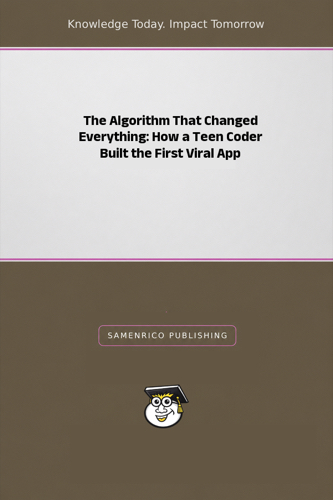
The Algorithm That Changed Everything: How a Teen Coder Built the First Viral App eBook
Uncover the untold story of how a 17-year-old self
by Alger Buford
Uncover the untold story of how a 17-year-old self-taught programmer accidentally created the world’s first viral social media app, sparking a digital revolution that reshaped global communication.
Formats
Free sample
Chapter 1: The Basement Line...--–- The first computer Alex Kovács ever touched was already obsolete. It arrived in a cardboard box stained with coffee rings, a hand-me-down Pentium III that his father had rescued from a church rummage sale. The case was beige, the fan rattled like a dying lawnmower, and the monitor weighed more than Alex did at age nine. But when he pressed the power button and the screen flickered to life—a blue Windows 98 desktop appearing pixel by pixel—he felt something he would later struggle to name. It wasn’t wonder, exactly.
It was recognition. As if the machine had been waiting for him.His mother, Ildikó, had come to the United States from Budapest in 1995 with a suitcase and a nursing degree that American hospitals refused to recognize. She worked double shifts at a nursing home in Bridgeport, Connecticut, changing bedpans and learning English from television commercials. His father, László, was a machinist who spent his days operating a lathe in a factory that made replacement parts for tractors. They sent money home to Hungary every month, lived in a two-bedroom apartment above a Polish bakery, and never complained.
When Alex’s older brother, Márk, wanted a Play Station, his parents said no. When Alex’s sister, Zita, wanted a new winter coat, they found one at a church giveaway. But when Alex, at nine, pointed at the rummage sale computer and said, “That one,” his father nodded without checking the price tag. László had never used a computer in his life. But he recognized hunger when he saw it.The Dial-Up Cathedral The apartment had one phone line, a rotary dial that hung on the kitchen wall.
Every time Alex wanted to connect to the internet, he had to unplug the phone, screw a thin cable into a modem port, and listen to the screeching symphony of a 56k connection negotiating with the world. The sound was liturgical—a series of hisses and handshakes that felt like a prayer answered or denied. Most nights, it was denied. The connection would drop after twenty minutes, or his mother would pick up the kitchen phone to call her sister in Budapest, and the line would go dead.So Alex learned to work offline. He downloaded HTML tutorials in pieces, saving each page as a text file before the modem kicked him off.
He printed out Java Script cheat sheets on a dot-matrix printer that took three minutes per page, the ink smearing under his fingers. His bedroom became a library of dead trees—stacked paper, handwritten notes, and dog-eared manuals from the library’s discard pile. He was not a prodigy. He did not write his first line of code at age six or hack into the school district’s servers by seventh grade. He was, by every measure, a slow learner.
But he was stubborn.At eleven, he built his first webpage: a shrine to the band Linkin Park, complete with a flashing animated GIF of a fireball and a MIDI file that played “In the End” on loop. The page took forty-five seconds to load on his own computer and probably three minutes on anyone else’s. He showed it to his older brother, Márk, who glanced at the screen, said, “Cool, I guess,” and went back to playing Halo on a friend’s Xbox. Alex stared at the page for another hour, refreshing it, watching the fireball flash. Then he deleted the whole thing and started over.The Rejection That Saved Him The high school coding club met in Room 207, a windowless computer lab that smelled of stale coffee and overheated motherboards.
Alex had been waiting for this moment since middle school. He had memorized the club’s meeting times, studied the projects from previous years (a weather app, a simple calculator, a choose-your-own-adventure game), and practiced his pitch. He would walk in, sit down, and finally find his people.The teacher, Mr. Hendricks, was a heavyset man with a gray beard and the resigned air of someone who had been teaching the same curriculum for twenty years. He sat behind his desk, grading papers, while Alex stood in the doorway.“You’re here for the coding club?” Mr.
Hendricks asked without looking up.“Yes,” Alex said. “I’ve been teaching myself for a couple of years. I’ve built a few things.”Mr. Hendricks finally raised his eyes. He looked at Alex’s hand-me-down hoodie, his scuffed sneakers, his too-long hair.
“What’s your GPA in math?”“Three point eight,” Alex said.“Have you taken AP Computer Science?”“We don’t have AP Comp Sci. It’s not offered until next year.”Mr. Hendricks sighed. “Look, kid. The coding club is for students who’ve already demonstrated proficiency.
We have a waitlist. We only take kids who’ve passed the prerequisite coursework. Come back next year.”Alex stood in the doorway for another five seconds. Then he turned and walked out. He did not cry—not yet.
He walked home in the rain, took the stairs to his bedroom, and sat on the edge of his bed. The Pentium III sat on his desk, its fan rattling. He opened a notepad file and typed:print(“They don’t know anything.”)He saved the file as revenge.txt. Then he started coding.The Three Failures Over the next two years, Alex built three apps. He called them apps because that was the word everyone used after the i Phone launched, but they were really just websites with pretensions.
The first was a homework-exchange platform called “Study Buddy.” The idea was simple: students could upload their notes, share study guides, and ask questions. Alex spent six weeks building it, learning PHP from a pirated PDF and figuring out databases from You Tube tutorials. He launched it on a school Facebook group. Twelve people signed up. Zero uploaded anything.
He realized too late that students did not want to share their notes—they wanted to hoard them like dragons. Study Buddy died in a week.The second was a meme generator called “LOLBuilder.” This was 2010, when memes were migrating from Something Awful to Facebook, and Alex thought he had spotted a gap in the market: a tool that let anyone add text to a photo in seconds. The problem was speed. On dial-up, uploading an image took forty-five seconds. Generating a meme took another minute.
Sharing it took forever. By the time a user finished, they had lost interest. Alex watched his analytics—three users, two of whom were him, one of whom was his sister—and shut it down after a month.The third was a local event calendar called “Bridgeport Beat.” He scraped data from the city’s website, the library’s events page, and a few community blogs. He built a clean interface, added an RSS feed, and waited. The traffic was… fine.
A hundred users a week. People showed up, checked the events, and left. No one returned. No one shared. No one cared.
The calendar was useful but not sticky. It solved a problem—knowing what was happening in town—but it did not create a…
This is the end of the free sample. Get the eBook to keep going. Buy now
About this book
Details
- Author
- Alger Buford
- Publisher
- SamEnrico
- Language
- English
- Genre
- Non-Fiction, Social Media Founder
- Released
- 2026-06-04
- Pages (approx.)
- 101
- Available as
- eBook, Audiobook

Read better in the ZLOADR app
Your eBooks on your phone or tablet. Sign in with your SamEnrico account and start reading.
More by Alger Buford
 The DBT Radical Acceptance GuideAlger Buford$11.99
 Remote Review Documentation ChecklistAlger Buford$11.99
 Affirmations For Jealousy GuideAlger Buford$11.99
 Stress And Tinnitus GuideAlger Buford$11.99
 Window of Tolerance TraumaAlger Buford$11.99
 Cristiano Amon GuideAlger Buford$12.99
 Finding Industry Mentors on LinkedInAlger Buford$12.99
 Understanding Panmyelophthisis Aplastic AnemiaAlger Buford$17.99
 Daylighting ConsultantAlger Buford$11.99
 How to Start a Paint and Varnish (wholesale) Business (Beginners Guide)Alger Buford$11.99
You may also like
 Hong Kong Handover 1997Dunn Johnnie$11.99
 Zumba For Postnatal Recovery CourseNeal Christian$11.99
 Zumba for BeginnersLadner Nikia$11.99
 YouTube Comment Mining GuideHumes Pandora$12.99
 Worry Box MeditationCarlin Rudy$11.99
 Workplace Stress MeditationNguyen Lynn$11.99
 Workplace Stress and Sleep RepairHawley Ivory$11.99
 Workplace Perfectionism CureDelaney Jeffry$11.99
 Workplace Injustice Anger GuideWallen Isabelle$11.99
 Work Addiction and Burnout LinkGreenwood Ester$11.99
 Women in Yoga and WellnessBeattie Galina$11.99
 Women in Stand Up ComedyChun Evangeline$11.99