
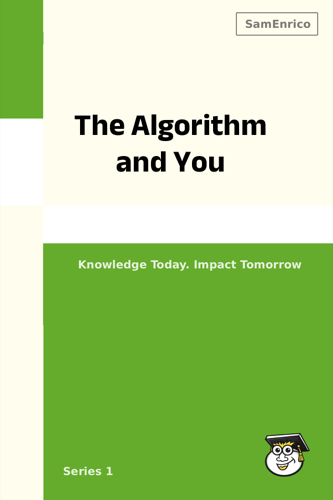
The Algorithm and You eBook
Understand how content feeds amplify comparison an
Understand how content feeds amplify comparison and envy.
Formats
Free sample
Chapter 1: The Unfair Scoreboard...--–- The first time I realized my phone was lying to me, I was sitting on my own couch, in my own living room, wearing sweatpants with a small hole in the left knee, and I was genuinely jealous of a woman I had never met who was standing on a yacht in a place I could not pronounce.Let me pause there. That sentence is embarrassing to write. I am an adult. I have a roof over my head, food in my refrigerator, people who love me, and a career that pays my bills. By any objective measure, I am fine.
More than fine. And yet, there I was, phone in hand, thumb frozen over a photograph of a stranger's charcuterie board—grapes the size of golf balls, cheeses that probably cost more than my weekly grocery budget, a golden hour glow that no amount of滤镜 could fake—feeling a specific, recognizable, unpleasant twist in my chest.That twist has a name. It is not "inspiration." It is not "motivation." It is not "admiration." It is envy. Raw, unfiltered, slightly shameful envy. And here is the part that kept me up that night: I did not want to be on a yacht.
I get seasick. I do not like crowds. I would have been miserable within an hour. But the envy was real anyway.That is the puzzle at the heart of this chapter. Why does your brain flood with distress when you see a stranger living a life you would not actually want?
Why does a friend's promotion hurt more than a stranger's lottery win? Why do you feel behind when the person in front of you is running a completely different race?The answer is not that you are weak, petty, or broken. The answer is that your brain is running software that is 200,000 years old on hardware that was never designed for the internet. And the algorithm has figured out exactly how to exploit that mismatch.The Day the Scoreboard Got Infinite Before social media, your scoreboard was small. Very small.
For almost all of human history, your reference group—the people whose lives you compared to your own—was limited to the people you could see with your own eyes. Your tribe. Your village. Your neighborhood. Maybe a hundred and fifty people at most, which anthropologists call Dunbar's number, the approximate limit of human social relationships.That small scoreboard had a crucial feature: it was fair.
Not fair in the sense of justice, but fair in the sense of visibility. When you compared yourself to your neighbor, you saw both his wins and his losses. You saw him bring home a successful hunt, but you also saw him fight with his wife. You saw her garden flourish, but you also saw her exhausted after childbirth. You saw his new tool, but you also saw him fail to fix the roof.
The information was symmetrical. You compared your full life to their full life.Then the internet happened. Then social media happened. Then the algorithm happened.Now your scoreboard is not a hundred and fifty people. It is everyone like you on the entire planet, curated to show only their absolute best moments, amplified by an algorithm that has learned exactly which posts will make you feel the most inadequate.
You are comparing your Tuesday afternoon—the laundry, the emails, the fatigue, the same lunch you have eaten a hundred times, the small fight with your partner, the bill you forgot to pay—to everyone else's curated Saturday night.This is not a fair fight. It was never designed to be.Festinger's Discovery: Why We Cannot Stop Comparing In 1954, a psychologist named Leon Festinger published a paper that changed how we understand human behavior. His theory, now called Social Comparison Theory, had a simple but profound insight: human beings do not have an internal meter for "good enough." We cannot look at our own lives in isolation and know whether we are succeeding. We need a reference point. We need to compare.Festinger identified two types of social comparison.
Upward comparison is when we compare ourselves to people we perceive as better off than us. Downward comparison is when we compare ourselves to people we perceive as worse off. Both serve evolutionary purposes. Downward comparison makes us feel safe—"at least I am not starving like that tribe." Upward comparison motivates us to improve—"if they can do it, maybe I can too."But Festinger also identified a critical variable: we only compare to similar others. You do not compare your tennis game to Roger Federer's because he is not a similar other.
He is a professional athlete; you are not. The comparison is meaningless. You compare yourself to your friend who also plays tennis on weekends. You compare your salary to your coworker who started the same day you did. You compare your parenting to your sibling who has kids the same age.This is where the algorithm delivers its most diabolical trick.The Reference Group Explosion The algorithm does not show you billionaires.
A billionaire is too dissimilar to trigger deep comparison—your brain dismisses them as a different species. The real torture is more subtle. The algorithm shows you people who are almost your peers. Someone your age. Someone from your city.
Someone with your profession. Someone who went to a similar school. Someone whose life looks, on the surface, like yours could have been.But the algorithm shows you that person at their absolute peak. On their best day. After months of planning, saving, filtering, and editing.
It shows you the vacation they saved two years for, not the credit card debt they are carrying. It shows you the promotion they finally got after three rejections, not the sleepless nights and the crying in the car. It shows you the engagement photo, not the argument they had three hours earlier.The person is similar. The circumstance is wildly dissimilar. That gap—similar person, impossible circumstance—is where envy lives.I call this the Reference Group Explosion.
Before social media, your reference group was your physical community. Now it is everyone like you on the planet, curated to show only their highlights. Your brain still processes each of these people as a relevant peer, because evolution did not prepare you for a world where you could see millions of "neighbors" through a glass screen. But they are not your neighbors. They are not your peers.
They are actors on a stage, and you are comparing your behind-the-scenes to their final cut.A Brief Acknowledgment of Downward Comparison Before we go further, I want to acknowledge something. This book focuses primarily on upward comparison—comparing to people better off than you—because that is what causes the most distress. But algorithms also serve downward comparison. Fail videos. Disaster news.
"Look at this mess" content. Schadenfreude. Platforms know that feeling relief that "you are not that person" also keeps you scrolling.Both directions are manipulation. But upward comparison is more insidious because it does not feel like manipulation. Downward comparison feels like relief, so you notice it less.
Upward comparison feels like pain, but you often blame yourself for the pain instead of recognizing the architecture that caused…
This is the end of the free sample. Get the eBook to keep going. Buy now
About this book
Details
- Author
- Vanover Sallie
- Publisher
- SamEnrico
- Language
- English
- Genre
- Non-Fiction, Self-Help, Technology
- Released
- 2026-06-11
- Pages (approx.)
- 118
- Available as
- eBook, Audiobook

Read better in the ZLOADR app
Your eBooks on your phone or tablet. Sign in with your SamEnrico account and start reading.
More by Vanover Sallie
 Remote Work Parent SchedulingVanover Sallie$11.99
 Financial Stress Senior GuideVanover Sallie$11.99Financial Stress Senior GuideVanover Sallie$11.99
 Gambling Addiction for Social WorkersVanover Sallie$11.99
 The Silk Road Showdown: Asia’s First Reality TV Drama (14th Century)Vanover Sallie$11.99
 Learn to Play the TroVanover Sallie$11.99
 Corporate Event Budget SpreadsheetVanover Sallie$12.99
 Outbound Wave PlannerVanover Sallie$11.99
 How to Start a Bladder Dressing Business (Beginners Guide)Vanover Sallie$11.99
You may also like
 The Affirmation App MethodMartindale Letha$11.99
 Tech Confidence For SeniorsGagne Rozanne$11.99
 Collaboration Tools GuideBeebe Chet$11.99
 Caregiver Technology ToolsEddy Cathrine$11.99
 The Caregiver Technology ToolkitMinter Jada$11.99
 Virtual Reality Palace BuildingCervantes Lucie$11.99
 Tech Imposter SyndromePham Hortensia$11.99
 Imposter Syndrome In TechQuick Kimiko$11.99
 Virtual Reality PalaceSewell Judie$11.99
 The Trigger Tracking AppRoark Elroy$11.99
 Morning Tech Stack GuidePaulson Queen$11.99
 Internet Filter Installation GuideValenti Carlos$11.99