
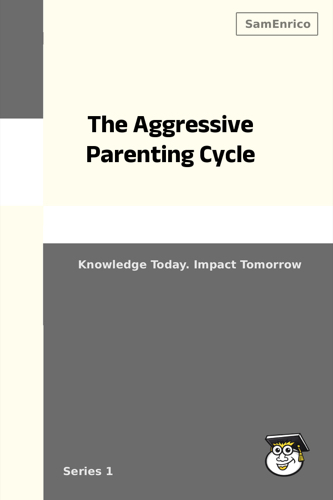
Non-FictionSelf-HelpGenerational
The Aggressive Parenting Cycle eBook
Break the intergenerational pattern of aggressive
Break the intergenerational pattern of aggressive communication.
Formats
Free sample
Chapter 1: The Ghost in Your Voice--–- Every aggressive parent I have ever worked with began the first session in the same way: with their elbows on their knees, their face in their hands, and a voice cracked open by shame. They do not say, “I have a problem with anger.” They say, “I became my mother.” Or worse: “I swore I would never be like him, and last night I heard his exact words coming out of my mouth while my child cried.” The confession is always delivered like a wound being reopened—because that is exactly what it is. The wound is not just the yelling. The wound is the realization that you are repeating something you swore to end. And the deepest cut is the question that follows: If I am doing the same thing, does that mean I am the same kind of person?The answer, which this entire book will prove, is no.
But to understand why, you have to stop looking at your aggression as a character flaw and start looking at it as an inheritance. Not a financial inheritance—the kind you would celebrate. Not a genetic inheritance—the kind you cannot change. An inherited script: a set of phrases, tones, facial expressions, and emotional reactions that traveled down your family line like a virus, long before you were born, and took up residence in your nervous system before you could speak. This chapter is about finding that script, recognizing its origins, and beginning the work of separating what you learned from who you actually are.The Confession That Begins Every Healing Let me tell you about a woman named Elena.
She came to see me after her seven-year-old son, Leo, accidentally knocked over a glass of water at dinner. The water spilled across the table, onto Leo’s homework, and into the lap of Elena’s mother, who was visiting. Elena described what happened next in a flat, clinical voice, as if she were reading a police report. “I stood up so fast my chair fell backward. I grabbed Leo’s wrist.
I pulled him out of his chair. I screamed, ‘What is wrong with you? You ruin everything. You are so careless. You are so stupid.’ Then I saw his face.
He wasn’t crying. He was staring at me like I was a stranger. Like he was waiting for me to hit him. Which I never have. But he was waiting for it anyway.”Elena had not yelled at Leo in six months.
She had been reading parenting books, practicing gentle discipline, and attending a weekly support group. She thought she was safe. And then her mother walked into the room, and the glass tipped over, and Elena became—in her own words—“my mother.” The voice that came out of her mouth was not her voice. The words were not her words. They were her mother’s words, spoken to Elena twenty years earlier, now recycled and aimed at her own child.Elena is not unique.
She is not broken. She is not a monster. She is a perfectly predictable product of what I call the Intergenerational Combustion Engine. And until you understand how that engine works—how trauma becomes tone, how unprocessed grief becomes rage, how a grandparent’s silence becomes a parent’s screaming—you will keep asking yourself the wrong question. The wrong question is “Why am I so angry?” The right question is “Whose anger am I carrying?”The Intergenerational Combustion Engine: A New Framework Imagine a car engine that has been running for three generations.
The original owner drove it too hard, overheated it, and cracked the block. The second owner patched the crack with duct tape and kept driving. The third owner—you—bought the car used, with no knowledge of the damage, and now you cannot figure out why the engine keeps catching fire every time you try to go uphill. You are not a bad driver. You are driving a broken car that was handed to you without a warning label.The Intergenerational Combustion Engine works like this: unprocessed trauma becomes behavior.
Behavior becomes pattern. Pattern becomes parenting. Parenting becomes the next generation’s trauma. It is a closed loop that runs on the fuel of unspoken family rules. Those rules are never written down, but every child learns them.
In aggressive families, the rules sound something like this: Feelings are dangerous. Weakness is punished. Apologies are for losers. Control equals love. If you are not angry, you are not paying attention.Here is what the research shows, drawn from Wolynn’s foundational work on inherited family trauma: children do not merely observe their parents’ aggression.
They absorb it into their autonomic nervous systems before the age of five. By the time a child starts kindergarten, their brain has already learned which emotional responses are safe (calm, submission, withdrawal) and which are rewarded (aggression, dominance, loudness). In families where aggression is the primary mode of conflict resolution, a child’s nervous system actually prefers aggression by adolescence—not because the child enjoys it, but because it is familiar. And the nervous system, unlike the rational mind, does not care about good or bad. It cares about known vs.
unknown. Aggression is known. Calm feels like a trap.Reactive vs. Instrumental Aggression: Two Different Animals Before we go any further, we need to name what we are dealing with. Not all aggression is the same.
If you try to treat every outburst with the same tool, you will fail—and then you will blame yourself for failing, which will make you more aggressive. This is the cycle within the cycle.Reactive aggression is the explosion that happens when your nervous system gets hijacked. It is fast, hot, and almost always followed by shame. Reactive aggression says: “I did not mean to yell. It just came out.” This is Elena pulling Leo out of his chair.
This is the parent who throws a shoe across the room and then immediately regrets it. Reactive aggression is the body’s fight response to a perceived threat—and to a traumatized nervous system, a child’s whining, backtalk, or simple noncompliance can feel like a genuine survival threat. We will spend a great deal of time in Chapter 3 and Chapter 6 on the physiology of reactive aggression. For now, just know this: reactive aggression is not premeditated. It is a seizure of the emotional brain.Instrumental aggression, by contrast, is cold, calculated, and intentional.
Instrumental aggression says: “If I scare you enough, you will do what I want.” It is the parent who lowers their voice to a whisper, leans in close, and says, “You will regret this.” It is the parent who uses sarcasm to humiliate a child into compliance. Instrumental aggression is not a loss of control. It is a use of control. And because it is intentional, it is often more damaging to the child’s sense of safety—because the child learns that the parent’s cruelty is not accidental. It is chosen.Most aggressive parents use both types, depending on the situation.
You might be a reactive yeller when you are tired and a instrumentally sarcastic parent when you are in a…
This is the end of the free sample. Get the eBook to keep going. Buy now
About this book
Details
- Author
- Mckee Florencio
- Publisher
- SamEnrico
- Language
- English
- Genre
- Non-Fiction, Self-Help, Generational
- Released
- 2026-06-07
- Pages (approx.)
- 140
- Available as
- eBook, Audiobook

Read better in the ZLOADR app
Your eBooks on your phone or tablet. Sign in with your SamEnrico account and start reading.
More by Mckee Florencio
 David Napoleon Painting Propaganda GuideMckee Florencio$11.99
 Talent Acquisition AssessmentMckee Florencio$11.99
 The Divorce Forgiveness WorkbookMckee Florencio$11.99
 Max Verstappen Natural TalentMckee Florencio$11.99
 The Golden Arches of Innovation: Ray Kroc and the McDonald's RevolutionMckee Florencio$11.99
 Understanding Syndactyly Ectodermal Dysplasia Cleft Lip Palate Hand FootMckee Florencio$17.99
 Firearms Team LeadMckee Florencio$11.99
 Chinese Supplier Due DiligenceMckee Florencio$12.99
 Conference Presentations SubstituteMckee Florencio$12.99
 How to Become a Spring Tester IiMckee Florencio$11.99
You may also like
 Hong Kong Handover 1997Dunn Johnnie$11.99
 Zumba For Postnatal Recovery CourseNeal Christian$11.99
 Zumba for BeginnersLadner Nikia$11.99
 YouTube Comment Mining GuideHumes Pandora$12.99
 Worry Box MeditationCarlin Rudy$11.99
 Workplace Stress MeditationNguyen Lynn$11.99
 Workplace Stress and Sleep RepairHawley Ivory$11.99
 Workplace Perfectionism CureDelaney Jeffry$11.99
 Workplace Injustice Anger GuideWallen Isabelle$11.99
 Work Addiction and Burnout LinkGreenwood Ester$11.99
 Women in Yoga and WellnessBeattie Galina$11.99
 Women in Stand Up ComedyChun Evangeline$11.99