
Non-FictionSelf-HelpPersonal Safety
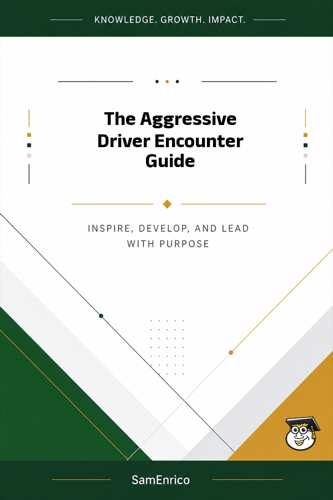
The Aggressive Driver Encounter Guide eBook
Safe responses to confrontational drivers, includi
Safe responses to confrontational drivers, including calling 911.
Formats
Free sample
Chapter 1: The Ten-Second Window--–- The first time Sarah saw the pickup truck in her rearview mirror, she thought nothing of it. It was 5:47 PM on a Tuesday, and the interstate was crowded with the usual rush-hour traffic. She was in the center lane, doing 68 in a 65, her six-year-old daughter Maya chattering from the backseat about a spelling test. The truck was two car lengths behind her, a battered Ford F-150 with a rusted tailgate. Sarah checked her mirror, then returned her attention to the road.
Ten seconds later, the truck was one car length behind her, its headlights flashing. Ten seconds after that, it was parallel to her driver's side door, the driver—a man in his forties with a red face and a grip white-knuckled on his steering wheel—screaming something she couldn't hear over the rush of wind. He swerved toward her lane. Sarah had a choice: brake, accelerate, or hold steady. She chose nothing.
She froze. The truck missed her bumper by inches, then sped ahead, weaving through traffic until it disappeared. Sarah pulled off at the next exit, pulled into a gas station, and sat with her hands shaking on the wheel for ten minutes. Maya asked, "Mommy, why is that man so mad?" Sarah didn't have an answer. She had survived, but she didn't know why.
She had done nothing right—and nothing wrong. She had simply been lucky.This book is for everyone who has been Sarah. For everyone who has felt their heart pound and their mind go blank as another driver decided, for reasons unknown, that you were the enemy. The Aggressive Driver Encounter Guide exists because luck is not a strategy. The ten-second window between a minor traffic irritation and a life-threatening assault is shorter than most people realize, and what you do in those ten seconds determines whether you drive away or become a statistic.In this chapter, we will establish the foundational vocabulary of aggressive driving versus road rage, examine the data on how quickly encounters escalate, explore the cultural and psychological factors that have made modern driving more dangerous than ever, and—most importantly—shift your mindset from passive victim to active survivor.
You will also be introduced to the single most important piece of safety equipment you can own, one that most drivers overlook until it is too late. By the end of this chapter, you will understand not just the scope of the problem, but your own power to change the outcome of the next encounter.The Epidemiology of Aggression Let us begin with definitions, because precision matters when lives are at stake. Law enforcement agencies and traffic safety researchers draw a sharp distinction between two terms that the general public routinely confuses: aggressive driving and road rage.Aggressive driving is a traffic offense. It involves the operation of a motor vehicle in a manner that endangers or is likely to endanger persons or property. The National Highway Traffic Safety Administration (NHTSA) defines aggressive driving as "the commission of two or more moving violations that are likely to endanger other persons or property, occurring as a single episode." These violations include speeding, tailgating, unsafe lane changes, failure to signal, running red lights, and weaving through traffic.
Aggressive driving is dangerous, illegal, and frightening—but it is not, in itself, a violent crime.Road rage is a criminal offense. It occurs when a driver uses their vehicle or another weapon to assault or threaten another person. Road rage includes ramming another vehicle, forcing a driver off the road, exiting a vehicle to confront another driver physically, brandishing a weapon, throwing objects at another vehicle, and any physical assault. The distinction is not merely academic. An aggressive driver can be cited with a traffic ticket.
A road rager can be arrested for assault with a deadly weapon.Why does this distinction matter for your survival? Because the tactics you use to respond to aggressive driving are different from the tactics you use to survive road rage. An aggressive tailgater may respond to a lane change and a wave. A road rager who has already exited their vehicle will not. This book will teach you how to identify which category you are facing—and how to respond appropriately to each.The data is sobering.
According to the AAA Foundation for Traffic Safety, nearly 80 percent of American drivers expressed significant anger, aggression, or road rage behind the wheel at least once in the preceding year. More than eight million drivers engaged in extreme road rage behaviors, including purposely ramming another vehicle or getting out of the car to confront another driver. The same study found that road rage has been a factor in more than half of all fatal crashes over the past decade. In 2022 alone, the organization Everytown for Gun Safety reported that road rage incidents involving firearms increased by 20 percent from the previous year, with an average of one person per week shot and killed in a road rage confrontation.These numbers are not abstract. They represent real people who, like Sarah, found themselves in the ten-second window.
The difference between those who survive and those who do not is not strength, not gender, not the car they drive. It is preparation.The Ten-Second Window: How Escalation Happens Traffic safety researchers have studied thousands of dashcam videos and police reports to understand how minor incidents become major assaults. The findings are remarkably consistent: escalation happens fast. In more than 70 percent of documented road rage incidents, the time between the initial triggering event (a cut-off, a slow driver, a perceived slight) and the first act of physical aggression was ten seconds or less.Let us walk through a typical escalation sequence, second by second.Second 1: A driver changes lanes without signaling. They do not see the car in their blind spot.
The other driver brakes hard to avoid a collision.Second 2: The other driver feels a jolt of adrenaline. Their heart rate spikes. Their brain interprets the near-miss as an intentional attack, not an accident. This misinterpretation is critical: most aggressive drivers genuinely believe they have been wronged intentionally.Second 3: The other driver accelerates to close the distance. They want to see the face of the person who "almost killed them."Second 4: Eye contact is made.
The other driver sees the offender's face. If the offender looks away, the other driver may interpret this as guilt or cowardice. If the offender looks back with any expression other than abject apology, the other driver may interpret this as defiance.Second 5: The other driver makes a gesture. It may be a honk, a flash of headlights, or a hand signal. This gesture is intended to communicate anger, but it is received as provocation.Second 6: The offender now feels attacked.
Their own adrenaline spikes. They may gesture back, speed up, or brake suddenly.Second 7: Both drivers are now in a feedback loop of anger. Neither is thinking clearly. Both are operating from the primitive fight-or-flight centers of their brains.Second 8: One driver escalates further—tailgating, swerving, or shouting.Second 9: The situation has become dangerous. A collision is seconds away.
One driver has a weapon in the glove compartment. The other has children in the backseat.Second 10: Something happens. A…
This is the end of the free sample. Get the eBook to keep going. Buy now
About this book
Details
- Author
- Mccarty Danelle
- Publisher
- SamEnrico
- Language
- English
- Genre
- Non-Fiction, Self-Help, Personal Safety
- Released
- 2026-06-06
- Pages (approx.)
- 150
- Available as
- eBook, Audiobook

Read better in the ZLOADR app
Your eBooks on your phone or tablet. Sign in with your SamEnrico account and start reading.
More by Mccarty Danelle
 Art School Critique Stress HandbookMccarty Danelle$11.99
 Narrating My Own LifeMccarty Danelle$11.99
 Roth IRA for Kids GuideMccarty Danelle$11.99
 Iron Rich Plant Foods GuideMccarty Danelle$11.99
 Fenrir and Gerda: The Wolf and the Maiden of the IceMccarty Danelle$11.99
 LaborantinMccarty Danelle$11.99
 A Beginners Guide to Gliding aerobatics (Volume 1)Mccarty Danelle$11.99
 US Scholarships for African StudentsMccarty Danelle$12.99
 Aldi SWOT GuideMccarty Danelle$12.99
 Understanding Neuritis With Brachial PredilectionMccarty Danelle$17.99
You may also like
 Hong Kong Handover 1997Dunn Johnnie$11.99
 Zumba For Postnatal Recovery CourseNeal Christian$11.99
 Zumba for BeginnersLadner Nikia$11.99
 YouTube Comment Mining GuideHumes Pandora$12.99
 Worry Box MeditationCarlin Rudy$11.99
 Workplace Stress MeditationNguyen Lynn$11.99
 Workplace Stress and Sleep RepairHawley Ivory$11.99
 Workplace Perfectionism CureDelaney Jeffry$11.99
 Workplace Injustice Anger GuideWallen Isabelle$11.99
 Work Addiction and Burnout LinkGreenwood Ester$11.99
 Women in Yoga and WellnessBeattie Galina$11.99
 Women in Stand Up ComedyChun Evangeline$11.99