
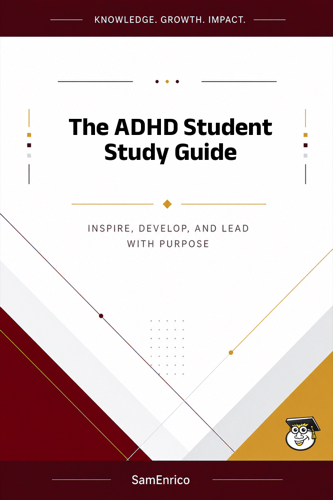
The ADHD Student Study Guide eBook
Adapt memory strategies for attention regulation c
by Levine Marti
Adapt memory strategies for attention regulation challenges.
Formats
Free sample
Chapter 1: The Broken Ladder--The first time you sat down to study and realized you had read the same sentence seven times without understanding a single word, you probably told yourself to try harder. The tenth time it happened, you might have wondered if you were lazy. The hundredth time, you may have concluded something darker: that you are simply not as smart as your classmates, or that your brain is fundamentally broken, or that academic success is a ladder you were never given the tools to climb.This chapter exists to tell you that every single one of those conclusions is wrong.What you are experiencing is not a failure of character, nor a deficit of intelligence, nor a mysterious curse that selects you for academic suffering. You are experiencing the predictable, well-documented, and entirely manageable consequences of an ADHD brain trying to navigate a study environment designed for a neurotypical nervous system. The problem is not that your ladder is missing rungs.
The problem is that you have been trying to climb a ladder built for someone else's feet, using someone else's rhythm, on someone else's wall.This chapter will give you a new map of your own mind. You will learn what executive functions are and how ADHD impairs them, why your brain craves urgency and novelty over importance and discipline, and why the very strategies that work for your classmates may be actively harmful for you. More importantly, you will learn to stop fighting your brain and start working with it. By the end of this chapter, you will have a new framework for understanding every failed study session, every blank exam page, and every moment of frustration—not as evidence of your inadequacy, but as data about a mismatch between your nervous system and your environment.Let us begin by naming the real enemy.The Real Enemy Is Not You The academic world is built on a quiet, unspoken assumption: that all students can sustain effort on tasks simply because those tasks are important. The neurotypical brain, for reasons that have nothing to do with virtue or intelligence, can generate motivation from abstract consequences.
A neurotypical student can look at a syllabus, see that an exam is three weeks away, and begin studying in a calm, measured way because the grade matters. The importance of the outcome generates enough dopamine to fuel the work.Your brain does not work that way.This is not a metaphor and it is not an excuse. It is a neurological fact. The dopamine pathways that convert "this is important" into "I will do this now" function differently in the ADHD brain. Your nervous system has evolved—or, more accurately, has been wired—to respond to four specific triggers: urgency, interest, challenge, and novelty.
Without at least one of these present, a task can feel literally impossible to start, regardless of how much you care about the consequences.This explains the devastating paradox that defines the ADHD student's life. You can spend six hours playing a video game, mastering complex strategies, memorizing maps, and executing split-second decisions. You can hyperfocus on a creative project until three in the morning without noticing time passing. You can learn the lyrics to an entire album in two days. But when you sit down to study for an exam that will determine your grade, your future, and your self-worth, you cannot read one paragraph without your mind drifting to the texture of the wall, the sound of the refrigerator, or a conversation you had three years ago.This is not laziness.
Laziness is the voluntary refusal to exert effort when effort is possible. What you are experiencing is the involuntary inability to initiate effort when the brain's reward circuitry fails to engage. The distinction is crucial, because the solutions for laziness (discipline, willpower, punishment) are the opposite of the solutions for ADHD (interest, engagement, novelty, structure).The Four Broken Executive Functions To understand why your brain fights you, you need to understand executive functions. These are the cognitive processes that manage, regulate, and direct other mental activities. Think of them as the air traffic control system of your mind—the coordination center that decides which planes take off, which ones land, and which ones circle the runway.
In the ADHD brain, the air traffic control tower is understaffed, the radar is intermittent, and some of the controllers are taking unscheduled naps.Executive functions are not a single ability but a collection of distinct processes. The scientific literature identifies anywhere from seven to twelve, but for the purpose of academic success, we will focus on the four that cause the most trouble: working memory, inhibition, emotional regulation, and rejection sensitive dysphoria. The first three are well-established in the ADHD literature. The fourth—rejection sensitive dysphoria—has only recently been recognized as a core feature of the ADHD experience, and it may be the most destructive of all.Working Memory: The Leaky Bucket Working memory is your brain's sticky note. It holds small amounts of information for brief periods while you do something with that information.
When you read a sentence and try to remember the beginning by the time you reach the end, that is working memory. When you listen to a lecture and try to hold the first point in mind while the professor moves to the second point, that is working memory. When you solve a multi-step math problem and need to keep the intermediate result in your head while you perform the next operation, that is working memory.In the neurotypical brain, the sticky note can hold approximately four to seven items for about fifteen to thirty seconds. That is not much, but it is usually enough. In the ADHD brain, the sticky note is smaller, fuzzier, and prone to sudden erasure.
Working memory capacity is reduced by approximately twenty to thirty percent on average, and the retention time is shorter. More importantly, working memory in ADHD is highly vulnerable to interference. A single distraction—a notification, a passing thought, a sound from the hallway—can wipe the entire sticky note clean.This explains why you can read a paragraph, reach the end, and have no idea what the beginning said. It explains why you can listen to a professor explain a concept, look down to write a note, and realize you have already forgotten the second half of the sentence. It explains why you can walk into a room to get something and immediately forget what you came for.
Your working memory is not broken—it is under-resourced. And like any under-resourced system, it needs external supports. Lists, alarms, visual aids, and written notes are not crutches; they are prosthetic extensions of a limited cognitive function.Inhibition: The Broken Filter Inhibition is your brain's ability to suppress irrelevant stimuli and impulses. Every second of every day, your senses are bombarded with an overwhelming amount of information. Your eyes see thousands of colors and shapes.
Your ears hear dozens of sounds. Your body feels the fabric of your clothes, the temperature of the air, the position of your limbs. Your brain also generates internal stimuli: memories, worries, plans, songs stuck in your head…
This is the end of the free sample. Get the eBook to keep going. Buy now
About this book
Details
- Author
- Levine Marti
- Publisher
- SamEnrico
- Language
- English
- Genre
- Non-Fiction, Self-Help, ADHD
- Released
- 2026-06-06
- Pages (approx.)
- 129
- Available as
- eBook, Audiobook

Read better in the ZLOADR app
Your eBooks on your phone or tablet. Sign in with your SamEnrico account and start reading.
More by Levine Marti
 The Retirement Housing Purchase ContingencyLevine Marti$11.99
 Parks Detroit Later YearsLevine Marti$11.99
 Sheppard Case Evidence LockerLevine Marti$11.99
 Nap Breathing TechniquesLevine Marti$11.99
 Pet Loss and SpiritualityLevine Marti$11.99
 The Grand Illusion: Rise and Fall of the Hotel Ritz ParisLevine Marti$11.99
 Reward System For GoalsLevine Marti$11.99
 Cold Shower Morning RoutineLevine Marti$11.99
 The Great Olympic Heist: How New Zealand’s Unknown Heroes Stole GoldLevine Marti$11.99
 How to Produce Vegetable MixesLevine Marti$11.99
 A Collector's Handbook to the Lancia Flaminia CoupeLevine Marti$11.99
 Cyberattack During UnrestLevine Marti$12.99
You may also like
 Hong Kong Handover 1997Dunn Johnnie$11.99
 Zumba For Postnatal Recovery CourseNeal Christian$11.99
 Zumba for BeginnersLadner Nikia$11.99
 YouTube Comment Mining GuideHumes Pandora$12.99
 Worry Box MeditationCarlin Rudy$11.99
 Workplace Stress MeditationNguyen Lynn$11.99
 Workplace Stress and Sleep RepairHawley Ivory$11.99
 Workplace Perfectionism CureDelaney Jeffry$11.99
 Workplace Injustice Anger GuideWallen Isabelle$11.99
 Work Addiction and Burnout LinkGreenwood Ester$11.99
 Women in Yoga and WellnessBeattie Galina$11.99
 Women in Stand Up ComedyChun Evangeline$11.99