
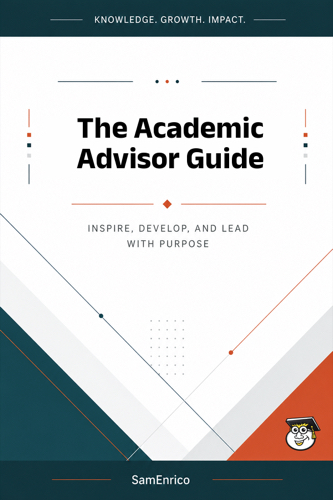
The Academic Advisor Guide eBook
Use advisor meetings to reduce course planning str
Use advisor meetings to reduce course planning stress and anxiety.
Formats
Free sample
Chapter 1: The Overwhelm Loop--–- The email arrived at 11:47 PM on a Sunday. Mia, a second-year biology major, had been staring at her degree audit for forty-five minutes. The screen showed a grid of requirements: core credits, major prerequisites, electives, distribution requirements. Some boxes were checked. Most were not.
Her cursor hovered over the registration portal, which would open in nine hours. She had fourteen tabs open: Rate My Professors, Reddit threads about organic chemistry professors, her university's course catalog, a spreadsheet her roommate made, a PDF of graduation requirements, three different major-minor combination planners, and a You Tube video titled "How to Stop Procrastinating (Works Every Time)."She closed the laptop, opened it again, and then burst into tears.Not because she was lazy. Not because she wasn't smart enough. But because her brain had just performed a familiar and brutal trick: it had transformed a task—pick classes for next semester—into a catastrophe. If I choose the wrong professor, my GPA will drop.
If my GPA drops, I won't get into medical school. If I don't get into medical school, my entire life is over. In less than sixty seconds, a scheduling decision had become a referendum on her worth as a human being.Mia was not broken. She was caught in the Overwhelm Loop, and this chapter is going to show you exactly what that loop is, why your brain creates it, and how to break it before it breaks you.The Hidden Epidemic of Planning Anxiety Here is something no one tells you before you enroll in college: for a significant percentage of students, the single most stressful academic event of the semester is not the final exam, not the twenty-page paper, not the group project with the silent partner. It is course registration.Academic advising appointments, degree audits, and registration portals produce a specific kind of anxiety that researchers are only beginning to name.
Unlike test anxiety, which is acute and time-bound, planning anxiety is diffuse and recursive. It doesn't peak during a single hour. It lingers for days or weeks. It follows you to bed. It wakes you up at 3:00 AM with a simple, devastating question: What if I'm doing this wrong?Consider these findings from recent student mental health surveys:Nearly 60% of undergraduate students report moderate to severe anxiety specifically related to academic planning and degree progression, separate from general academic stress.Among first-generation college students, that number rises to 74%.The most common description students use for the registration process is not "confusing" or "time-consuming." It is "overwhelming."When asked to rate the difficulty of various academic tasks on a 10-point scale, students rank "choosing classes that keep me on track for graduation" higher than "writing a research paper" and nearly as high as "taking a final exam in a subject I struggle with."Why is this happening?
Why does a task that is fundamentally administrative—selecting courses from a menu—trigger such intense emotional responses?The answer lies in three converging forces: the neuroscience of decision-making, the architecture of choice in modern universities, and a cognitive pattern that psychologists call catastrophizing. Together, they form the Overwhelm Loop, and once you understand how it works, you can stop it at its source.The Neuroscience of Decision Fatigue Every decision you make depletes a finite cognitive resource. This is not a metaphor. It is a measurable neurological phenomenon. When you make decisions, your brain uses glucose and oxygen to evaluate options, compare outcomes, and commit to a choice.
Over time, as you make more decisions, your brain's ability to make subsequent decisions with the same level of care degrades. This is decision fatigue, a concept popularized by social psychologist Roy Baumeister and confirmed by dozens of subsequent studies.Here is what decision fatigue feels like in real life: you start your day capable of complex reasoning. By mid-afternoon, after choosing what to wear, what to eat for breakfast, whether to go to the gym, which route to take to class, what to prioritize in your first two lectures, and where to sit for lunch, your decision-making capacity is diminished. By evening, faced with a degree audit containing dozens of choices, your brain is running on fumes.But here is the cruel irony: the registration portal does not care about your cognitive state. It opens at a specific time, often in the evening or early morning, long after you have already made hundreds of small decisions.
You are supposed to choose your entire next semester's trajectory at the exact moment when your brain is least equipped to do so.Mia's 11:47 PM breakdown was not a sign of weakness. It was a predictable outcome of a brain that had been making decisions for sixteen waking hours and was then asked to make one of the most consequential sets of choices in her academic life.The Paradox of Choice in Higher Education Decision fatigue is bad enough when you have two or three options. But modern universities do not give you two or three options. They give you hundreds.Psychologist Barry Schwartz, in his seminal work The Paradox of Choice, demonstrated that while some choice is liberating, more choice is not always better. In fact, beyond a certain point, additional options decrease satisfaction and increase anxiety.
Schwartz found that consumers faced with six options for jam were more likely to make a purchase and feel good about it than consumers faced with twenty-four options. The larger array produced paralysis, regret, and self-blame.Now translate that to course registration.You are not choosing between six jams. You are choosing between:40 to 100 different courses in a given semester Multiple sections of the same course with different professors, different times, different grading schemes Electives that may or may not fulfill distribution requirements Major requirements that must be taken in a specific sequence Prerequisites that block access to courses you actually want Waitlists that function as probabilistic gambles Overrides that require special permission Summer and winter terms that operate on different calendars The average undergraduate degree audit contains between 30 and 45 distinct requirements. Each requirement can typically be fulfilled by multiple courses. The number of possible combinations—the number of possible schedules—is not in the dozens or hundreds.
It is in the thousands.Your brain was not designed to evaluate thousands of options. It was designed to evaluate maybe five to seven at a time, in a low-stakes environment, with immediate feedback. Course registration offers none of these conditions. The stakes are high, the feedback is delayed (you won't know if you made a mistake until midterms), and the options are effectively infinite.This is why staring at a degree audit feels like drowning. Your brain is trying to do something evolutionarily impossible.Productive Future-Casting vs.
Catastrophizing Here is where the Overwhelm Loop becomes truly dangerous. Decision fatigue plus unlimited options creates a vacuum. Into that vacuum rushes a cognitive pattern that psychologists call catastrophizing.Catastrophizing is the tendency to imagine the worst possible outcome of a situation and then treat that imagined outcome as inevitable. It is not mere worrying. Worrying is "I'm concerned about this." Catastrophizing is "This concern will definitely lead to disaster."In the context of course planning…
This is the end of the free sample. Get the eBook to keep going. Buy now
About this book
Details
- Author
- Charlton Gracie
- Publisher
- SamEnrico
- Language
- English
- Genre
- Non-Fiction, Self-Help, Advising
- Released
- 2026-06-07
- Pages (approx.)
- 131
- Available as
- eBook, Audiobook

Read better in the ZLOADR app
Your eBooks on your phone or tablet. Sign in with your SamEnrico account and start reading.
More by Charlton Gracie
 Active Listening For First RespondersCharlton Gracie$11.99
 Parental Anger Reset ManualCharlton Gracie$11.99
 Daily Emotion Regulation PlanCharlton Gracie$11.99
 The Email Analytics Dashboard GuideCharlton Gracie$11.99
 The Vanishing of Roberto Durán: A Boxer’s Last RoundCharlton Gracie$11.99
 Understanding Tetrahydrobiopterin DeficiencyCharlton Gracie$17.99
 Nursery Bank StaffCharlton Gracie$11.99
 Madrid Renewal GuideCharlton Gracie$12.99
 Green Credit for Real EstateCharlton Gracie$12.99
 How to Start a Janitorial Service Business (Beginners Guide)Charlton Gracie$11.99
You may also like
 Hong Kong Handover 1997Dunn Johnnie$11.99
 Zumba For Postnatal Recovery CourseNeal Christian$11.99
 Zumba for BeginnersLadner Nikia$11.99
 YouTube Comment Mining GuideHumes Pandora$12.99
 Worry Box MeditationCarlin Rudy$11.99
 Workplace Stress MeditationNguyen Lynn$11.99
 Workplace Stress and Sleep RepairHawley Ivory$11.99
 Workplace Perfectionism CureDelaney Jeffry$11.99
 Workplace Injustice Anger GuideWallen Isabelle$11.99
 Work Addiction and Burnout LinkGreenwood Ester$11.99
 Women in Yoga and WellnessBeattie Galina$11.99
 Women in Stand Up ComedyChun Evangeline$11.99