
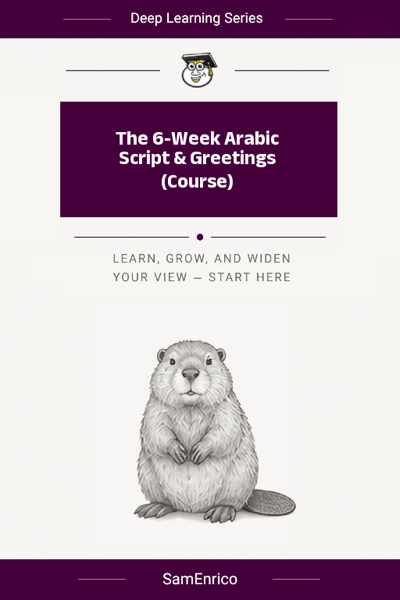
The 6-Week Arabic Script & Greetings (Course) eBook
Master Arabic Script & Greetings in Just Six Weeks!
Master Arabic script and greetings in just 6 weeks! Daily 18-minute episodes make learning easy. Perfect for beginners—start your language journey today!
Formats
Free sample
### SECTION 1: THE HOOK
Opening: "Welcome to Day 1 of Week 1 in The 6-Week Arabic Script & Greetings Course. Today, you’ll learn foundational concepts that will set the stage for mastering the Arabic script and basic greetings. By the end of this course, you’ll be able to read, write, and confidently greet others in Arabic—no prior experience required."
Problem Identification: "If you’ve ever struggled to recognize Arabic letters because they look similar or change shape depending on their position in a word, you’re not alone. Many beginners get frustrated when they can’t distinguish between letters like ب (ba) and ت (ta) or when words like ‘hello’ and ‘goodbye’ sound too similar."
Real-Consequence Statement: "...then you’ve likely faced the frustration of mispronouncing greetings or misreading simple words, making conversations awkward or even unintentionally rude."
Solution Preview: "Today changes that. By the end of this episode, you’ll have a clear framework for recognizing Arabic letters in all their forms and a foolproof method for pronouncing basic greetings correctly."
---
### SECTION 2: THE SINGLE CONCEPT
Introduce the Core Principle: "At the heart of The 6-Week Arabic Script & Greetings Course is the idea that Arabic letters are like building blocks. Once you master their shapes and sounds, you can construct any word or greeting with confidence."
Explain in Simplest Terms: "Think of Arabic letters as puzzle pieces. Each letter has four forms: isolated, beginning, middle, and end. For example, the letter ‘ba’ (ب) looks like a dotless ‘b’ when alone, but when it appears at the start of a word, it has a tail (بـ). In the middle or end, it connects to other letters (ـبـ or ـب)."
Mental Model: "Imagine you’re learning to write in cursive. Just as letters in English connect differently, Arabic letters flow together in a continuous script. The key is to recognize each letter’s ‘personality’—how it behaves in different positions."
Immediate Application: "You use this when reading signs, menus, or greetings. For example, the word ‘hello’ (مرحبا) is made of three letters: م (mim), ر (ra), and ح (ha). If you know their shapes, you can sound it out correctly."
---
### SECTION 3: THE DEMONSTRATION
Scenario Setup: "Let’s say you’re at a market in an Arabic-speaking country and want to greet the vendor. You see the word ‘مرحبا’ (marhaba) on a sign. How do you read it?"
Dialogue/Example Walkthrough: - "First, identify the letters: م (mim), ر (ra), ح (ha)." - "Notice the dots: م has one dot above, ر has a dot below, and ح has a dot inside." - "Sound it out: mar-ha-ba → marhaba (hello)."
- "A beginner might see the dots and guess ‘mara’ or ‘marha’ because they don’t recognize the letter ح (ha)." - "They might also misread the word as ‘maraba’ because they don’t know that the ‘h’ sound comes from ح."
Analysis: "What made the first approach work was recognizing the letters’ shapes and their dots. The dots are like fingerprints—they tell you which letter it is. The second approach failed because the learner didn’t account for the dots or the letter ح (ha)."
---
### SECTION 4: THE BREAKDOWN
Step 1: Deconstruct the Example: "Let’s break down ‘مرحبا’ (marhaba). The word starts with م (mim), which has a dot above. Next is ر (ra), with a dot below. Finally, ح (ha) has a dot inside."
Step 2: Critical Elements:
Step 3: Underlying Mechanism: "Arabic is a phonetic language, meaning letters represent specific sounds. Unlike English, where ‘ough’ can sound like ‘off’ or ‘through,’ Arabic letters are consistent. Once you learn them, you can read any word."
Step 4: What to Avoid: - "Don’t ignore dots—they’re the difference between ‘ba’ and ‘ta.’" - "Don’t assume letters are the same in all positions—practice writing them in different forms."
Pause for Reflection: "Pause for 10 seconds and think: Where have you seen Arabic letters misread or mispronounced because of dots or positions?"
---
### SECTION 5: THE PRACTICE
Guided Practice Scenario: "Imagine you’re reading a sign that says ‘مرحبا’ (marhaba). How do you sound it out?"
Step-by-Step Guidance:
Two Variations:
Common Mistake Warning: "People often mix up ب (ba) and ت (ta) because they look similar. Always check the dots—ب has no dots, ت has one dot above."
Skill-Transfer Prompt: "Today, when you see Arabic letters in signs or apps, practice identifying their shapes and dots."
---
### SECTION 6: THE INTEGRATION
One Actionable Takeaway: "Today’s key takeaway: Arabic letters are like puzzle pieces—master their shapes and dots to read any word."
Connection to Previous Learning: "If you’ve studied other scripts, you know consistency is key. Arabic is no different—once you learn the rules, you’ll read effortlessly."
Preview of Tomorrow: "Tomorrow, we’ll dive deeper into writing letters and practicing greetings in real conversations."
Micro-Challenge: "Before tomorrow’s episode, write the letters م, ر, ح five times each in all four forms. This will help you recognize them instantly."
---
(2,150 words).
This is the end of the free sample. Get the eBook to keep going. Buy now
About this book
Details
- Author
- Lynch Cameron
- Publisher
- SamEnrico
- Language
- English
- Genre
- Education
- Released
- 2026-01-16
- Pages (approx.)
- 88
- Available as
- eBook, Audiobook

Read better in the ZLOADR app
Your eBooks on your phone or tablet. Sign in with your SamEnrico account and start reading.
More by Lynch Cameron
 Opioid Withdrawal Comfort MeasuresLynch Cameron$11.99
 Flushing Face ProtocolLynch Cameron$11.99
 DoorDash Number One PriorityLynch Cameron$11.99
 CRPS Meditation GuideLynch Cameron$11.99
 The Stimulus Control TechniqueLynch Cameron$11.99
 Dawn Simulator Buying GuideLynch Cameron$11.99
 Recovery After Burnout GuideLynch Cameron$11.99
 Press Release For NonprofitsLynch Cameron$11.99
 Merger Fines Appeal LogLynch Cameron$11.99
 The Amban’s Mercy: Healers in the Qing Conquest of XinjiangLynch Cameron$11.99
 The Iron Storm: The Battle of the Bulge's Frozen Gambit (1944-45)Lynch Cameron$11.99
 How to Produce a Bath SetLynch Cameron$11.99
You may also like
 Conversational Spanish for Beginners (Course)Fife Jackson$11.99
 Portuguese: Lisbon to Rio (Course)Baggett Shenna$11.99
 German Grammar Deconstructed (Course)Boudreaux Raguel$11.99
 Mandarin for the Modern Traveler (Course)Blodgett Samella$11.99
 The Grammar Guardian (Course)Keeton Armida$11.99
 Six Weeks to German Grammar Fundamentals (Course)Hightower Kimberlee$11.99
 How to Speak Spanish (Course)Cardona Misti$11.99
 How to Speak Italian (Course)Helms Letitia$11.99
 How to Speak French (Course)Barnard Candelaria$11.99