
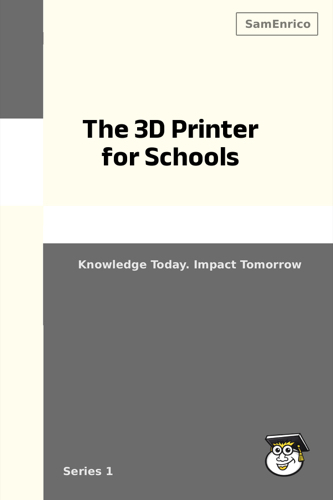
Non-FictionBiographySTEM Education
The 3D Printer for Schools eBook
Tells of a maker who brought technology to classro
Tells of a maker who brought technology to classrooms.
Formats
Free sample
Chapter 1: The Blue Plastic Boat...–- Maya had not intended to change her life on a Tuesday. She had intended to drop off a box of old baking pans for her sister, kiss her niece goodbye, and drive back to her sterile home office where a product design contract awaited—something about a redesigned handle for a high-end kitchen knife. But the universe, she would later reflect, has a cruel sense of timing.The hallway of Martin Luther King Jr. Middle School smelled like floor wax, cafeteria chili, and the particular desperation of a building that had not seen a fresh coat of paint since the Clinton administration. Maya navigated the fluorescent-lit corridor, dodging a child who was running backward while arguing with an invisible friend, and found her niece, Elena, loitering outside Room 212.“Tía Maya!” Elena hugged her around the waist.
“Did you bring the cookies?”“Baking pans,” Maya corrected, holding up the box. “For your mother’s garage sale. And no, you cannot have the box to make a fort.”Elena pouted, but her attention was already drifting toward a cluster of students gathered around a classroom door. They were peering through the small wire-reinforced window, pressing their faces against the glass like fish in a too-small tank. A low murmur of excitement rippled through the group.“What’s going on?” Maya asked.“Mr.
Harrison’s class is watching a video about robots,” Elena said with a shrug. “It’s just You Tube.”But Maya’s curiosity was piqued. She had spent five years as a product designer for a mid-sized consumer goods company before burning out on endless meetings about “synergy” and “deliverables.” She had left to freelance, filling her garage workshop with the tools she actually loved: a lathe, a soldering station, and most preciously, a small desktop 3D printer she had built from a kit. It was nothing fancy—an open-frame FDM machine that required constant tinkering, bed leveling, and the occasional prayer to the filament gods—but it was hers. She printed replacement knobs for her kitchen cabinets, custom phone stands, and once, a working gear mechanism for a student’s science fair project.She had never thought to bring it here.The Demonstration That Wasn’t Planned An hour later, after dropping off the baking pans and enduring her sister’s lecture about why freelancing “wasn’t a real job,” Maya found herself back in the school’s main office.
Principal Davis—a tall, exhausted man whose tie was perpetually askew—was on the phone, gesturing vaguely at a chair. She sat.When he hung up, he rubbed his eyes. “Ms. Vega, right? Elena’s aunt?”“Maya,” she said.
“I’m sorry to bother you. I was just… I heard the students talking about robotics, and I wondered if the school had any hands-on technology programs.”Principal Davis laughed without humor. “Hands-on? We’re lucky if the science lab has working microscopes. Our budget this year was cut by twelve percent.
The robotics video you saw? That’s the closest most of these kids will get to a real robot until high school—if they make it that far.”Maya hesitated. Then, before she could talk herself out of it, she said, “I have a 3D printer. It’s small, not expensive, but it works. I could bring it in.
Just for a day. Show the kids what it does.”The principal’s eyebrows rose. “A 3D printer? Like… the ones that make guns?”“No,” Maya said quickly. “Like the ones that make replacement parts, prototypes, educational models.
It melts plastic filament layer by layer. It’s safer than a glue gun if you use PLA—which is plant-based and non-toxic. I’ve printed cookie cutters, battery covers, even a working whistle.”Principal Davis studied her for a long moment. Maya could see the calculation behind his eyes: liability, time, disruption, and beneath all of that, a flicker of genuine interest. “You’d need to clear it with Mr.
Harrison, the eighth-grade science teacher. And with Carlos, our IT director. And Mr. Frank, the janitor—he’s particular about smells.”“I can do that,” Maya said, though she had no idea if she could.The Bureaucracy Beneath the Surface What followed was two weeks of what Maya privately called “The Paperwork Crawl.” Mr. Harrison was cautiously optimistic but wanted a lesson plan aligned to state standards.
Carlos, the IT director, sent a three-page questionnaire about network security, data storage, and whether the printer’s software “phoned home” to external servers. Mr. Frank, the janitor, simply asked, “Does it smell like burning plastic? Because I ain’t dealing with that again after the incident with the microwave popcorn.”Maya answered each question with painstaking detail. She wrote a lesson plan titled “Introduction to Additive Manufacturing: From Digital Design to Physical Object.” She learned that PLA filament smells faintly of waffles or maple syrup when heated, not burning plastic.
She assured Carlos that the printer could run entirely offline, using an SD card for file transfers.Finally, on a gray Thursday morning, she carried her printer—wrapped in a beach towel and wedged into a rolling suitcase—through the school’s front doors.The Blue Plastic Boat Maya set up the printer on a lab table near the window. The machine was unassuming: a tangle of aluminum extrusions, exposed stepper motors, and a glass bed held in place with binder clips. It looked more like a science fair project than technology of the future. The students filed in, twenty-eight eighth-graders with varying degrees of interest, and gathered around.“This,” Maya said, “is a 3D printer. It turns digital designs into physical objects by melting plastic and building up layers.
It’s called additive manufacturing because you add material only where you need it—unlike traditional machining, where you cut away from a block of material.”She had prepared a simple print: a tiny blue boat, a classic test model known as the “Benchy.” The printer whirred to life, its nozzle heating to 200 degrees Celsius. The students watched as the first layer squirted onto the glass bed, a thin smear of molten plastic that quickly cooled and solidified. Layer by layer, the boat emerged from nothing. It was slow—the print would take forty-five minutes—but the students did not look away.“Why does it take so long?” a girl in the front row asked.“Because each layer is only 0.2 millimeters thick,” Maya said. “Imagine building a skyscraper out of playing cards, one card at a time.
That’s what this machine does, but with plastic.”She used the wait time to explain the difference between additive and subtractive manufacturing. “Subtractive is like carving a statue from a block of marble—you remove everything that isn’t the statue. But you waste material. Additive only uses what you need. That’s why 3D printing is good for the environment, for prototyping, and for schools where budgets are tight.”The printer hummed.
The boat grew. Some students lost interest and returned to their phones. Others stayed, mesmerized by the dance of the nozzle.And then Marcus spoke.Marcus was a quiet kid, Maya had noticed. He sat in…
This is the end of the free sample. Get the eBook to keep going. Buy now
About this book
Details
- Author
- Schiller Shenika
- Publisher
- SamEnrico
- Language
- English
- Genre
- Non-Fiction, Biography, STEM Education
- Released
- 2026-06-06
- Pages (approx.)
- 123
- Available as
- eBook, Audiobook

Read better in the ZLOADR app
Your eBooks on your phone or tablet. Sign in with your SamEnrico account and start reading.
More by Schiller Shenika
 Flash Sales InflationSchiller Shenika$11.99
 Physical Touch Stress GuideSchiller Shenika$11.99
 Memory Palace Technique for StudentsSchiller Shenika$11.99
 Name Memory Palace GuideSchiller Shenika$11.99
 Resignation ConversationSchiller Shenika$11.99
 SMART Goals for WritersSchiller Shenika$11.99
 One Week Spending FastSchiller Shenika$11.99
 The Ballad of the Wandering Composer: The Lost Symphony of Gustav MahlerSchiller Shenika$11.99
 The Lost Art of the Gilded Age: How America's First Billionaires Built a Legacy of ExcessSchiller Shenika$11.99
 Service Providers Guide to Music InstructionSchiller Shenika$11.99
 A Collector's Handbook to the Lagonda 3-litre Drophead CoupeSchiller Shenika$11.99
 How to Start a Cocks for Industrial Use Business (Beginners Guide)Schiller Shenika$11.99
You may also like
 Hong Kong Handover 1997Dunn Johnnie$11.99
 Zumba For Postnatal Recovery CourseNeal Christian$11.99
 Zumba for BeginnersLadner Nikia$11.99
 YouTube Comment Mining GuideHumes Pandora$12.99
 Worry Box MeditationCarlin Rudy$11.99
 Workplace Stress MeditationNguyen Lynn$11.99
 Workplace Stress and Sleep RepairHawley Ivory$11.99
 Workplace Perfectionism CureDelaney Jeffry$11.99
 Workplace Injustice Anger GuideWallen Isabelle$11.99
 Work Addiction and Burnout LinkGreenwood Ester$11.99
 Women in Yoga and WellnessBeattie Galina$11.99
 Women in Stand Up ComedyChun Evangeline$11.99