
Non-FictionInformativeEducational
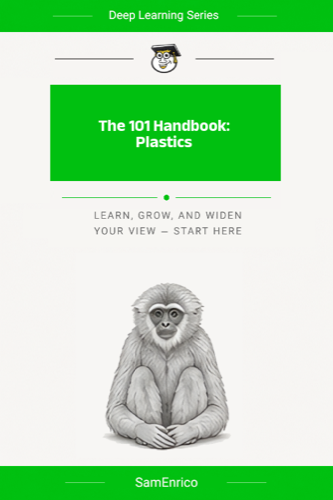
The 101 Handbook: Plastics
This publication, published by SamEnrico, covers T
This publication, published by SamEnrico, covers The 101 Handbook: Plastics
Formats
About this book
Free sample
Chapter 1: The Elephant in the Room--– Before plastic, the world was a slaughterhouse. Not because humans were more cruel then—though by modern standards, they certainly were—but because every object we now take for granted as cheap, light, and disposable once required the death of something alive. Your morning coffee? The cup would have been ceramic or carved wood. Your toothbrush?
Boar bristles set into bone. Your water bottle? Either glass (heavy, breakable) or a leather bladder (leaky, rank). The buttons on your shirt? Mother-of-pearl from the shell of a sea creature.
The billiard balls in the pub? Ivory from the tusk of an elephant. And not just any elephant—a specific species, the African elephant, whose tusks produced the finest, densest ivory for turning on a lathe.In 1867, the billiard ball industry faced a crisis. The game had exploded in popularity among the Victorian middle class, and the world's elephants were running out. Not metaphorically.
Actually. The great herds of Africa were being pushed toward extinction by the sheer demand for recreational spheres. The Phelan and Collender Company of New York, the largest billiard ball manufacturer in the world, placed a public notice offering a bounty of ten thousand dollars—roughly a quarter of a million dollars in today's money—to any man who could invent a substitute for ivory that did not: (a) come from a dead animal, (b) crack on impact, or (c) smell like a wet dog when struck (a problem with early celluloid prototypes).That bounty would never be claimed. But the search for an answer to the elephant problem set in motion a chain of discovery that would, within fifty years, birth an entirely new class of material: synthetics. Materials made not from anything that had ever lived, but from molecules arranged by human hands in human factories.
Materials that could be hard as stone or soft as silk. Materials that could be clear as glass or black as coal. Materials that could be shaped, coloured, melted, and reshaped—again and again.These materials would come to be called plastics, from the Greek plastikos, meaning…
This is the end of the free sample. Get the eBook to keep going. Buy now
Contents
- Chapter 1
- Chapter 2
- Chapter 3
- Chapter 4
- Chapter 5
- Chapter 6
- Chapter 7
- Chapter 8
- Chapter 9
- Chapter 10
- Chapter 11
- Chapter 12
Details
- Author
- Ervin Phillis
- Publisher
- SamEnrico
- Language
- English
- Genre
- Non-Fiction, Informative, Educational
- Released
- 2026-05-09
- Pages (approx.)
- 157
- Available as
- eBook, Audiobook

Read better in the ZLOADR app
Your eBooks on your phone or tablet. Sign in with your SamEnrico account and start reading.
More by Ervin Phillis
 Bring Along ProvisionErvin Phillis$11.99
 Micronutrients For Gut Health GuideErvin Phillis$11.99
 The Sleeping Cat MethodErvin Phillis$11.99
 Metaphor Library for ScriptsErvin Phillis$11.99
 Pet Loss For ExpatriatesErvin Phillis$11.99
 The Bomb Squad Technician StressErvin Phillis$11.99
 Pelvic Pain Release ExercisesErvin Phillis$11.99
 Time Blocking For Holiday PrepErvin Phillis$11.99
 BossypantsErvin Phillis$11.99
 The Lioness of Dahomey: A Warrior Queen's Unyielding ReignErvin Phillis$11.99
 The Last Unknown River: Mapping the Amazon’s Hidden HeartErvin Phillis$11.99
 Shadow Votes: The 2000 Florida Ballot ScandalErvin Phillis$11.99
You may also like
 Hong Kong Handover 1997Dunn Johnnie$11.99
 Zumba For Postnatal Recovery CourseNeal Christian$11.99
 Zumba for BeginnersLadner Nikia$11.99
 YouTube Comment Mining GuideHumes Pandora$12.99
 Worry Box MeditationCarlin Rudy$11.99
 Workplace Stress MeditationNguyen Lynn$11.99
 Workplace Stress and Sleep RepairHawley Ivory$11.99
 Workplace Perfectionism CureDelaney Jeffry$11.99
 Workplace Injustice Anger GuideWallen Isabelle$11.99
 Work Addiction and Burnout LinkGreenwood Ester$11.99
 Women in Yoga and WellnessBeattie Galina$11.99
 Women in Stand Up ComedyChun Evangeline$11.99