
Non-FictionInformativeEducational
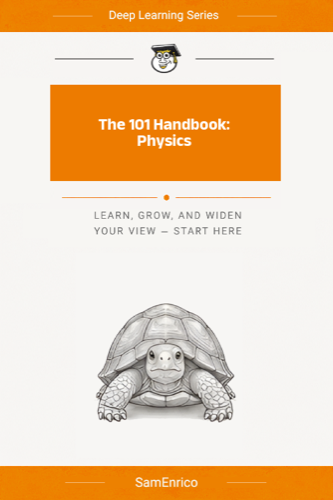
The 101 Handbook: Physics eBook
This publication, published by SamEnrico, covers T
This publication, published by SamEnrico, covers The 101 Handbook: Physics
Formats
Free sample
Chapter 1: Measuring the Infinite...--– You are about to learn something that most people never realize about physics. It is not about formulas. It is not about memorizing that force equals mass times acceleration. And it is certainly not about becoming a human calculator. Physics, at its core, is a way of thinking.
It is a set of habits, a method for cutting through confusion, for detecting lies disguised as facts, and for finding order in what looks like chaos. Before Galileo, before Newton, before Einstein, there was a radical idea. The idea was this: authority does not matter. What your senses tell you does not even matter, not by itself. What matters is measurement.
What matters is whether you can predict something, test it, and have anyone else in the world repeat your experiment and get the same result.This chapter is the foundation of everything that follows. Without it, the later chapters about motion, energy, electricity, relativity, and quantum mechanics would be just recipes without a kitchen. You would learn the formulas, but you would not understand why they work or when they break. So we are going to start not with a grand law of the universe, but with a question that seems almost too simple: how do we know anything at all in physics?The Death of Common Sense Aristotle was the most trusted mind of the ancient world. He said that heavy objects fall faster than light ones.
It made perfect sense. A rock drops faster than a feather. Everyone could see it. For nearly two thousand years, no one seriously questioned him. Why would they?
His answer matched everyday experience. Then Galileo allegedly climbed the Leaning Tower of Pisa, dropped two balls of different weights, and watched them land at the same time. The story is probably a myth. But the real history is more important. Galileo did not just drop balls from a tower.
He rolled balls down inclined planes. He slowed down gravity so he could measure it. He timed the rolls with his pulse, then with water clocks, then with marks on the wood. He discovered that the distance the ball traveled increased with the square of the time. That is the first kinematic equation hiding in raw data.
More importantly, he discovered that Aristotle was not just wrong but dangerously wrong. Not because Aristotle was stupid. Because Aristotle never measured.This is the first lesson of physics: your intuition is trained on a very narrow slice of reality. You live on the surface of a medium-sized planet, moving at a medium speed, at a medium temperature. Your senses evolved to find food and avoid predators, not to discover the structure of spacetime.
So when your intuition screams that something is impossible, check your measurements. When your intuition says something is obvious, test it anyway.Falsifiability Karl Popper, a philosopher of science, asked a deceptively simple question: what makes a statement scientific? He answered that a statement is scientific only if it can be proven wrong. Not if it is true. If it can be proven wrong.
This is called falsifiability. The statement "all swans are white" is scientific because one black swan would destroy it. The statement "God created the universe in seven days" is not scientific, not because it is false, but because no possible observation could disprove it. You cannot run an experiment that would show, beyond doubt, that the seven days did not happen. Popper does not say such statements are meaningless.
He says they are outside the realm of science.Physics lives inside the realm of falsifiability. Every law of physics is a standing bet. Newton's law of gravity says that two masses attract each other with a force inversely proportional to the square of the distance between them. If you find a pair of masses that do not obey that rule, the law falls. That is its strength, not its weakness.
The best theories are the ones that survive the most attempts to kill them.Consider the history of the ether. In the 1800s, physicists were convinced that light waves needed a medium to travel through, just as sound travels through air and water waves travel through water. They called this medium the luminiferous ether. It had to be everywhere. It had to be transparent.
It had to be rigid enough to carry high-frequency light waves but also allow planets to move through it without resistance. That is a lot of contradictory properties. The Michelson-Morley experiment of 1887 tried to detect the ether by measuring the speed of light in different directions as Earth moved through space. They found nothing. No ether wind.
No change in the speed of light. The theory of the ether was falsified. It died. And from its death came Einstein's special relativity. That is how physics progresses.
Not by proving theories true, but by failing to prove them false, then replacing them when they finally break.Paradigm Shifts Thomas Kuhn added a crucial layer to Popper's picture. Kuhn argued that science does not progress smoothly, with one fact added after another. Instead, science moves in cycles. Most of the time, scientists work within a paradigm. A paradigm is a shared set of assumptions, methods, and problems.
Newtonian physics was a paradigm. It told physicists what questions to ask, what instruments to use, and what counted as an explanation. Within a paradigm, scientists solve puzzles. They calculate planetary orbits. They design steam engines.
They refine measurements.But every paradigm has anomalies. Small inconsistencies that do not fit. At first, these are ignored or explained away. Mercury's orbit wobbles slightly in a way that Newton's laws cannot fully explain. The speed of light seems to be constant no matter how you measure it.
The ultraviolet catastrophe, where classical physics predicted that hot objects would emit infinite energy, was a screaming anomaly. When enough anomalies accumulate, the paradigm enters a crisis. Scientists fight. Older scientists die. And eventually, a new paradigm emerges.
Newton gave way to Einstein. Classical mechanics gave way to quantum mechanics. Kuhn called these transitions paradigm shifts. They are not gradual. They are revolutions.Understanding paradigm shifts is essential for reading this book.
You will learn Newtonian physics in Chapters 2 through 5. Then you will learn that Newton was wrong about gravity being a force. You will learn that time is not absolute. You will learn that particles can be waves and waves can be particles. This is not a contradiction.
It is a paradigm shift. You are not unlearning. You are upgrading.Units Before you can measure anything, you need a ruler. Not a physical ruler, but a system of agreed-upon units. In physics, that system is the International System of Units, abbreviated SI from the French.
It is built on seven base units, but for mechanics, you only need three: the meter for length, the second for time, and the kilogram for mass. Everything else is derived from these three.The meter was originally defined as one ten-millionth of the distance from the equator to the North Pole. Now it is defined as the distance light travels in a vacuum in 1/299,792,458 of a second. The second was defined as 1/86,400…
This is the end of the free sample. Get the eBook to keep going. Buy now
About this book
Details
- Author
- Malloy Lamonica
- Publisher
- SamEnrico
- Language
- English
- Genre
- Non-Fiction, Informative, Educational
- Released
- 2026-05-06
- Pages (approx.)
- 128
- Available as
- eBook, Audiobook

Read better in the ZLOADR app
Your eBooks on your phone or tablet. Sign in with your SamEnrico account and start reading.
More by Malloy Lamonica
 The White House Aide StressMalloy Lamonica$11.99
 Micronutrients For Athletes GuideMalloy Lamonica$11.99
 The Full Moon Over LakeMalloy Lamonica$11.99
 Pelvic Organ Prolapse GuideMalloy Lamonica$11.99
 Co Sale Agreement TermsMalloy Lamonica$11.99
 The IBS Mental Health GuideMalloy Lamonica$11.99
 MBSR for Body DysmorphiaMalloy Lamonica$11.99
 Time Blocking For Travel PlanningMalloy Lamonica$11.99
 The Midnight Codebreakers: Harriet Tubman’s Secret SignalsMalloy Lamonica$11.99
 The Last Black UnicornMalloy Lamonica$11.99
 The Unseen Brush: Frida Kahlo’s Secret Diaries RevealedMalloy Lamonica$11.99
 How to Start a Mortgage Broker Business (Beginners Guide)Malloy Lamonica$11.99
You may also like
 Hong Kong Handover 1997Dunn Johnnie$11.99
 Zumba For Postnatal Recovery CourseNeal Christian$11.99
 Zumba for BeginnersLadner Nikia$11.99
 YouTube Comment Mining GuideHumes Pandora$12.99
 Worry Box MeditationCarlin Rudy$11.99
 Workplace Stress MeditationNguyen Lynn$11.99
 Workplace Stress and Sleep RepairHawley Ivory$11.99
 Workplace Perfectionism CureDelaney Jeffry$11.99
 Workplace Injustice Anger GuideWallen Isabelle$11.99
 Work Addiction and Burnout LinkGreenwood Ester$11.99
 Women in Yoga and WellnessBeattie Galina$11.99
 Women in Stand Up ComedyChun Evangeline$11.99