
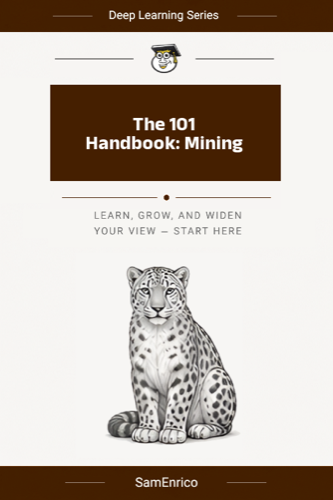
Non-FictionInformativeEducational
The 101 Handbook: Mining eBook
This publication, published by SamEnrico, covers T
This publication, published by SamEnrico, covers The 101 Handbook: Mining
Formats
Free sample
Chapter 1: The Stone Sleuths...--Most people look at a mountain and see a mountain. They see granite cliffs, snow-capped peaks, or forested slopes. A geologist looks at the same mountain and reads a novel written in stone—a four-billion-year story of molten fire, crushing pressure, chemical transformation, and patient time. And a mining geologist looks at that same mountain and asks a single, obsessive question: Where is the money hiding?This is the art and science of economic geology. It is the difference between knowing that a rock contains copper and knowing whether that copper can be dug up, crushed, boiled in acid, and sold for more than the cost of all that digging, crushing, and boiling.
The difference between a mineral occurrence—a geologist’s curiosity—and an ore body—a mining company’s reason for existence.Welcome to the treasure hunt. It is not glamorous. It rarely involves maps with dotted lines and red X’s. It involves drill core, assay certificates, statistical models, and a brutal understanding of physics and finance. But when it works, when a geologist correctly reads the stone and a mining engineer builds a million-ton-per-year operation on that reading, the result is civilization itself.
Every copper wire in your wall, every steel beam in your building, every lithium atom in your phone’s battery came from someone who first asked: Where is the money hiding?This chapter will teach you to ask that question. You will learn the three families of ore deposits—where they come from, what they look like, and which metals they tend to carry. You will learn the single most important relationship in mining economics: grade versus tonnage, the trade-off that determines whether a deposit becomes a mine or remains a hole in the ground. And you will meet the major commodities that drive global mining—gold, copper, lithium, and iron ore—each with its own geology, its own economics, and its own personality.By the end of this chapter, you will never look at a mountain the same way again.The Three Families of Ore: Where Metal Comes From The Earth’s crust is mostly garbage. Silicon and oxygen dominate—sand and quartz are everywhere.
Aluminum is abundant but locked in clays. Iron is common but scattered. For a metal to be worth mining, nature has to do something unusual: it has to concentrate that metal by a factor of hundreds or thousands compared to average crustal abundance. Copper, for example, averages about 0.006% in the Earth’s crust. To be economic, you need to find it at 0.3% or higher—a fifty-fold concentration.
Gold averages 0.0000004% (4 parts per billion). A gold mine needs 1-5 grams per tonne, which is 250 to 1,250 times average concentration.Nature has three main ways of achieving this magic trick. Geologists call them magmatic, hydrothermal, and sedimentary deposits. Each has its own fingerprint, its own suite of metals, and its own mining methods.Magmatic Deposits: Crystals That Sink Imagine a vat of molten rock—magma—deep beneath a volcano. It is a soup of every element, all mixed together.
As the magma cools, the first minerals to crystallize are the dense, heavy ones. They sink to the bottom of the magma chamber, like chocolate chips settling in cookie dough. Over millions of years, as the magma pulses, settles, and re-melts, these dense minerals accumulate into layers of extraordinary richness.That is a magmatic deposit.The most famous example is the Bushveld Complex in South Africa. It is a layered intrusion the size of Ireland, formed two billion years ago. In its deepest layers, it contains 90% of the world’s known platinum and chromium reserves.
The Sudbury Basin in Canada is another—a magmatic deposit formed by a massive asteroid impact that melted the crust and allowed heavy metals to settle. Sudbury has produced more nickel and copper than almost any other district on Earth.What metals should you look for in magmatic deposits? Platinum, palladium, rhodium (the platinum group metals, or PGMs), chromium, vanadium, titanium, and nickel-copper sulfides. These deposits tend to be large, low-to-medium grade, and flat-lying—perfect for massive underground mining or, if shallow, open pits. They are the industrial backbone of catalytic converters, stainless steel, and aerospace alloys.Hydrothermal Deposits: Hot Water Pipes Now imagine a different scene.
Magma rises toward the surface, not as a solid intrusion but as a heat engine. It warms groundwater to superheated temperatures—300°C to 500°C, under immense pressure. This hot water is a phenomenal solvent. It leaches metals out of the surrounding rock—gold, silver, copper, zinc, lead—and carries them in solution. The water flows up through cracks and faults in the crust.
As it rises, it cools. As it cools, the metals precipitate out, forming veins and replacement bodies.That is a hydrothermal deposit.Most of the world’s gold, silver, copper, and zinc come from hydrothermal systems. They come in two main flavors: porphyry copper deposits and epithermal gold-silver veins.Porphyry copper deposits are the giants of the mining world. They form above large magma chambers where hot water circulates through a stockwork of thousands of tiny quartz veins. The result is a low-grade (0.3-1.0% copper), enormous tonnage (hundreds of millions to billions of tons) deposit that is mined in massive open pits.
Bingham Canyon in Utah, Chuquicamata in Chile, and Grasberg in Indonesia are porphyry deposits. They provide the majority of the world’s copper, along with significant molybdenum, gold, and silver.Epithermal gold-silver veins form closer to the surface—often directly above porphyry systems. The water is cooler (150°C-300°C), and the veins are narrower. A single vein might be meters wide but extend for kilometers. Gold grades can be spectacular—10, 20, even 50 grams per tonne.
But the tonnage is small. These are underground mines, chasing the vein downward. The Comstock Lode in Nevada and the Hishikari mine in Japan are classic examples.Hydrothermal deposits also include volcanogenic massive sulfide (VMS) deposits—formed on the seafloor by black smokers—and sedimentary exhalative (SEDEX) deposits—formed in ancient basins. Both are important sources of zinc, lead, silver, and copper.What metals should you look for in hydrothermal deposits? Copper, gold, silver, zinc, lead, molybdenum, tin, tungsten, and uranium.
These deposits vary wildly in size and grade, but they are the favorite hunting grounds of exploration geologists because they can be exceptionally rich.Sedimentary Deposits: Layers of Fortune The third family forms at the Earth’s surface. Wind, water, and chemical reactions concentrate metals into layers that can be mined like any other sedimentary rock. There are three main types.Banded iron formations (BIFs) are the source of almost all iron ore. Two and a half billion years ago, the Earth’s oceans were rich in dissolved iron. When photosynthetic bacteria began pumping out oxygen, the iron oxidized and precipitated to the seafloor in alternating bands of iron oxide and chert.
The result is a rock that is 30-50% iron—already enriched. Weathering over billions of years can leach out the silica, leaving 60-70% iron ore. The Mesabi Range in Minnesota and the Hamersley Basin in Australia are BIF-derived iron mines. They are the backbone of steelmaking.Evaporites form when sealed basins of seawater evaporate. As the…
This is the end of the free sample. Get the eBook to keep going. Buy now
About this book
Details
- Author
- Ferry Socorro
- Publisher
- SamEnrico
- Language
- English
- Genre
- Non-Fiction, Informative, Educational
- Released
- 2026-05-08
- Pages (approx.)
- 147
- Available as
- eBook, Audiobook

Read better in the ZLOADR app
Your eBooks on your phone or tablet. Sign in with your SamEnrico account and start reading.
More by Ferry Socorro
 The IBS Career GuideFerry Socorro$11.99
 The Hammam Steam RoomFerry Socorro$11.99
 Pet Loss For Active MilitaryFerry Socorro$11.99
 Mindfulness Based CBTFerry Socorro$11.99
 Micronutrients For Children GuideFerry Socorro$11.99
 Pay to Play ProvisionsFerry Socorro$11.99
 The Professional Athlete StressFerry Socorro$11.99
 MPS Storage DisorderFerry Socorro$11.99
 Time Blocking For Empty NestersFerry Socorro$11.99
 The Last Dance: How a Single Performance Won the WarFerry Socorro$11.99
 The Lion Kings of the Savannah: The Military Prowess of the Kingdom of KongoFerry Socorro$11.99
 The Great Bitcoin Heist: How a Single Hacker Stole $500 MillionFerry Socorro$11.99
You may also like
 Hong Kong Handover 1997Dunn Johnnie$11.99
 Zumba For Postnatal Recovery CourseNeal Christian$11.99
 Zumba for BeginnersLadner Nikia$11.99
 YouTube Comment Mining GuideHumes Pandora$12.99
 Worry Box MeditationCarlin Rudy$11.99
 Workplace Stress MeditationNguyen Lynn$11.99
 Workplace Stress and Sleep RepairHawley Ivory$11.99
 Workplace Perfectionism CureDelaney Jeffry$11.99
 Workplace Injustice Anger GuideWallen Isabelle$11.99
 Work Addiction and Burnout LinkGreenwood Ester$11.99
 Women in Yoga and WellnessBeattie Galina$11.99
 Women in Stand Up ComedyChun Evangeline$11.99