
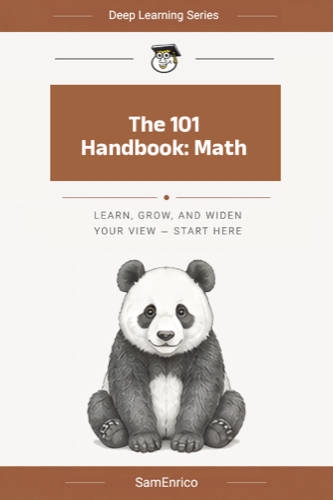
Non-FictionInformativeEducational
The 101 Handbook: Math eBook
This publication, published by SamEnrico, covers T
This publication, published by SamEnrico, covers The 101 Handbook: Math
Formats
Free sample
Chapter 1: The 5-Cent Trap--–- Most people never see it coming. You are sitting in a coffee shop, relaxed, when a friend slides a napkin across the table. On it is written: "A bat and a ball cost $1.10. The bat costs $1.00 more than the ball. How much does the ball cost?" Your brain, moving faster than you can control, whispers an answer: ten cents.
It feels right. It feels obvious. It is wrong.This is the 5-cent trap. The correct answer is five cents. If the ball costs five cents, then the bat costs one dollar and five cents, and together they cost one dollar and ten cents.
The moment your friend reveals the correct answer, you feel a strange combination of embarrassment and curiosity. How did your brain—a perfectly functional organ that has navigated traffic, conversations, and careers—get fooled by a simple word problem about baseball equipment?The answer reveals something profound about mathematics, about learning, and about this book. Your brain did not fail because you are bad at math. Your brain failed because it is optimized for survival, not for algebra. Evolution taught your ancestors to spot a lion in the tall grass instantly, not to solve systems of equations.
The bat-and-ball problem exploits a cognitive shortcut called "intuitive substitution." Your brain saw the numbers 1.10 and 1.00 and subtracted them without checking the logic. This is not stupidity. This is efficiency. And efficiency, in the modern world of spreadsheets, statistics, and financial fine print, is dangerous.This chapter, the first of The 101 Handbook: Math, has a single mission: to convince you that your mathematical intuition is a liar, and that learning to distrust it is the first step toward genuine numeracy. We will explore why numbers deceive us, how experts use estimation to avoid being fooled, and when "close enough" is actually better than "exactly precise." By the end, you will not only avoid the 5-cent trap but will also possess a superpower: the ability to be comfortably wrong—and to know exactly when that is acceptable.The Two Kinds of Math (And Why Schools Teach the Wrong One)Before we fix your relationship with numbers, we must diagnose the problem.
Most people believe there is only one kind of math: the kind that demands exact answers, that punishes small errors, and that lives in the cold pages of a textbook. This is sometimes called "school math." It values precision above all else. It asks questions like "Solve for x" and "Find the derivative" and marks you wrong if you forget the constant of integration.But there is another kind of math, one that professional scientists, engineers, and quantitative analysts use every day. This is "estimation math" or "Fermi math," named after the physicist Enrico Fermi. It values speed, judgment, and the ability to be roughly right rather than precisely wrong.
It asks questions like "How many piano tuners are in Chicago?" and "What is the annual pizza consumption of your city?" and considers an answer within a factor of ten to be a success.Here is the secret that schools rarely teach: the vast majority of real-world decisions do not require exact answers. When you are deciding whether to buy a house, you do not need the exact mortgage payment to the penny; you need to know whether you can afford it within a reasonable range. When you are evaluating a business proposal, you do not need the precise ROI; you need to know whether the investment is likely to pay off or not. When you are reading a news article about a new medical treatment, you do not need the exact percentage improvement; you need to know whether the effect is meaningful or just statistical noise.This chapter focuses on the first kind of mathematical literacy: knowing when to estimate, how to estimate well, and why your brain's automatic answers are often systematically wrong. Later chapters will teach you the exact methods of algebra (Chapter 2), combinatorics (Chapter 3), geometry (Chapter 4), calculus (Chapters 5 through 7), probability (Chapter 8), statistics (Chapters 9 and 10), and discrete math (Chapter 11).
But before you can use those tools effectively, you must learn when to reach for them and when to trust a quick estimate.The Historical Heist: Enrico Fermi and the Art of the Back-of-the-Envelope Enrico Fermi was not a typical physicist. He was born in Rome in 1901, the son of a railway employee. By the age of 14, he had taught himself physics from a set of second-hand books he found at a market stall. By 26, he had created the first mathematical theory of beta decay, a process that would later lead to the discovery of the weak nuclear force. By 38, he had won the Nobel Prize.
But Fermi's true genius was not his mathematical rigor. It was his ability to estimate.The most famous Fermi story takes place in the New Mexico desert on July 16, 1945. Fermi was a key member of the Manhattan Project, the secret American effort to build the first atomic bomb. On that morning, the team detonated the first nuclear weapon, code-named "Trinity." The blast was far larger than anyone had predicted. The fireball lit up the sky, the shockwave knocked observers off their feet, and a mushroom cloud rose eight miles into the atmosphere.While other physicists rushed to collect data from sophisticated instruments, Fermi performed a different kind of measurement.
He stood at a safe distance, holding a small notebook. As the shockwave passed, he dropped scraps of paper from his hand and watched how far they were carried. Then he did a quick calculation in his head, factoring in the distance from the blast, the estimated wind speed, and the weight of the paper. His result: the bomb had an explosive yield of approximately ten kilotons of TNT.Later, after weeks of analyzing instrument data, the official yield was calculated as 18.6 kilotons. Fermi had been off by nearly a factor of two.
But here is the remarkable part: he was the only person at the Trinity test who had any estimate at all in the first few minutes. He was comfortable being wrong by a factor of two because he knew that being roughly right immediately was more valuable than being exactly right three weeks later.This is the Fermi method. It has four steps:Break the impossible into manageable pieces. "How many piano tuners are in Chicago?" becomes: population of Chicago, number of households, percentage of households with pianos, how often pianos need tuning, how many tunings one tuner can do in a year.Estimate each piece using reasonable assumptions. These assumptions can be educated guesses, known averages, or even wild approximations.
The key is to write them down explicitly so they can be debated.Multiply the pieces together. Use orders of magnitude (powers of ten) to keep the numbers manageable.Adjust for known biases. If you know your estimates tend to be too high, apply a correction factor.Fermi's genius was not being right. It was knowing how wrong he was likely to be, and being willing to be that wrong in exchange for speed.The Toolbox: Orders of Magnitude, Significant Figures, and the Fermi Method To become a skilled estimator, you need three tools. They are simple, but…
This is the end of the free sample. Get the eBook to keep going. Buy now
About this book
Details
- Author
- Ornelas Dionne
- Publisher
- SamEnrico
- Language
- English
- Genre
- Non-Fiction, Informative, Educational
- Released
- 2026-06-02
- Pages (approx.)
- 125
- Available as
- eBook, Audiobook

Read better in the ZLOADR app
Your eBooks on your phone or tablet. Sign in with your SamEnrico account and start reading.
More by Ornelas Dionne
 The Trance Journal MethodOrnelas Dionne$11.99
 The IBS School GuideOrnelas Dionne$11.99
 Desert Starry Night GuideOrnelas Dionne$11.99
 MBSR for PTSDOrnelas Dionne$11.99
 Employee Option PoolOrnelas Dionne$11.99
 The Dental Surgeon Stress PlanOrnelas Dionne$11.99
 Time Blocking For Gap YearsOrnelas Dionne$11.99
 OCD Podcasts GuideOrnelas Dionne$11.99
 Cystic Fibrosis FighterOrnelas Dionne$11.99
 The Alchemists of the Nile: Ancient Egypt's Forgotten ScientistsOrnelas Dionne$11.99
 The Sand Serpent’s Curse: A Pharaoh’s Forbidden LoveOrnelas Dionne$11.99
 The Last Days of the Dot-Com Boom: How a Billion-Dollar Dream Turned to DustOrnelas Dionne$11.99
You may also like
 Hong Kong Handover 1997Dunn Johnnie$11.99
 Zumba For Postnatal Recovery CourseNeal Christian$11.99
 Zumba for BeginnersLadner Nikia$11.99
 YouTube Comment Mining GuideHumes Pandora$12.99
 Worry Box MeditationCarlin Rudy$11.99
 Workplace Stress MeditationNguyen Lynn$11.99
 Workplace Stress and Sleep RepairHawley Ivory$11.99
 Workplace Perfectionism CureDelaney Jeffry$11.99
 Workplace Injustice Anger GuideWallen Isabelle$11.99
 Work Addiction and Burnout LinkGreenwood Ester$11.99
 Women in Yoga and WellnessBeattie Galina$11.99
 Women in Stand Up ComedyChun Evangeline$11.99