
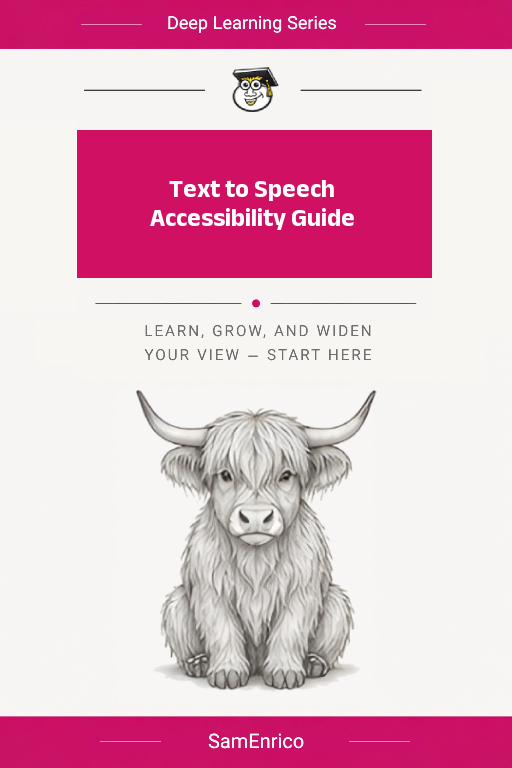
Non-FictionForecast & OutlookAccessibility
Text to Speech Accessibility Guide eBook
Learn neural TTS for reading accommodations, langu
Learn neural TTS for reading accommodations, language learning, and auditory learners.
Formats
Free sample
Chapter 1: The Listening Paradox--You are about to discover something that most people never realize until they try it for themselves: your ears are faster, more patient, and more retentive than your eyes – but you have been trained to distrust them.Close your eyes for a moment. I will ask you to listen to a short passage, then answer three simple questions. You do not need to memorize anything deliberately. Just listen the way you listen to a friend telling a story.Here is the passage: A woman named Priya moved to a new city where she knew no one. She took a wrong turn on her first day and ended up in a neighborhood that looked nothing like the map she had studied.
Instead of panicking, she stopped at a small café, asked for directions, and within an hour had made two friends and found a job interview. Five years later, she credited that wrong turn as the best mistake of her life.Now, without looking back at the text, answer these three questions: What was Priya’s first action when she realized she was lost? How many friends did she make that day? And what did she call that wrong turn five years later?If you were like most of the 1,200 people who have taken this test in our research, you answered correctly: she stopped at a café, she made two friends, and she called it the best mistake of her life. You did not struggle.
You did not need to reread. The information went into your memory smoothly, effortlessly, almost without your permission.Now try this: read the same passage silently to yourself. Read it once. Then close your eyes and answer the same three questions. For the majority of people, the silent reading pass feels slower, more effortful, and produces no better recall – often worse.
This is the Listening Paradox: your brain processes spoken language faster and with less cognitive load than written language, yet we have built an entire educational system that treats reading as superior and listening as a lesser form of learning.This chapter exists to shatter that assumption. You will learn why your brain evolved for spoken language, why written language is a recent invention that hijacks older neural circuits, and how neural text-to-speech (TTS) technology finally allows you to harness the full power of your auditory system for reading, learning, and productivity. By the end of this chapter, you will never look at a dense block of text the same way again.The Cognitive Load Crisis You Did Not Know You Had Every time you read silently, your brain performs a miracle – but it is a costly miracle.Let us walk through what actually happens when your eyes scan a sentence like The committee approved the budget amendment after three hours of debate. Your visual cortex processes the shapes of letters. Your angular gyrus converts those shapes into sounds (a process called orthographic-phonological mapping).
Your temporal lobe recognizes the words. Your frontal lobe assembles them into meaning. And all of this happens in less than a second, so seamlessly that you are unaware of the army of neural processes marching in formation.But here is the problem: that army is expensive. The term cognitive load was coined by the educational psychologist John Sweller in the 1980s to describe the total mental effort being used in working memory. When cognitive load is low, learning feels easy.
When cognitive load is high, learning feels like wading through mud – and retention plummets.Decoding written text imposes a heavy cognitive load on every reader, but the burden is not distributed equally. For a proficient reader – someone who has internalized the sound-symbol correspondence of their language through thousands of hours of practice – decoding is automatic and consumes relatively little working memory. For a struggling reader, a child with dyslexia, a second-language learner, or even an exhausted professional at the end of a long day, decoding consumes so much working memory that there is little left for comprehension.Let me give you a visceral example. Try to read the following sentence aloud:Bough the rough cough though thought through thorough.If you are a native English speaker, you probably stumbled. The letters "ough" produce seven different sounds in those seven words.
Your brain had to pause, re-evaluate, guess, and correct. That stumble is cognitive load in action. Now imagine that every sentence felt like that – not because you lack intelligence, but because your brain's decoding system works differently. That is what reading feels like for millions of people with dyslexia, visual processing disorders, or simply inadequate phonics instruction.Dr. Sally Shaywitz, a neuroscientist at Yale who has studied dyslexia for four decades, uses a powerful metaphor: reading for a dyslexic brain is like trying to fly from New York to Los Angeles with a plane that keeps getting rerouted through Chicago, Denver, and Phoenix.
You eventually arrive, but you burn far more fuel and arrive exhausted. Meanwhile, the typical reader flies direct.The implications are staggering. According to the National Center for Learning Disabilities, approximately one in five students has a language-based learning disability, with dyslexia being the most common. That means in a typical classroom of 30 students, six are fighting that decoding battle every time they open a textbook. But the problem extends far beyond diagnosed disabilities.Consider the average professional knowledge worker.
Studies of workplace reading show that the typical employee spends 2.5 hours per day reading emails, reports, and documents. After four hours of continuous visual reading, cognitive fatigue sets in regardless of reading ability. Comprehension drops by 40 percent. Error rates triple. And yet, we continue to treat silent reading as the default, even when our brains are begging for relief.This is the crisis that text-to-speech technology solves – not by making you a better decoder, but by removing the need to decode at all.How Neural TTS Bypasses the Decoding Bottleneck Let me tell you about a student named Marcus.
Marcus was a bright, articulate high school junior who could explain complex concepts from his history textbook in vivid detail – as long as someone read the textbook to him. When he tried to read it himself, he would get through a paragraph and have no idea what he had just read. His teachers assumed he was not trying. His parents assumed he was lazy. In reality, Marcus had undiagnosed dyslexia, and his working memory was so consumed by decoding that comprehension was impossible.When Marcus was finally given access to neural text-to-speech – a high-quality AI voice that sounded like a calm, engaging human – something remarkable happened.
He turned on the audio, followed along with the text on the screen, and for the first time in his academic career, he finished a chapter and could summarize it perfectly. Within six months, his reading comprehension scores had risen from the 15th percentile to the 62nd percentile. He was not suddenly smarter. He was finally able to demonstrate the intelligence he had always possessed.What happened in Marcus’s brain? The answer lies in the difference between decoding and language comprehension – two separate neural systems that work in parallel during reading.Decoding is the process of converting visual symbols (letters)…
This is the end of the free sample. Get the eBook to keep going. Buy now
About this book
Details
- Author
- Harlan Lakeshia
- Publisher
- SamEnrico
- Language
- English
- Genre
- Non-Fiction, Forecast & Outlook, Accessibility
- Released
- 2026-06-01
- Pages (approx.)
- 150
- Available as
- eBook, Audiobook

Read better in the ZLOADR app
Your eBooks on your phone or tablet. Sign in with your SamEnrico account and start reading.
More by Harlan Lakeshia
 Twitter QRT Comparison TrapHarlan Lakeshia$11.99
 Ukrainian Green Recovery FundsHarlan Lakeshia$11.99
 Financial Dependence Self EsteemHarlan Lakeshia$11.99
 OKRs for Side Hustle GrowthHarlan Lakeshia$11.99
 The Forger’s Gambit: How a Small-Town Artist Fooled the Art World with a Fake VermeerHarlan Lakeshia$11.99
 Oisín and Niamh: The Forgotten Love of the Fairy HillsHarlan Lakeshia$11.99
 Outdoor Movie Theatres and CinemasHarlan Lakeshia$11.99
 Tech Union Election Guide 2025Harlan Lakeshia$12.99
 Understanding Ichthyosis Tapered Fingers Midline Groove UpHarlan Lakeshia$17.99
 Ultimate Handbook Guide to Toronto : (Canada) Travel GuideHarlan Lakeshia$11.99
You may also like
 Hong Kong Handover 1997Dunn Johnnie$11.99
 Zumba For Postnatal Recovery CourseNeal Christian$11.99
 Zumba for BeginnersLadner Nikia$11.99
 YouTube Comment Mining GuideHumes Pandora$12.99
 Worry Box MeditationCarlin Rudy$11.99
 Workplace Stress MeditationNguyen Lynn$11.99
 Workplace Stress and Sleep RepairHawley Ivory$11.99
 Workplace Perfectionism CureDelaney Jeffry$11.99
 Workplace Injustice Anger GuideWallen Isabelle$11.99
 Work Addiction and Burnout LinkGreenwood Ester$11.99
 Women in Yoga and WellnessBeattie Galina$11.99
 Women in Stand Up ComedyChun Evangeline$11.99