
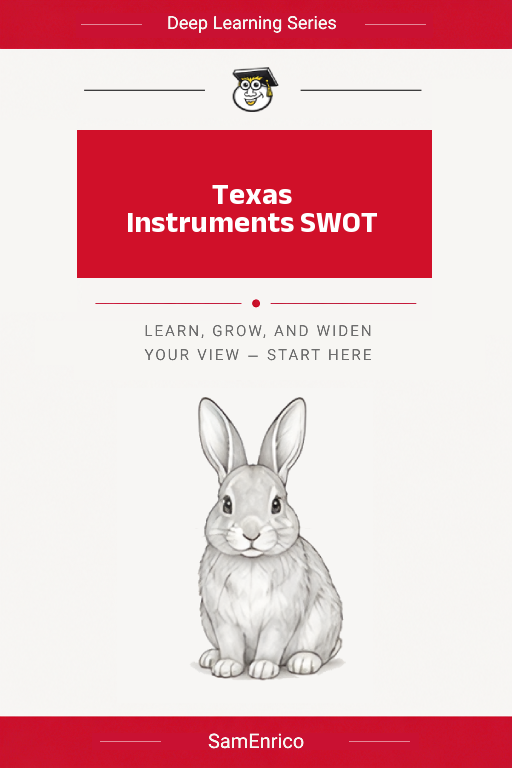
Non-FictionStrategic AtlasSemiconductor
Texas Instruments SWOT Audiobook
Analyze analog chip focus, industrial/auto exposur
Analyze analog chip focus, industrial/auto exposure, fab ownership advantage, and cyclical demand risks.
Formats
Free sample
Chapter 1: The Long-Lifecycle Fortress--–- In the spring of 2023, while the world’s attention fixated on Nvidia’s sudden ascent to a trillion-dollar valuation powered by artificial intelligence, a far quieter but equally significant event occurred in the semiconductor industry. Texas Instruments, a company whose founding predated the invention of the integrated circuit itself, released a routine quarterly presentation. Buried on page twelve was a chart showing that TI’s average product lifecycle exceeded fifteen years—longer than most technology companies have existed. In an industry where planned obsolescence is a business model, Texas Instruments had quietly built an empire on the radical proposition of making chips that simply refuse to die.This chapter establishes the foundational strength of the Texas Instruments SWOT analysis: the long-lifecycle model. Understanding this model is not merely an academic exercise; it is the key to decoding why institutional investors treat TI less like a high-tech growth stock and more like an industrial conglomerate with exceptional margins.
The long-lifecycle model explains TI’s deliberate avoidance of consumer electronics, its staggering portfolio of over 80,000 products, and its ability to generate predictable revenue streams while competitors lurch from one smartphone cycle to the next. However, as with all strengths in this book, the long-lifecycle model carries a conditional shadow. The very durability that provides stability during mild recessions becomes a liability during capex-driven downturns, when customers delay new design-ins for years rather than months. This chapter will build the framework for that nuance without contradicting later risk chapters, instead laying the groundwork for the conditional analysis that follows.The Boring Revolution: Why Durability Beats Speed The semiconductor industry has been hypnotized for five decades by Moore’s Law—the observation that the number of transistors on a chip doubles approximately every two years, driving relentless obsolescence. For digital logic chips (CPUs, GPUs, application processors), this law is both destiny and business model.
A smartphone processor designed in 2023 is functionally obsolete by 2025. A laptop chip from 2021 struggles to run today’s operating systems. Planned obsolescence is not a bug; it is the feature that drives upgrade cycles.Texas Instruments rejected this religion decades ago. While digital chips pursue shrinking transistors and ever-higher clock speeds, analog chips pursue a different goal: accurately measuring a temperature, converting a sound wave to an electrical signal, or managing the power flowing into a motor. These functions do not benefit from shrinks.
A voltage regulator that worked in a 2005 factory robot still works perfectly in a 2025 factory robot. A signal…
This is the end of the free sample. Get the Audiobook to keep going. Buy now
About this book
Details
- Author
- Chilton Therese
- Publisher
- SamEnrico
- Language
- English
- Genre
- Non-Fiction, Strategic Atlas, Semiconductor
- Released
- 2026-06-01
- Pages (approx.)
- 137
- Available as
- eBook, Audiobook

Listen in the VoxFlicks app
Audiobooks and audio dramas wherever you go. Sign in with your SamEnrico account and press play.
More by Chilton Therese
 Senior Boundary Esteem GuideChilton Therese$11.99
 Gratitude Nature WalkChilton Therese$11.99
 Medicaid Childhood MemoirChilton Therese$11.99
 The Self Esteem and Premarital CounselingChilton Therese$11.99
 Therapist EQ Self Care GuideChilton Therese$11.99
 The Eagle and the Lion: Napoleon vs. Toussaint Louverture in Saint-DomingueChilton Therese$11.99
 Understanding Myelofibrosis, IdiopathicChilton Therese$17.99
 Administrative CoordinatorChilton Therese$11.99
 Cost Accounting Formulas UnlockedChilton Therese$12.99
 How to Start a Music Copyist and Transcriber (own Account) Business (Beginners Guide)Chilton Therese$11.99
You may also like
 Hong Kong Handover 1997Dunn Johnnie$11.99
 Zumba For Postnatal Recovery CourseNeal Christian$11.99
 Zumba for BeginnersLadner Nikia$11.99
 YouTube Comment Mining GuideHumes Pandora$12.99
 Worry Box MeditationCarlin Rudy$11.99
 Workplace Stress MeditationNguyen Lynn$11.99
 Workplace Stress and Sleep RepairHawley Ivory$11.99
 Workplace Perfectionism CureDelaney Jeffry$11.99
 Workplace Injustice Anger GuideWallen Isabelle$11.99
 Work Addiction and Burnout LinkGreenwood Ester$11.99
 Women in Yoga and WellnessBeattie Galina$11.99
 Women in Stand Up ComedyChun Evangeline$11.99