
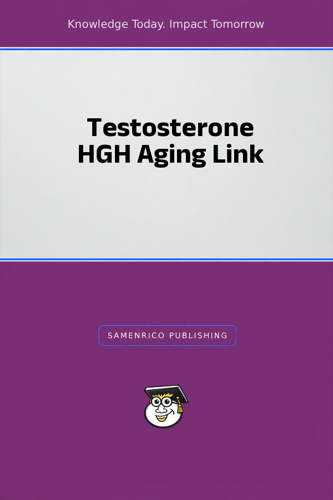
Non-FictionHealth & WellnessHormone Balance
Testosterone HGH Aging Link eBook
Discover how growth hormone interacts with testost
by Quick Taina
Discover how growth hormone interacts with testosterone and other anabolic hormones during aging.
Formats
Free sample
Chapter 1: The Silent Betrayal--It begins so subtly that you almost miss it. One morning, you realize the spring in your step has softened. The weights in the gym feel heavier than they should. That spare tire around your midsection seems more stubborn than ever, resisting every diet and workout you throw at it. You tell yourself it's just stress, just a busy season at work, just the natural price of getting older.
But deep down, you know something has shifted. Your body has stopped cooperating, and you cannot quite explain why.This is not laziness. This is not a lack of willpower. This is the silent betrayal of your own endocrine system—a betrayal that begins, on average, at age thirty for growth hormone and age forty for testosterone. By the time you notice the symptoms, the decline has been underway for years.
And if you are like most men, your doctor has told you that your lab results are "normal" and sent you home with no answers, no plan, and no hope beyond accepting aging as an inevitable march toward frailty, fatigue, and forgetfulness.But here is the truth they are not telling you: "normal" is not the same as optimal. The reference ranges used by most laboratories were established by testing unhealthy, sedentary, aging populations. Being "normal" in that context simply means you are aging at the same rate as everyone else—which is to say, poorly. This book exists to offer you an alternative path. Not a magical fountain of youth, not dangerous black-market hormones, but a science-based, practical roadmap to restore the conversation between two of the most powerful anabolic hormones in the human body: testosterone and human growth hormone.Before we can fix the problem, we must understand how it starts.
And to understand that, we need to travel up from your muscles, through your bloodstream, into your brain—to the tiny command centers that orchestrate the hormonal symphony of your life.The Orchestra Without a Conductor Imagine your body as a symphony orchestra. Testosterone and growth hormone are not the only players, but they are the lead violin and the first-chair cello. When they play together, in rhythm, the music is powerful—muscle grows, fat burns, skin repairs, and the mind stays sharp. But when the conductor (your brain) becomes erratic, when the musicians cannot hear each other, the music falls apart. That is what happens to your hormones as you age.The brain's ability to generate pulsatile release—the rhythmic bursts of hormone signals—deteriorates slowly but relentlessly.
In a healthy twenty-five-year-old man, the hypothalamus releases pulses of gonadotropin-releasing hormone (Gn RH) every sixty to ninety minutes. Each pulse travels to the pituitary gland, which responds by releasing luteinizing hormone (LH) and follicle-stimulating hormone (FSH). Those hormones then travel to the testes, instructing them to produce testosterone in matching pulses. The result is a steady, rhythmic pattern that keeps testosterone levels high and responsive.Simultaneously, the same hypothalamus releases growth hormone-releasing hormone (GHRH) in pulses, primarily during deep sleep. The pituitary responds with bursts of growth hormone, which then stimulate the liver to produce insulin-like growth factor-1 (IGF-1)—the workhorse that actually drives tissue repair and fat metabolism.By age forty, the amplitude of those pulses diminishes.
By age fifty, the synchrony between them begins to fracture. By age sixty, many men have lost the coordinated rhythm entirely, leaving behind a flat, erratic, weakened signal. The orchestra still has musicians, but the conductor has lost the score.This is why simply injecting testosterone or growth hormone often disappoints. You can pour more musicians into the orchestra, but if the conductor is still waving his baton randomly, the music will not improve. The goal of this book is not just to raise your hormone levels—it is to restore the rhythm.Two Declines, One Story Most books and clinics treat testosterone and growth hormone as separate problems.
You go to a men's health clinic for testosterone replacement therapy (TRT). You go to a longevity clinic for growth hormone injections. Rarely do the two conversations meet. This is a catastrophic error, because these two hormones are biologically designed to work together.Testosterone is the architect. It tells your body to build: more muscle protein, stronger bones, higher red blood cell count, sharper cognitive function.
It drives ambition, confidence, and competitive drive. Without testosterone, the blueprints for a strong, vital body simply do not exist.Growth hormone is the construction crew. It mobilizes fat from storage to provide the energy needed for building. It directs repair resources to damaged tissues. It tells the liver to produce IGF-1, which carries out the actual work of cell division and regeneration.
Without growth hormone, the architect draws plans on paper that never become buildings.When both are present and coordinated, you experience the anabolic state: muscle grows, fat shrinks, recovery accelerates, and vitality soars. When one declines without the other, the system limps along. When both decline, you enter the catabolic state: muscle wastes, fat accumulates, energy plummets, and aging accelerates.The medical literature is clear on this point. A 2006 study by Brill and colleagues published in the Journal of Clinical Endocrinology & Metabolism found that men who received combined testosterone and growth hormone therapy gained significantly more lean mass and lost more fat than men who received either hormone alone. A 2005 trial by Giannoulis and colleagues reached similar conclusions: the combination improved aerobic capacity and muscle strength in ways that monotherapy could not match.Yet most men never hear this message.
They are offered testosterone by one doctor, told growth hormone is too dangerous by another, and left to navigate the conflicting information alone. This book is the map you have been missing.The Three Lies You Have Been Told Before we go further, we must clear away the myths that prevent most men from ever solving this problem. These lies are repeated daily in doctors' offices, fitness forums, and even academic journals. Each one contains a grain of truth wrapped in a blanket of distortion.Lie #1: "Your levels are normal for your age."This is the most damaging lie in all of men's health. The reference range for testosterone, for example, typically runs from 300 to 1,000 nanograms per deciliter.
A sixty-year-old man with a level of 320 is considered "normal." But consider what that means: he has less than one-third the testosterone of a healthy twenty-five-year-old. His muscles are shrinking, his bones are thinning, his brain is fogging, and his doctor tells him nothing is wrong.The reference ranges are statistical, not functional. They tell you what is, not what could be. A man with a testosterone level of 350 may be "normal" compared to other sixty-year-olds, but he is far from optimal. The goal of this book is not to make you normal.
The goal is to restore you to the best version of yourself.Lie #2: "Testosterone causes prostate cancer."This myth has haunted testosterone therapy for decades, despite being debunked by multiple large-scale studies. The original concern came from a flawed 1941 study that suggested prostate cancer grew faster when testosterone was administered. Modern research—including a 2016 meta-analysis of over 50,000 men—has shown no increased risk of prostate cancer in…
This is the end of the free sample. Get the eBook to keep going. Buy now
About this book
Details
- Author
- Quick Taina
- Publisher
- SamEnrico
- Language
- English
- Genre
- Non-Fiction, Health & Wellness, Hormone Balance
- Released
- 2026-06-10
- Pages (approx.)
- 153
- Available as
- eBook, Audiobook

Read better in the ZLOADR app
Your eBooks on your phone or tablet. Sign in with your SamEnrico account and start reading.
More by Quick Taina
 Group Empathy MappingQuick Taina$11.99
 Impossible Workload PrioritizationQuick Taina$11.99
 Chemistry Loci MethodQuick Taina$11.99
 Diamond Vault Alarm BypassQuick Taina$11.99
 PMS Breast Tenderness GuideQuick Taina$11.99
 Retirement Assets QTIP TrustQuick Taina$11.99
 Cold Turkey Nicotine ManualQuick Taina$11.99
 Church Pew RLS StrategyQuick Taina$11.99
 The Lion and the Rose: Elizabeth I and the Golden Age of EnglandQuick Taina$11.99
 Shadows of the Forgotten: The Black Spartans of Ancient RomeQuick Taina$11.99
 The Billionaire's Last Gift: How Warren Buffett's Pledge Transformed PhilanthropyQuick Taina$11.99
 The Dancer's Guide to KizombaQuick Taina$11.99
You may also like
 Hong Kong Handover 1997Dunn Johnnie$11.99
 Zumba For Postnatal Recovery CourseNeal Christian$11.99
 Zumba for BeginnersLadner Nikia$11.99
 YouTube Comment Mining GuideHumes Pandora$12.99
 Worry Box MeditationCarlin Rudy$11.99
 Workplace Stress MeditationNguyen Lynn$11.99
 Workplace Stress and Sleep RepairHawley Ivory$11.99
 Workplace Perfectionism CureDelaney Jeffry$11.99
 Workplace Injustice Anger GuideWallen Isabelle$11.99
 Work Addiction and Burnout LinkGreenwood Ester$11.99
 Women in Yoga and WellnessBeattie Galina$11.99
 Women in Stand Up ComedyChun Evangeline$11.99