
Non-FictionFirst 30 DaysRemote Hiring
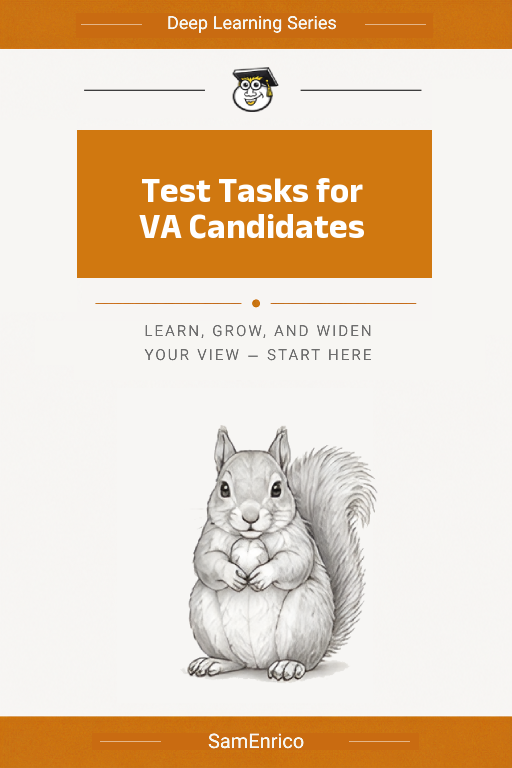
Test Tasks for VA Candidates eBook
Design paid test tasks to evaluate VA skills befor
Design paid test tasks to evaluate VA skills before hiring. Practical assessments for real work samples.
Formats
Free sample
Chapter 1: Systems Over Soulmates--The most expensive hire I ever made walked into the interview wearing a blazer, smiled at the right moments, and told me exactly what I wanted to hear. She said she was "obsessed with details." She called herself a "process person." She laughed at my jokes and asked smart questions about the company's future. I hired her within forty-eight hours. Three weeks later, she had accidentally emailed two thousand clients the wrong attachment, double-booked me for two board meetings on the same afternoon, and lost an entire month of expense receipts somewhere in the labyrinth of her Google Drive. The total cost to fix her mistakes exceeded forty thousand dollars.
The worst part? She had failed a fifteen-minute paid test task that I had sitting in my drafts folder. I never sent it. I trusted the interview instead.This is not a story about a bad virtual assistant. This is a story about a broken hiring system.Every day, thousands of business owners, agency founders, and team leads repeat my mistake.
They post a job description, receive a flood of applications, scan resumes for keywords, conduct hour-long Zoom interviews, check references, and make an offer. Then, six to eight weeks later, they find themselves wondering why their new VA cannot seem to prioritize a simple inbox, follow basic written instructions, or handle an upset client without making things worse. The answer is painful but simple: interviews measure presentation skills, not execution skills. Resumes measure the ability to write a resume, not the ability to do the job. And references measure the candidate's skill at collecting phone numbers of people who like them.This chapter dismantles the false god of "culture fit" and replaces it with something that actually works: work sample testing.
You will learn why unstructured interviews are barely better than random chance, why the "good person" fallacy costs companies millions every year, and how shifting from passive screening to active testing will transform your hiring outcomes. By the end of this chapter, you will never conduct another traditional VA interview without demanding proof of competence first.The Predictive Validity Disaster Let us start with a number that should shock you: 0.20.That is the predictive validity of the unstructured job interview on a scale where 1.0 means perfect prediction and 0.0 means no prediction at all. In plain English, the traditional interview predicts future job performance only slightly better than flipping a coin. A coin would give you 0.50 accuracy if you guessed heads for everyone. The interview, with all its charm, rapport-building, and careful questioning, clocks in at 0.20.This is not my opinion.
This is the consensus of decades of industrial-organizational psychology research. Schmidt and Hunter's 1998 meta-analysis of eighty-five years of selection methods remains the gold standard. They found that unstructured interviews, the kind most small business owners conduct over Zoom, are among the least predictive methods available. They are outperformed by structured interviews, which reach 0.51. They are crushed by work sample tests, which hit 0.54.
And they are embarrassed by the combination of work samples and cognitive ability tests, which exceed 0.60.Why are unstructured interviews so useless? The reasons are numerous and damning.First, candidates prepare. A motivated applicant will spend hours rehearsing answers to common questions like "Tell me about a time you handled a difficult client" or "What is your greatest weakness?" They will craft stories, memorize frameworks, and practice delivery. What you hear in the interview is not an authentic representation of their skills. It is a performance.Second, interviewers fall prey to likeability bias.
Research consistently shows that we hire people we like, regardless of their competence. A candidate who shares your alma mater, laughs at your jokes, or simply reminds you of yourself will receive higher ratings than an objectively more qualified candidate who does not trigger those feelings. This bias operates unconsciously. You do not know you are doing it, which makes it even more dangerous.Third, no two interviews are conducted the same way. You might ask one candidate about their experience with email management and another about their approach to calendar scheduling.
You might be tired during the third interview and rushed during the fourth. You might be in a good mood when you meet one candidate and frustrated about an unrelated issue when you meet another. These variations introduce noise into the process, making fair comparison impossible.Fourth, interviews measure verbal fluency and charisma, not job-relevant skills. A candidate who speaks confidently and tells compelling stories will score well, even if they cannot organize a simple spreadsheet. A candidate who is quiet, thoughtful, and slightly awkward in conversation might be an absolute wizard at process improvement, but you will never know because you will reject them after thirty minutes of awkward silence.The virtual assistant role magnifies every single one of these problems.
VAs work remotely. You will rarely, if ever, meet them in person. Their primary interaction with you and your clients will be written. Their value comes from execution, not presentation. Hiring a VA based on an interview is like hiring a chef based on their ability to describe a meal rather than cook one.
You would never do that. Yet we do the equivalent with administrative hires every single day.The Good Person Fallacy I have a confession to make. For years, I believed that hiring was about finding good people. Nice people. People I would want to have a beer with.
People who shared my values and laughed at my jokes and seemed like they would fit into the "culture" I was trying to build.This is the Good Person Fallacy, and it is a trap.You do not need your virtual assistant to be your best friend. You do not need them to share your taste in music, your political views, or your sense of humor. You do not even need them to like you. What you need is for them to accurately enter data, respond to emails within the agreed timeframe, follow written instructions without creative interpretation, and handle routine tasks without constant supervision. These are skills, not personality traits.The Good Person Fallacy leads to predictable disasters.
A founder named Sarah, who runs a boutique marketing agency, told me her story at a conference. She had hired a VA named Marcus who was, by every measure, a wonderful human being. He volunteered at an animal shelter. He sent handwritten thank-you notes. He remembered her birthday.
He was also, by every measure, a terrible VA. He missed deadlines repeatedly. He lost client login credentials three times. He once scheduled a client call for 3:00 AM because he forgot about time zones. Sarah kept him for eight months because she "really liked him as a person." She finally fired him after losing a fifty-thousand-dollar client due to his errors.The counterexample is a VA named Priya.
Priya is not particularly charming. She does not make small talk. Her video is often off during calls because she says it "distracts from the work." She does not ask about your weekend. What Priya does is flawless. She has managed my inbox for three years.
She has never missed a deadline. She once identified a billing error that saved me twelve thousand dollars. I do…
This is the end of the free sample. Get the eBook to keep going. Buy now
About this book
Details
- Author
- Courtney Dillon
- Publisher
- SamEnrico
- Language
- English
- Genre
- Non-Fiction, First 30 Days, Remote Hiring
- Released
- 2026-05-29
- Pages (approx.)
- 152
- Available as
- eBook, Audiobook

Read better in the ZLOADR app
Your eBooks on your phone or tablet. Sign in with your SamEnrico account and start reading.
More by Courtney Dillon
 Mantra Repetition for SafetyCourtney Dillon$11.99
 The Assertiveness for Construction Workers GuideCourtney Dillon$11.99
 Creative Starvation ProtocolCourtney Dillon$11.99
 The Postpartum Anemia GuideCourtney Dillon$11.99
 Politics Office Anger GuideCourtney Dillon$11.99
 The Last Healer of the Silk RoadCourtney Dillon$11.99
 Understanding Phosphoglucomutase Deficiency Type 3Courtney Dillon$17.99
 Online Travel Agency MapCourtney Dillon$12.99
 How to Start a Hobby in TurtlesCourtney Dillon$11.99
 Administrative SecretaryCourtney Dillon$11.99
You may also like
 Hong Kong Handover 1997Dunn Johnnie$11.99
 Zumba For Postnatal Recovery CourseNeal Christian$11.99
 Zumba for BeginnersLadner Nikia$11.99
 YouTube Comment Mining GuideHumes Pandora$12.99
 Worry Box MeditationCarlin Rudy$11.99
 Workplace Stress MeditationNguyen Lynn$11.99
 Workplace Stress and Sleep RepairHawley Ivory$11.99
 Workplace Perfectionism CureDelaney Jeffry$11.99
 Workplace Injustice Anger GuideWallen Isabelle$11.99
 Work Addiction and Burnout LinkGreenwood Ester$11.99
 Women in Yoga and WellnessBeattie Galina$11.99
 Women in Stand Up ComedyChun Evangeline$11.99