
Non-FictionSelf-HelpPhysical Anxiety
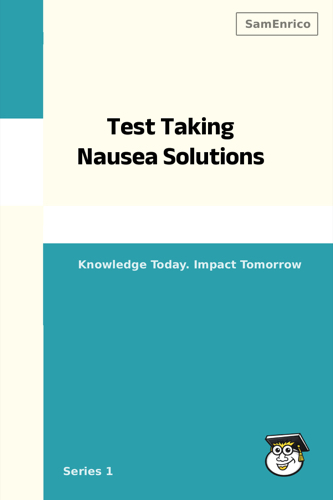
Test Taking Nausea Solutions eBook
Addresses physical symptoms of anxiety including s
by Higdon Val
Addresses physical symptoms of anxiety including sweating, shaking, and stomach issues.
Formats
Free sample
Chapter 1: The Hidden Truth...--There is a secret that millions of test-takers never say out loud. It is not about failing to study, not about freezing on a difficult question, and not about running out of time. The secret is this: long before the exam begins, their bodies have already betrayed them. They wake up on test morning with a stomach that feels like it is tied in knots. They stand in the bathroom, gripping the sink, wondering if they are going to be sick.
They feel the first trickle of cold sweat on their palms while waiting in line outside the testing center. By the time they sit down to fill in their name, their hands are shaking so badly that they can barely hold the pencil. And the cruelest part of all? They know the material. They studied for weeks.
They could answer every question if someone asked them in a quiet room. But their body will not cooperate.This is not a character flaw. This is not weakness. This is not something you should be ashamed of. This is your nervous system doing exactly what it evolved to do, and the only problem is that it has mistaken a standardized test for a life-threatening predator.
The gap between what you know and how you perform is not a mystery. It is physiology. And once you understand the hidden truth about what is happening inside your body during those terrible moments before and during a test, you can stop fighting yourself and start working with the very system that seems to be working against you.The term for what you are experiencing is somatic anxiety, and it is strikingly different from the cognitive worry that most people associate with test stress. Cognitive worry sounds like this: What if I fail? What if I forgot everything?
What if this question is impossible? These are thoughts, and while they are unpleasant, they live in the realm of language and logic. Somatic anxiety, by contrast, lives entirely in the body. It is the churning stomach, the racing heart, the trembling hands, the cold sweats, the urgent need to leave the room. You are not thinking your way into these symptoms.
Your body is producing them directly, bypassing your conscious mind entirely. This is why telling someone with somatic anxiety to "just calm down" or "just breathe" is not only useless but actively harmful. It implies that they are failing at something simple, when in fact their body is running a completely different operating system than the one the advice-giver assumes.Recent large-scale studies have quantified what has long been whispered in student support offices. Approximately 35 percent of test-takers report significant gastrointestinal distress before or during exams. Nearly 30 percent experience noticeable hand tremors that interfere with writing or bubbling in answers.
And over 25 percent report sweating so profusely that they feel embarrassed or have difficulty handling test materials. These numbers rise dramatically for high-stakes exams like the MCAT, bar exam, CPA exam, and graduate school entrance tests, where the pressure is highest and the consequences of poor performance can reshape an entire career trajectory. You are not alone. You are not unusual. You are part of a vast and largely silent population of people whose bodies react to evaluation as if it were a physical threat.To understand why this happens, we need to take a brief journey into the evolution of the human nervous system.
Imagine, for a moment, that you are a prehistoric human walking across the savanna. You are looking for food, perhaps scanning the horizon for edible plants or small game. Suddenly, you see a large predator—a lion, a bear, something with teeth and speed and hunger. In that instant, your brain does not pause to consider philosophical questions about the meaning of fear. It triggers an ancient, automatic, life-saving response that psychologists and neuroscientists call the fight, flight, or freeze response.
Your sympathetic nervous system floods your body with hormones. Your heart rate doubles. Your breathing becomes rapid and shallow. Blood rushes away from your digestive system and toward your large muscle groups, preparing you to run or fight. Your palms sweat, which improves grip strength for holding a weapon or climbing a tree.
You begin to tremble, which is your muscles loading with tension and energy, ready to explode into action. Your stomach churns and may even empty itself, because digestion is not a priority when you are about to be eaten. Every single one of these responses is adaptive. Every single one increases your chance of survival.Now fast forward a hundred thousand years. You are sitting in a fluorescent-lit classroom, or a quiet cubicle in a testing center, or a conference room with a proctor at the front.
In front of you is a booklet full of questions. There is no predator. There is no immediate physical danger. But your brain, in a cruel quirk of evolutionary biology, has learned to treat social evaluation and performance pressure as if it were that lion on the savanna. The same sympathetic nervous system response activates.
Your stomach churns. Your hands shake. You sweat. And because you are sitting still—because you cannot run, cannot fight, cannot flee—the energy your body has mobilized has nowhere to go. It builds up inside you, amplifying every sensation until you feel like you might fly apart.
This is the hidden truth. Your test anxiety is not a malfunction. It is a misfire. It is an ancient survival system responding to a modern threat that it cannot distinguish from a predator.This misfire is mediated by a remarkable structure called the autonomic nervous system, which has two primary branches. The sympathetic nervous system is the accelerator.
It revs you up, mobilizes energy, and prepares you for action. The parasympathetic nervous system is the brake. It calms you down, supports digestion, and helps you rest and recover. In a healthy, well-regulated nervous system, these two branches work in balance, like the gas and brake pedals of a car. You accelerate when you need to, brake when you need to, and most of the time you cruise along smoothly.
But in people with test-taking somatic anxiety, the sympathetic nervous system hits the accelerator far too hard and far too early, and the parasympathetic brake is too slow to engage. You end up flooring the gas pedal while standing still, which is why you feel like your engine is going to explode.The primary chemical messengers in this process are two hormones: adrenaline (also called epinephrine) and cortisol. When your brain perceives a threat—including the social threat of being evaluated and potentially judged as inadequate—it signals your adrenal glands to release these hormones. Adrenaline acts almost instantly. It increases your heart rate, raises your blood pressure, and triggers the release of glucose for quick energy.
It also causes the physical symptoms you know so well: sweaty palms, trembling hands, a feeling of butterflies or churning in your stomach. Cortisol acts more slowly but persists longer. It keeps your body in a state of high alert, suppresses non-essential functions like digestion and immune response, and can leave you feeling jittery and…
This is the end of the free sample. Get the eBook to keep going. Buy now
About this book
Details
- Author
- Higdon Val
- Publisher
- SamEnrico
- Language
- English
- Genre
- Non-Fiction, Self-Help, Physical Anxiety
- Released
- 2026-06-10
- Pages (approx.)
- 152
- Available as
- eBook, Audiobook

Read better in the ZLOADR app
Your eBooks on your phone or tablet. Sign in with your SamEnrico account and start reading.
More by Higdon Val
 Self Esteem Restoration GuideHigdon Val$11.99
 Gaming Peer Support GroupsHigdon Val$11.99
 Morning Anxiety SurrenderHigdon Val$11.99
 Asylum Family Reunification JourneyHigdon Val$11.99
 Corporate Lawyer Stress ReductionHigdon Val$11.99
 The Prison Visit Gone WrongHigdon Val$11.99
 Bankruptcy And Your BondHigdon Val$11.99
 Sir Alexander Mackenzie: The Pathfinder of the NorthwestHigdon Val$11.99
 The Twitter Bitcoin ScamHigdon Val$11.99
 The Pedal Pioneers: How Victorian Cyclists Conquered the Tour de France's Forgotten BeginningsHigdon Val$11.99
 The Mineral Guide to Allingite (Synonym of Amber)Higdon Val$11.99
 Business Process ManagementHigdon Val$11.99
You may also like
 Hong Kong Handover 1997Dunn Johnnie$11.99
 Zumba For Postnatal Recovery CourseNeal Christian$11.99
 Zumba for BeginnersLadner Nikia$11.99
 YouTube Comment Mining GuideHumes Pandora$12.99
 Worry Box MeditationCarlin Rudy$11.99
 Workplace Stress MeditationNguyen Lynn$11.99
 Workplace Stress and Sleep RepairHawley Ivory$11.99
 Workplace Perfectionism CureDelaney Jeffry$11.99
 Workplace Injustice Anger GuideWallen Isabelle$11.99
 Work Addiction and Burnout LinkGreenwood Ester$11.99
 Women in Yoga and WellnessBeattie Galina$11.99
 Women in Stand Up ComedyChun Evangeline$11.99