
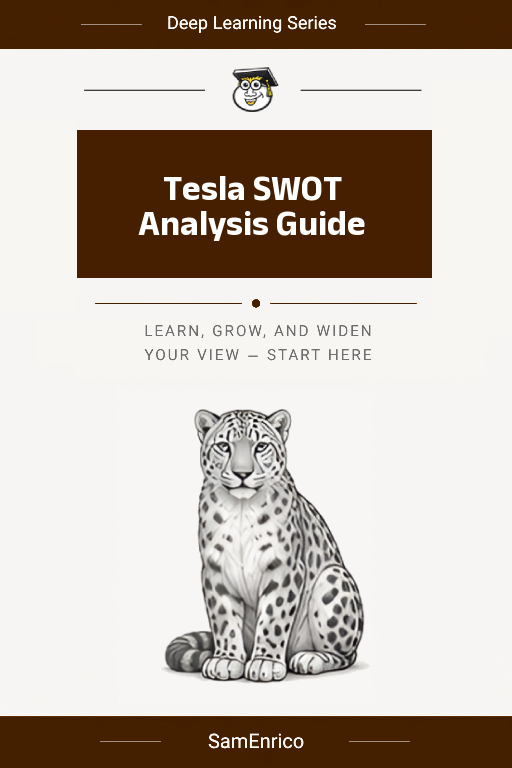
Non-FictionStrategic AtlasAuto Analysis
Tesla SWOT Analysis Guide eBook
Assess EV leadership, manufacturing scaling, compe
Assess EV leadership, manufacturing scaling, competition from legacy automakers, and autonomy timeline risks.
Formats
Free sample
Chapter 1: The Physics Gambler--–- In 2004, a thirty-three-year-old Pay Pal millionaire walked into a conference room in Los Angeles and told a room full of aerospace engineers that they were idiots. Not in so many words, but the implication was clear. He had just returned from a failed attempt to buy refurbished ICBMs from the Russians—a journey that involved a defector, a secret meeting in a Moscow apartment, and a vodka-soaked negotiating session that ended with a Russian general laughing at him. The engineers expected him to be humbled. Instead, Elon Musk pulled out a spreadsheet.
On it, he had broken down the cost of a rocket into raw materials: aluminum, copper, titanium, and a small amount of volatile fuel. The total came to roughly 2 percent of what established aerospace companies like Boeing and Lockheed Martin charged for a comparable vehicle. The engineers told him it couldn't be done. Musk asked why. They gave him a hundred reasons, each one rooted in decades of industry dogma.
He listened carefully, then asked the same question again: "What are the physical limits, not the historical ones?"That moment, more than any single engineering breakthrough, is the origin story of Tesla. The same question—what are the physical limits, not the historical ones?—would later redefine the automobile. Legacy automakers had accepted 10,000to10,000 to 10,000to15,000 battery packs as an inevitable cost of building an electric vehicle. They had spreadsheets to prove it. They had decades of supply chain relationships that reinforced it.
They had Ph Ds in materials science who had never thought to ask the question Musk asked in 2004: "What are batteries actually made of?" The answer was lithium, cobalt, nickel, and aluminum. He bought the raw materials. The cost dropped to roughly $5,000 per pack. That is not a product advantage. That is a thinking advantage.
And it is the single most important strength Tesla possesses—not its batteries, not its software, not even its charismatic and volatile CEO. The strength is the question itself.The Unasked Question This chapter is about that question. In the language of this book, it is called "first principles" reasoning—a term borrowed from physics that means breaking a problem down to its most basic, undeniable truths and rebuilding from scratch, ignoring all assumptions about how things have always been done. It is the opposite of "analogy" reasoning, which looks at what competitors are doing and tries to do it slightly better. Analogy reasoning is why the i Phone looks like every other smartphone.
First principles reasoning is why the i Phone had a touchscreen when everyone else had keyboards. Tesla's advantage over legacy automakers is not technology. It is epistemic. Tesla knows how to know things differently.But here is the crucial distinction that most Tesla analysis gets wrong, and that this chapter will establish as a framework for the rest of the book. First principles reasoning is not universally applicable.
It works brilliantly in domains governed by physics and code—battery chemistry, software architecture, aerodynamics, thermal management. It fails catastrophically in domains governed by human factors, manufacturing tolerances, and safety certification. Musk himself has learned this lesson multiple times, at great expense, and then forgotten it again. The "Alien Dreadnought"—his dream of a fully automated, dark factory run entirely by robots—was a first principles approach to manufacturing. It nearly bankrupted the company.
The Cybertruck's stainless steel exoskeleton—a beautiful first principles solution to the problem of painting cars—shipped with panel gaps wide enough to fit a finger and a surface that shows every fingerprint permanently. First principles gave Tesla the best battery chemistry in the industry. It also gave Tesla the worst launch of a mass-market vehicle in a decade.So this chapter does two things. First, it explains what first principles reasoning actually is, how Musk learned it, and why it creates durable competitive advantages in specific domains. Second, it establishes the boundary conditions—when first principles helps and when it hurts.
Investors and strategists who understand this distinction will know which Tesla initiatives to bet on (battery technology, software stack, thermal systems) and which to fear (any manufacturing process that cannot tolerate a few millimeters of variance). Let us begin with the origin story, because the origin story explains everything.The Pay Pal Mafia Education Most people know that Musk made his first fortune from Pay Pal. Fewer know that the Pay Pal experience taught him something he would later call "the algorithm"—a way of thinking that he first articulated in internal emails at Space X and Tesla and that was later codified in the book The Algorithm by former Tesla executive Jon Mc Neill. The algorithm has five rules, and every one of them is a first principles tool:Question every requirement. Not the ones that seem questionable.
Every single one.Delete any part or process that is not essential. If you are not forced to add it back later, you did not delete enough.Simplify. Before you optimize, before you accelerate, before you automate—simplify.Accelerate cycle time. Speed reveals problems that slowness hides.Automate last. Only after you have questioned, deleted, simplified, and accelerated should you even think about robots.What is striking about this algorithm is what it does not include.
There is no rule about quality. No rule about employee retention. No rule about brand consistency. The algorithm is optimized for two things: speed and cost reduction. It assumes that quality will emerge from iteration and that people will tolerate chaos.
In engineering problems, this assumption is often correct. In human systems, it is often catastrophic. This is the first boundary condition. First principles works on the rocket. It works on the battery cell.
It does not always work on the factory floor or in the boardroom.The Pay Pal experience taught Musk something else, too. In the early days of Pay Pal, the company was losing 10millionayeartocreditcardfraud.Theindustrysolutionwasexpensivefrauddetectionsoftwarethatcaughtabout70percentoffraudulenttransactions.Muskaskedafirstprinciplesquestion:"Whatisfraud,physically?"Theanswerwasasetofpatterns—transactionsfromcertain IPaddresses,certainpurchaseamounts,certainvelocityofactivity.Hebuiltasimplerulesenginethatcaught99percentoffraudwithzeromarginalcost.Theindustryhadacceptedthe10 million a year to credit card fraud. The industry solution was expensive fraud detection software that caught about 70 percent of fraudulent transactions. Musk asked a first principles question: "What is fraud, physically?" The answer was a set of patterns—transactions from certain IP addresses, certain purchase amounts, certain velocity of activity. He built a simple rules engine that caught 99 percent of fraud with zero marginal cost.
The industry had accepted the 10millionayeartocreditcardfraud.Theindustrysolutionwasexpensivefrauddetectionsoftwarethatcaughtabout70percentoffraudulenttransactions.Muskaskedafirstprinciplesquestion:"Whatisfraud,physically?"Theanswerwasasetofpatterns—transactionsfromcertain IPaddresses,certainpurchaseamounts,certainvelocityofactivity.Hebuiltasimplerulesenginethatcaught99percentoffraudwithzeromarginalcost.Theindustryhadacceptedthe10 million loss as inevitable. Musk did not. That is first principles thinking in its purest form: refuse to accept constraints that are merely historical, not physical.From Rockets to Cars: The Battery Breakthrough The transition from Space X to Tesla is a direct line. In 2004, when Musk became chairman of Tesla (then a tiny startup with a prototype and no production capability), the auto industry had a consensus: electric vehicles were impossible at scale because batteries cost too much. The numbers were not made up.
A typical lithium-ion battery pack in 2004 cost about 600perkilowatt−hour.AModel S−sizedpack(85k Wh)wouldcost600 per kilowatt-hour. A Model S-sized pack (85 k Wh) would cost 600perkilowatt−hour.AModel S−sizedpack(85k Wh)wouldcost51,000 just for the cells—before any…
This is the end of the free sample. Get the eBook to keep going. Buy now
About this book
Details
- Author
- Peterman Keri
- Publisher
- SamEnrico
- Language
- English
- Genre
- Non-Fiction, Strategic Atlas, Auto Analysis
- Released
- 2026-06-01
- Pages (approx.)
- 136
- Available as
- eBook, Audiobook

Read better in the ZLOADR app
Your eBooks on your phone or tablet. Sign in with your SamEnrico account and start reading.
More by Peterman Keri
 Teaching EQ to ChildrenPeterman Keri$11.99
 TM And Creativity Enhancement HandbookPeterman Keri$11.99
 Tea Ceremony PeacePeterman Keri$11.99
 Dating With Low Self Esteem GuidePeterman Keri$11.99
 Vaccine Regulatory Approval FDAPeterman Keri$11.99
 The Golden Quill: The Lost Epic of Sundiata's CourtPeterman Keri$11.99
 Traffic Crash ReconstructionPeterman Keri$11.99
 A Beginners Guide to Cowboy polo (Volume 1)Peterman Keri$11.99
 AI Financial Data Anomaly InvestigationPeterman Keri$12.99
 Understanding Multiple Vertebral Anomalies Unusual FaciesPeterman Keri$17.99
You may also like
 Hong Kong Handover 1997Dunn Johnnie$11.99
 Zumba For Postnatal Recovery CourseNeal Christian$11.99
 Zumba for BeginnersLadner Nikia$11.99
 YouTube Comment Mining GuideHumes Pandora$12.99
 Worry Box MeditationCarlin Rudy$11.99
 Workplace Stress MeditationNguyen Lynn$11.99
 Workplace Stress and Sleep RepairHawley Ivory$11.99
 Workplace Perfectionism CureDelaney Jeffry$11.99
 Workplace Injustice Anger GuideWallen Isabelle$11.99
 Work Addiction and Burnout LinkGreenwood Ester$11.99
 Women in Yoga and WellnessBeattie Galina$11.99
 Women in Stand Up ComedyChun Evangeline$11.99