
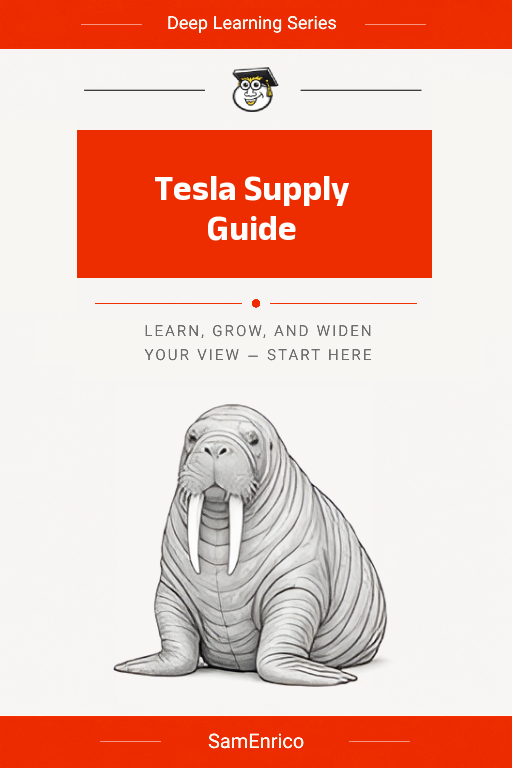
Non-FictionStrategic AtlasEV Supply Chains
Tesla Supply Guide eBook
Trace battery supply agreements, vertical integrat
Trace battery supply agreements, vertical integration, and gigafactory logistics that enabled EV production ramps.
Formats
Free sample
Chapter 1: The Verticalized Bet...--Tesla’s most important product is not a car. It is a question asked every morning in a dozen war rooms across three continents: What if we owned the entire chain? This chapter answers that question by tracing the origins of Tesla’s supply chain philosophy, dismantling the Just-in-Time dogma that ruled auto manufacturing for half a century, and introducing the three-part framework for vertical integration that underpins every subsequent chapter.The story begins not in a factory but in a lithium mine in Western Australia’s Pilbara region, on a sweltering December day in 2019. A Tesla supply chain executive named Jessica (a composite character based on real job postings and Linked In profiles of former Tesla employees) stood at the edge of an open pit, watching trucks haul raw ore the color of wet concrete. She was there because Tesla had just signed its first direct offtake agreement with a miner—bypassing three layers of chemical processors, traders, and logistics brokers that traditionally sat between a mine and an automaker.
The mining executive walking beside her was confused. “No automaker has ever come here,” he said. “They buy from traders. Why are you here?”Jessica’s answer would become Tesla’s supply chain manifesto: “Because I need to know exactly how much lithium is in this rock, how much water you use to extract it, and whether your night shift supervisor has ever caused a fire. My production line stops if any of those answers is wrong.”That conversation, more than any boardroom presentation, captures the essence of what this book calls the Verticalized Imperative.
Traditional automakers built empires on specialization. Ford made engines but bought seats. Toyota assembled cars but outsourced electronics. The assumption was that no single company could master every component, and that competition among suppliers would drive down costs. Tesla rejected this assumption not out of ideology but out of necessity.
When you are building a battery that contains hundreds of pounds of materials that can catch fire, degrade in humidity, and double in price during a trade war, you cannot afford to trust a trader you have never met.The Day Just-in-Time Died To understand why Tesla abandoned the playbook, you must first understand the playbook itself. Just-in-Time manufacturing, perfected by Toyota in the 1970s and 1980s, is a thing of beauty. Parts arrive at the assembly line exactly when needed—sometimes within a two-hour window. Inventory is a waste. Storage is a drag.
The ideal state is a part arriving from a supplier truck and moving directly to the vehicle without ever touching a warehouse shelf.For high-volume, low-complexity components like seats, tires, and glass, JIT works brilliantly. A seat foam supplier knows that the Fremont factory needs 1,200 driver-side seats every shift, and they deliver accordingly. If a truck is late, the line stops—but that almost never happens because seat foam is not volatile, not hazardous, and available from dozens of suppliers.Battery cells are none of those things.A lithium-ion battery cell is a chemical bomb wrapped in aluminum. It must be kept between 15 and 25 degrees Celsius during transport. It cannot be stacked more than five pallets high because of fire codes.
Its voltage degrades if left unused for more than 30 days. And in 2019, before Tesla’s verticalization push, a typical battery cell traveled from a Panasonic factory in Osaka to a port in Kobe, spent three weeks on a ship to Los Angeles, cleared customs (if no inspection), and then traveled by truck to Fremont. Total journey: 45 days, during which the cell lost approximately 2% of its capacity and required continuous temperature monitoring.But the real problem was not the journey time. It was the volatility. In 2020, when COVID-19 shut down ports, Tesla discovered that its JIT battery supply chain had exactly 72 hours of buffer.
When a single Panasonic factory in Nevada had a quality control issue in 2018, Tesla could not simply switch to another supplier because no other supplier made cells compatible with Tesla’s pack design. When cobalt prices spiked in 2019 due to instability in the Democratic Republic of Congo, Tesla had to renegotiate contracts mid-year because its fixed-price agreements with Panasonic did not cover raw material fluctuations.This is what the chapter calls the JIT Paradox: the system that works perfectly for stable commodities fails catastrophically for volatile ones. And battery cells are the most volatile component in automotive history.The moment of reckoning came in March 2020. Tesla’s Fremont factory was idled by government order, but the supply chain team kept working remotely. They mapped every single component back to its raw material—lithium, nickel, cobalt, graphite, manganese, copper, aluminum, silicon.
What they found was terrifying. For nickel, there were only three refineries in the world capable of producing the purity Tesla required, and all three were in China. For cobalt, 70% came from one country (the DRC) and was refined almost exclusively in China. For lithium, despite Australia and Chile having ample reserves, the refining capacity was concentrated in China’s Inner Mongolia region.Tesla was not dependent on suppliers. Tesla was dependent on geopolitics.
And that was unacceptable.The Three Layers of Vertical Integration When Tesla executives talk about “vertical integration,” they mean something different from what the term meant at Ford’s River Rouge plant in the 1920s, where iron ore entered one end and cars exited the other. Modern vertical integration is not all-or-nothing. It is a portfolio of three distinct mechanisms, and understanding these three layers is essential for every chapter that follows.Layer One: Ownership. Tesla owns the asset outright. This includes cathode refineries built next to Gigafactories, the 4680 cell production lines in Texas and Berlin, and the in-house battery management system chips designed by Tesla’s own semiconductor team.
Ownership provides maximum control and maximum margin capture, but it also requires maximum capital—a single cathode refinery costs upwards of $500 million and takes three to five years to permit and build.Layer Two: Control via Exclusivity. Tesla does not own the factory, but it owns the output. The Panasonic partnership at Giga Nevada is the archetype: Panasonic invested in equipment, Tesla provided the factory building and the cell design, and all cells produced go to Tesla. This arrangement gives Tesla the benefits of dedicated capacity without the full capital burden. However, it also creates dangerous single-point dependencies, as Tesla learned in 2018 when Panasonic’s yield problems became Tesla’s production problems.Layer Three: Strategic Dependency.
Tesla does not own the supplier, nor does it have exclusivity, but the supplier’s business depends on Tesla. This is the case with junior miners who signed offtake agreements with Tesla before they had fully operational mines. Without Tesla’s prepayment and guaranteed purchase volume, these miners could not secure financing from banks. Tesla effectively becomes the miner’s only customer for the first five to seven years of production. The dependency flows both ways: Tesla needs the material, but the miner needs Tesla more.Tesla’s target of 80% vertical integration by 2030 refers to the percentage of battery component value controlled through these three mechanisms.
Not volume, not part count, but value. A battery cell’s value is concentrated in three things: the cathode (about 35%…
This is the end of the free sample. Get the eBook to keep going. Buy now
About this book
Details
- Author
- Morrow Shanika
- Publisher
- SamEnrico
- Language
- English
- Genre
- Non-Fiction, Strategic Atlas, EV Supply Chains
- Released
- 2026-06-01
- Pages (approx.)
- 156
- Available as
- eBook, Audiobook

Read better in the ZLOADR app
Your eBooks on your phone or tablet. Sign in with your SamEnrico account and start reading.
More by Morrow Shanika
 Zimbabwean British Return To Harare MemoirMorrow Shanika$11.99
 Somalia Independence Five PointsMorrow Shanika$11.99
 Equifax Response FailuresMorrow Shanika$11.99
 Metta for End of LifeMorrow Shanika$11.99
 Self Doubt for Sales ProfessionalsMorrow Shanika$11.99
 The Inner Game: How a Tennis Maverick Redefined Mental ToughnessMorrow Shanika$11.99
 Understanding Morphea SclerodermaMorrow Shanika$17.99
 Medical Device DocumentationMorrow Shanika$12.99
 Internal WholesalerMorrow Shanika$11.99
 A Beginners Guide to Cutthroat (Volume 1)Morrow Shanika$11.99
You may also like
 Hong Kong Handover 1997Dunn Johnnie$11.99
 Zumba For Postnatal Recovery CourseNeal Christian$11.99
 Zumba for BeginnersLadner Nikia$11.99
 YouTube Comment Mining GuideHumes Pandora$12.99
 Worry Box MeditationCarlin Rudy$11.99
 Workplace Stress MeditationNguyen Lynn$11.99
 Workplace Stress and Sleep RepairHawley Ivory$11.99
 Workplace Perfectionism CureDelaney Jeffry$11.99
 Workplace Injustice Anger GuideWallen Isabelle$11.99
 Work Addiction and Burnout LinkGreenwood Ester$11.99
 Women in Yoga and WellnessBeattie Galina$11.99
 Women in Stand Up ComedyChun Evangeline$11.99