
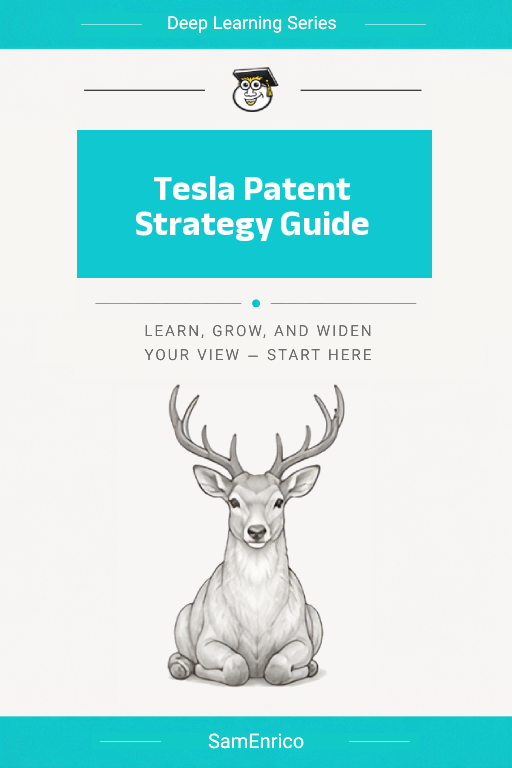
Non-FictionStrategic AtlasAuto Patents
Tesla Patent Strategy Guide eBook
Explore EV leader's open-source philosophy, batter
Explore EV leader's open-source philosophy, battery tech (4680, dry electrode), autonomous driving, and manufacturing innovations.
Formats
Free sample
Chapter 1: The Suicide Pact...-- On the morning of June 12, 2014, Elon Musk sat in the third-floor conference room of Tesla's Palo Alto headquarters, surrounded by patent attorneys who looked like they had just watched their own houses catch fire. The coffee on the table had gone cold two hours ago. The whiteboard behind Musk was covered in numbers – valuation estimates, litigation risk calculations, and a single circled phrase that read: "$2.4 BILLION AT RISK." That was the estimated value of Tesla's patent portfolio, according to an internal audit completed three weeks earlier. Musk was about to announce that he was giving every single one of those patents away for free. His legal team had one hour to talk him out of it.They failed.At 5:00 PM Pacific Time, Musk published a 1,200-word blog post on Tesla's official website.
The title was a deliberate misspelling of a famous internet meme from the early 2000s: "All Our Patent Are Belong To You." The announcement was brief, shocking, and seemingly insane. "Tesla will not initiate patent lawsuits against anyone who, in good faith, wants to use our technology," Musk wrote. "We believe that applying the open source philosophy to our patents will strengthen rather than diminish Tesla's position."The automotive world reacted with a mixture of confusion and mockery. "Musk is giving away the crown jewels," wrote a Forbes columnist. "This is either genius or the most expensive act of philanthropy in industrial history." A Bloomberg headline was more blunt: "Tesla Just Gave Away Its Biggest Advantage." On Wall Street, Tesla's stock dropped 4% in after-hours trading.
One analyst downgraded the stock, writing: "Without patent protection, competitors will copy everything Tesla has built. There is now no reason to buy a Tesla over a Ford or GM electric vehicle."Twelve years later, Tesla is worth more than Ford, GM, and Toyota combined. Every major automaker has adopted Tesla's charging standard. The company's battery technology is the benchmark against which all others are measured. And not a single competitor has successfully copied Tesla's core innovations, despite having free access to the patents.This is the story of the most misunderstood strategic move in modern business history.
It is not a story about generosity or open-source idealism. It is a story about a company that was trapped – trapped by its own intellectual property, trapped by suppliers who were too afraid to work with it, and trapped in a market so small that winning 100% of it would still mean losing. The patent pledge was not a gift. It was a suicide pact that saved Tesla's life.The Trap That Looked Like a Treasure To understand why Musk gave away the patents, you must first understand what patents actually are – and what they are not. Most people believe patents are shields that protect inventors from copycats.
This is true, but only partially. Patents are also fences. And fences keep things both out and in.By 2014, Tesla held 271 active patents. The portfolio covered everything from battery cell chemistry to motor winding techniques to the touchscreen interface that controlled the entire vehicle. On paper, this was a fortress.
In reality, it was a cage.Consider the problem of suppliers. Tesla did not make its own batteries in 2014; it purchased cells from Panasonic. It did not make its own electric motors; it bought stators and rotors from a German supplier. It did not even make its own seats – those came from a company called Futuris. Every one of these suppliers faced a fundamental business risk: if they built tooling, factories, and supply chains specifically for Tesla's unique technology, and then another automaker asked them to build similar components, could they say yes?
Or would Tesla sue them for using Tesla's intellectual property on a competitor's product?The answer, from the perspective of a supplier's legal department, was terrifying. Automotive suppliers operate on razor-thin margins, typically 3-5%. A single patent lawsuit can cost $10 million to defend, even if you win. If you lose, the damages can be hundreds of millions. No supplier was willing to bet their entire company on Tesla's goodwill.This was not a hypothetical concern.
In 2013, Tesla had approached Bosch, the world's largest automotive supplier, about producing a new electric power steering system specifically optimized for the Model 3. Bosch's engineers were excited; the project was technically interesting. But Bosch's legal team killed it. Their reasoning, documented in an internal memo that later surfaced in litigation, was simple: "Tesla's patent portfolio creates unacceptable downstream risk. If we tool up for Tesla's steering architecture and a different automaker later requests a similar system, we cannot determine whether that would infringe Tesla's IP.
We decline."Tesla was not being sued. Tesla had never sued a supplier. But the threat of a lawsuit – the mere existence of the patent portfolio – was enough to make suppliers walk away. This is the hidden cost of patents: they signal to partners that you are armed. And armed neighbors are dangerous neighbors.The problem extended beyond suppliers.
Tesla also needed other automakers to enter the electric vehicle market. This sounds counterintuitive – why would Tesla want competition? Because in 2014, the entire global EV market was 320,000 vehicles per year, less than 0.4% of total auto sales. The battery supply chain was still optimized for consumer electronics – laptops, power tools, phones. There were no dedicated EV battery factories, no nationwide charging networks, no trained EV mechanics.
Tesla could not build this infrastructure alone. It needed the collective weight of the entire automotive industry to pour billions of dollars into electrification.But other automakers were terrified of Tesla's patents. A senior executive at General Motors, speaking anonymously to Reuters in 2013, put it bluntly: "We're not going to pour $10 billion into EVs only to have Tesla show up with a patent lawsuit the moment we try to sell a car with a battery pack that looks too much like theirs."Tesla had built a fortress, but the fortress was empty. The land outside the walls was barren. And the gates were locked from the inside.The Mathematics of a Microscopic Market Musk's insight in 2014 was brutally simple: owning 100% of nothing is still nothing.Do the math.
In 2014, global auto sales were approximately 85 million vehicles per year. Tesla sold 31,655 cars – a market share of 0.037%. Even if Tesla grew ten times faster than any automaker in history, and even if every other automaker abandoned EVs entirely, Tesla's maximum addressable market in 2020 would have been approximately 1% of global sales. That was the ceiling: a niche, a curiosity, a footnote.Now consider the alternative. What if Tesla could grow the entire EV market to 10% of global sales by 2025?
That would be 8.5 million vehicles per year. Even if Tesla's share of that market dropped to 20% – a dramatic loss of relative position – Tesla would be selling 1.7 million vehicles per year, more than fifty times its 2014 volume. A smaller slice of a much larger pie is, mathematically, a vastly larger meal.This is the logic of the "open source moat." It is the same logic that drove Google to give away Android, that drove Amazon to open-source its cloud computing tools, that drove Netflix to publish its streaming algorithms. When you are a tiny player in…
This is the end of the free sample. Get the eBook to keep going. Buy now
About this book
Details
- Author
- Woodruff Lajuana
- Publisher
- SamEnrico
- Language
- English
- Genre
- Non-Fiction, Strategic Atlas, Auto Patents
- Released
- 2026-06-01
- Pages (approx.)
- 154
- Available as
- eBook, Audiobook

Read better in the ZLOADR app
Your eBooks on your phone or tablet. Sign in with your SamEnrico account and start reading.
More by Woodruff Lajuana
 Attire and Accessories LanguageWoodruff Lajuana$11.99
 Transgender HRT Estrogen GuideWoodruff Lajuana$11.99
 Laci Peterson Pregnancy Motive TheoryWoodruff Lajuana$11.99
 Probate Avoidance Legal GuideWoodruff Lajuana$11.99
 Raven and the First Fire: A Haida Creation MythWoodruff Lajuana$11.99
 Lounge ServerWoodruff Lajuana$11.99
 Brand Protection with Geo DomainsWoodruff Lajuana$12.99
 Understanding Patel–bixler SyndromeWoodruff Lajuana$17.99
 How to Start a Industrial Building Construction BusinessWoodruff Lajuana$11.99
You may also like
 Hong Kong Handover 1997Dunn Johnnie$11.99
 Zumba For Postnatal Recovery CourseNeal Christian$11.99
 Zumba for BeginnersLadner Nikia$11.99
 YouTube Comment Mining GuideHumes Pandora$12.99
 Worry Box MeditationCarlin Rudy$11.99
 Workplace Stress MeditationNguyen Lynn$11.99
 Workplace Stress and Sleep RepairHawley Ivory$11.99
 Workplace Perfectionism CureDelaney Jeffry$11.99
 Workplace Injustice Anger GuideWallen Isabelle$11.99
 Work Addiction and Burnout LinkGreenwood Ester$11.99
 Women in Yoga and WellnessBeattie Galina$11.99
 Women in Stand Up ComedyChun Evangeline$11.99