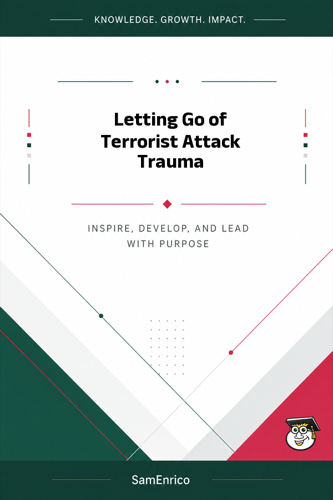
Terrorism Attack Dream Work eBook
Teaches processing dreams about bombings, shooting
Teaches processing dreams about bombings, shootings, or mass casualty events.
Formats
Free sample
Chapter 1: The Container Before the Key...--You wake up with your heart slamming against your ribs like a fist on a locked door. You do not know where you are for three full seconds. The room is dark. The sheets are twisted around your legs like something tried to pull you under. You were just there—in the smoke, in the screaming, in the moment before the ceiling came down—and now you are here, in a quiet bedroom, and the silence feels like a lie.You check your phone.
3:47 AM. You will not go back to sleep tonight. Or if you do, you will dream it again. The same bomb. The same shooter.
The same crowd scattering like leaves in a wind that smells like metal and dust. And tomorrow you will tell yourself it was just a dream. Just a dream. But your body does not believe that. Your body is still running.This book is for that 3:47 AM version of you.Not the daytime you who can rationalize and explain and push the nightmare into the corner of your mind labeled "not real." The you who is alone in the dark with a racing heart and a question you are afraid to say out loud: Does this dream mean something is wrong with me?The answer is no.
Nothing is wrong with you. But something is wrong with your process. You have been living inside the nightmare without a container to hold it. You have been opening the door to the terror without first building a room to keep it safe. And that is what this chapter will give you: the container.Not the interpretation.
Not the meaning. Not the cure. First, the container. Because you cannot work with a live wire. You must first shut off the power.The Mistake Everyone Makes First You have probably already done what most people do after a terrorism dream.
You Googled it. You searched "dream of bomb explosion meaning" or "why do I keep dreaming about shootings" and you found websites with lists of symbols. A bomb means repressed anger. A shooter means feeling attacked. A crowd means anxiety about social situations.
You read these interpretations and they felt both too specific and not specific enough. They landed on you like a wet blanket—heavy but not warm.Or maybe you did something else. Maybe you told someone. You whispered to your partner or a friend: "I had a terrible dream." And they said something like "it's just a dream" or "you've been watching too much news" and you felt dismissed. Or worse, they looked at you with concern, and suddenly you were not just someone who had a nightmare.
You were someone who might be struggling. And that label felt heavier than the dream itself.Or maybe you did the most common thing of all. You tried to ignore it. You got up, made coffee, went to work, and pretended the 3:47 AM terror had not happened. But your body remembered.
Your shoulders stayed up by your ears all day. You checked exits in the grocery store. You flinched at a loud car backfiring. You scrolled the news to "stay informed" and felt worse, then scrolled more because feeling worse felt like vigilance, and vigilance felt like safety.Here is the problem with all of these responses. None of them contain the dream.
Googling spreads the dream into the abstract internet. Telling someone spreads it into the social realm without structure. Ignoring it spreads it into your body where it festers. You have been trying to deal with a fire by opening all the windows. What you need is a fireproof box.The Container Principle: What It Is and Why It Works The Container Principle comes from trauma therapy, specifically from a branch called Sensorimotor Psychotherapy and from the work of Dr.
Bessel van der Kolk. The idea is simple but counterintuitive: before you can safely explore a terrifying memory, image, or dream, you must first build a psychological "vessel" that can hold its contents without leaking into the rest of your life.Think of it this way. If you had a jar of toxic chemicals in your kitchen, you would not open the jar and start sniffing it. You would not pour it into your bare hands. You would not carry it around with you all day.
You would put on gloves, open it in a well-ventilated area, and have a sealed container ready to receive it when you were done. The chemicals themselves are not the problem. The problem is uncontained exposure.Your nightmare is the jar of toxic chemicals. Not because it is actually dangerous, but because your nervous system treats it as if it is. When you wake up from a terrorism dream, your amygdala—the brain's smoke detector—is still blaring.
Your cortisol levels are elevated. Your heart rate is up. Your body does not know the difference between a dream and a real threat. It only knows that there was an explosion, and you are still reacting to it.The Container Principle gives you a way to tell your nervous system: I see the threat. I am not ignoring it.
But I am going to look at it from inside this safe box, not while standing in the middle of it.In practical terms, the container is a combination of three things:A physical space where dream work happens and only dream work happens A time boundary that limits how long you engage with the dream A ritualized action that signals to your brain when you are entering and exiting the container This chapter will teach you all three. By the end, you will have built a container that you can use for every nightmare you process in this book. And you will not interpret a single dream yet. That comes later. First, the box.The Pencil Protocol: Handwriting as Neurological Containment Before you build a physical altar, you need to understand the most basic container of all: the act of handwriting.
This is called the Pencil Protocol, and it is the foundation of everything that follows.Here is what we know from neuroscience. When you type on a keyboard, your brain processes the action as a mechanical task. It is fast, efficient, and emotionally neutral. Typing bypasses the limbic system—the emotional brain—and goes straight to the prefrontal cortex. That is why you can type an email about something upsetting and feel relatively fine.Handwriting is different.
Handwriting engages the reticular activating system, the motor cortex, and the limbic system all at once. The physical act of forming letters slows down your thinking. It forces you to spend more time with each word. And it creates a neurological bridge between the emotional memory of the dream (stored in the amygdala and hippocampus) and the language centers of the brain (Broca's area and Wernicke's area). In plain English: handwriting moves the dream from the place where it haunts you to the place where you can describe it.But here is the crucial step that almost everyone misses.
You cannot just write the dream and then leave it there. That is like opening the jar of toxic chemicals…
This is the end of the free sample. Get the eBook to keep going. Buy now
About this book
Details
- Author
- Hanna Herminia
- Publisher
- SamEnrico
- Language
- English
- Genre
- Non-Fiction, Self-Help, Terrorism
- Released
- 2026-06-07
- Pages (approx.)
- 145
- Available as
- eBook, Audiobook

Read better in the ZLOADR app
Your eBooks on your phone or tablet. Sign in with your SamEnrico account and start reading.
More by Hanna Herminia
 Team Creative Feedback CircleHanna Herminia$11.99
 Workplace Stress for ImmigrantsHanna Herminia$11.99
 Carson DDT CrusadeHanna Herminia$11.99
 Warm Outreach Validation GuideHanna Herminia$11.99
 Habit JournalHanna Herminia$11.99
 Software Developer Crunch CultureHanna Herminia$11.99
 Bipolar Support Group Facilitation GuideHanna Herminia$11.99
 Vietnamese Green IncentivesHanna Herminia$11.99
 The Silent Banquet: A Royal Feast of BetrayalHanna Herminia$11.99
 Beneath the Glass: The Unseen Metropolis of Venice's Forgotten FoundationsHanna Herminia$11.99
 The Silent Betrayal: How a Whistleblower Exposed the World’s Largest Corporate Cover-UpHanna Herminia$11.99
 MLA Works Cited Page GuideHanna Herminia$12.99