
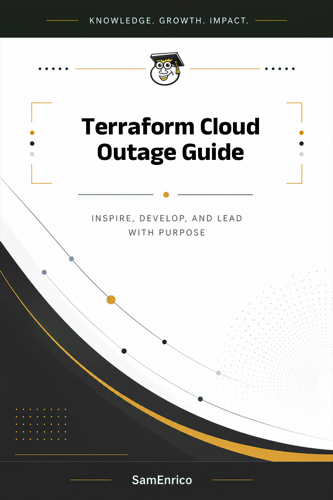
Terraform Cloud Outage Guide eBook
Emergency infrastructure when Terraform Cloud fail
by Chow Glennie
Emergency infrastructure when Terraform Cloud fails, including local state management and manual apply.
Formats
Free sample
Chapter 1: The Silent Crash...–- The alert came in at 2:14 AM on a Sunday. Not the screaming, red-alert kind with sirens and Slack notifications firing every second. No, this was worse. This was silence. The CI/CD dashboard showed a deployment that had been “in progress” for forty-seven minutes.
The Terraform Cloud UI was a ghost town – spinning spinners, grayed-out buttons, and an API that returned HTTP 500s to every curl command. The on-call engineer, let’s call her Maya, did what any trained professional would do: she opened a terminal and tried to run terraform apply from her laptop. And that’s when the real nightmare began. The remote backend refused the connection. The state file was locked.
And somewhere in the cloud, half a dozen EC2 instances were spinning up without any record of who created them or why. Maya had a choice: wait for Hashi Corp to fix TFC, or cut the cord and go local. This book is for everyone who chooses the second path – and needs to survive it.The Single Point of Failure You Never Admitted Existed Let’s be honest with ourselves. We have spent the last decade building beautiful, automated, “click-free” infrastructure pipelines. We have celebrated the death of the snowflake server and the rise of immutable, declarative, version-controlled everything.
Terraform Cloud (TFC) is the crown jewel of this movement – remote state, private module registry, policy as code, and a beautiful UI that lets managers see what engineers are doing. It is, by almost any measure, better than running Terraform from a laptop.But there is a dirty secret that the white papers and case studies don’t mention: TFC is a single point of failure.Not architecturally, of course. Hashi Corp runs it on redundant, multi-region infrastructure. They have SLAs and incident response teams and everything. But from the perspective of your ability to change your infrastructure during an outage, TFC is a choke point.
If the TFC API is unreachable – whether because of a regional failure, a bad deployment on their side, a DNS issue, or a malicious actor – your CI/CD pipeline cannot plan, cannot apply, and cannot read state. You are, to put it technically, stuck.Worse, the very features that make TFC powerful become liabilities when it fails. Remote state is inaccessible. Run triggers are dead. The state lock that prevents two engineers from clobbering each other’s changes now prevents anyone from doing anything.
And because most organizations have trained their engineers to never run Terraform locally, the muscle memory for manual intervention has atrophied.This chapter is not about blaming Hashi Corp. Outages happen to every Saa S provider. This chapter is about recognizing that your beautiful automation pipeline is a house of cards – and that the first card to fall is always the one you trusted the most.Anatomy of a Terraform Cloud Outage: What Actually Breaks Before you can recover from an outage, you need to know what kind of outage you are facing. Not every “Terraform isn’t working” problem is a TFC outage. In fact, many are not.
Let’s break down the three distinct failure modes that will send you reaching for this book.True TFC Outages A genuine Terraform Cloud outage means that the control plane itself is degraded or unavailable. Symptoms include:UI lockout: The web interface at app.terraform.io loads slowly, returns gateway timeouts, or shows a generic error page. You cannot view workspaces, runs, or state files through the browser.API failures: curl requests to the TFC API (e.g., https://app.terraform.io/api/v2/runs) return HTTP 500, 502, 503, or 504. Authentication endpoints may also fail.Agent queue stalls: If you use TFC agents (self-hosted runners), they may show as “connected” but never pick up new runs. The run queue grows indefinitely.State lock timeouts: terraform apply from any context (CLI, CI, or API) fails with messages like Error: Failed to acquire state lock or timed out waiting for lock.VCS integration breaks: Pull requests no longer trigger plans.
The “Plan” status in Git Hub or Git Lab never updates.These are the scenarios where TFC is the problem. Your internet connection is fine. Your cloud provider (AWS, Azure, GCP) is fine. But the automation engine you depend on is not.Cloud Provider API Failures The second category is when your cloud provider’s API is having issues. TFC may be perfectly healthy, but it cannot create EC2 instances, S3 buckets, or Azure VMs because the underlying API is returning errors.
Symptoms include:TFC runs fail with provider-specific errors: Error creating instance: Request Limit Exceeded, Internal Error, or Service Unavailable.The TFC UI loads normally, but runs hang at “Planning” or “Applying” indefinitely.Other tools (AWS CLI, Azure CLI, GCP Cloud Shell) also show degraded performance or errors.In this case, TFC is not the culprit. But you still cannot change your infrastructure. The solution is not to go around TFC – it is to wait for the cloud provider to recover or to fail over to another region (covered in Chapter 8). However, there is a dangerous gray area: what if only some API calls fail? Terraform may partially succeed, leaving your infrastructure in a half-created, half-destroyed state.
That scenario is covered in depth in Chapter 7.Network Segmentation or Local Issues The third category is the most deceptive: problems on your side. These include:Corporate VPN outages that block access to app.terraform.io.DNS resolution failures (e.g., your office network blocks terraform.io domains).Expired or revoked TFC API tokens.Local firewall rules that prevent outbound HTTPS to the TFC control plane.Symptoms often mimic a true TFC outage – timeouts, connection resets, or SSL errors – but the service is actually healthy. The fix is local network troubleshooting, not emergency state surgery. However, if your entire team is affected and the outage is prolonged, you may still need the emergency procedures in this book.Rule of Thumb: If you can reach https://app.terraform.io/health from a personal hotspot but not from your corporate network, you have a network issue, not a TFC outage. If that health endpoint returns anything other than ok, TFC is having problems.The Blast Radius: How an Outage Ripples Through Your Organization A TFC outage is rarely just a “Terraform problem.” Because TFC sits at the intersection of development, operations, and security, its failure cascades through multiple systems.
Understanding this blast radius is critical because it determines who needs to be involved in the response.CI/CD Pipeline Freeze Most modern CI/CD pipelines have at least one step that calls Terraform. Whether it is a Git Hub Action, a Git Lab CI job, a Jenkins pipeline, or an Argo Workflow, that step will fail or hang during a TFC outage. The consequences:Pull requests stack up: Every PR that requires a Terraform plan will be blocked. Developers cannot merge infrastructure changes.Hotfixes become impossible: If a production incident requires an infrastructure change (e.g., scaling up a service, rotating a database password), you cannot execute it through the normal pipeline.Rollbacks are delayed: If a recent deployment introduced a bug, you may need to revert to a previous infrastructure state. That revert also requires Terraform.The result…
This is the end of the free sample. Get the eBook to keep going. Buy now
About this book
Details
- Author
- Chow Glennie
- Publisher
- SamEnrico
- Language
- English
- Genre
- Non-Fiction, Crisis Management, IaC
- Released
- 2026-06-10
- Pages (approx.)
- 154
- Available as
- eBook, Audiobook

Read better in the ZLOADR app
Your eBooks on your phone or tablet. Sign in with your SamEnrico account and start reading.
More by Chow Glennie
 TM For Postpartum SupportChow Glennie$11.99
 The Teen Child Death GuideChow Glennie$11.99
 Bridge Loan for Buying Before SellingChow Glennie$11.99
 Retirement Transition Couples GuideChow Glennie$11.99
 The Ballarat Gold Escort Robbery: Australia's First Great HeistChow Glennie$11.99
 Madrid Protocol Step by StepChow Glennie$12.99
 Venture Debt vs Revenue BasedChow Glennie$12.99
 Understanding Waldenström's MacroglobulinemiaChow Glennie$17.99
 Safe Deposit Box Access ProcedureChow Glennie$11.99
 How to Start a Bathing Caps of Rubber Business (Beginners Guide)Chow Glennie$11.99