
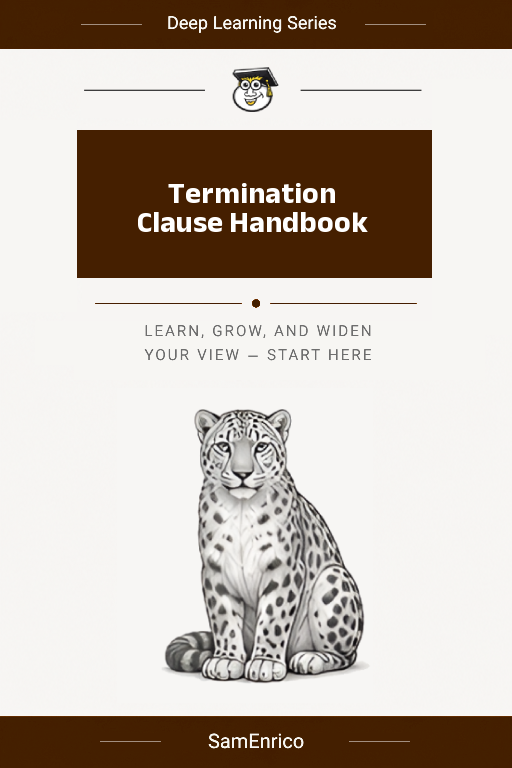
Non-FictionFirst 30 DaysUser Management
Termination Clause Handbook eBook
Define how and when you can ban users from your pl
by Cerda Reggie
Define how and when you can ban users from your platform. This guide covers breach scenarios and notice periods for service termination.
Formats
Free sample
Chapter 1: The $2 Million Ban--–- The email arrived at 9:47 AM on a Tuesday. "You have been permanently banned from the platform for violating our Terms of Service. This decision is final and not subject to appeal."Three sentences. Forty-one words. Zero explanation.Within six months, that email would cost the platform over two million dollars in legal fees, settlement costs, and lost revenue.
The user who received it wasn't a troll, a spammer, or a bad actor. She was a professional influencer with 47,000 followers who had generated over $80,000 in affiliate revenue for the platform in the previous year alone. The violation? She had posted a link to her own website three times in one week – a practice the platform's moderators had explicitly approved via email six months earlier.The platform's lawyers argued that the Terms of Service gave them "sole discretion" to terminate any account for any reason. The court agreed that the To S contained that language.
But the court also found that the platform had acted in bad faith by approving the behavior, then banning it without notice, and then refusing to provide any explanation or appeal. The jury awarded the influencer 450,000indamagesforbreachofcontract,andthejudgeadded450,000 in damages for breach of contract, and the judge added 450,000indamagesforbreachofcontract,andthejudgeadded1.2 million in attorneys' fees and costs. The platform spent another 400,000defendingitself.Totalcost:over400,000 defending itself. Total cost: over 400,000defendingitself.Totalcost:over2 million. For a forty-one-word email that took thirty seconds to send.This book exists because most platform founders, community managers, and even lawyers do not understand how profoundly dangerous the act of banning a user has become.
They treat the "ban button" as a simple operational tool – a way to remove troublesome users with the click of a mouse. In reality, the ban button is a legal weapon. When you press it, you are potentially firing the first shot in a lawsuit, triggering regulatory investigations, and creating evidence that will be scrutinized by judges, juries, and government agencies.The good news is that you can ban users. You must ban users. A platform without the ability to remove bad actors is not a platform – it is a lawless wasteland that will be overrun by spam, abuse, and illegal content.
But you must do it correctly. The difference between a lawful ban that protects your community and an unlawful ban that costs you millions of dollars is not a matter of luck. It is a matter of understanding the legal framework that governs user termination and designing your policies, processes, and notices to fit within that framework.This chapter establishes the foundational legal principles that every platform operator must understand before they ever click the ban button. It explains who actually owns the relationship between platform and user, why your Terms of Service is a binding contract (and why most To S documents fail as contracts), and how the most important law you have never heard of – Section 230 of the Communications Decency Act – actually protects your right to ban users rather than restricting it. Most importantly, this chapter introduces the single most powerful legal doctrine that will determine whether your bans survive judicial scrutiny: the Implied Covenant of Good Faith and Fair Dealing.By the end of this chapter, you will understand why vague To S provisions like "at our sole discretion" are lawsuits waiting to happen, how to draft a "Right to Refuse Service" clause that actually works, and what the most expensive ban mistakes in internet history can teach you about protecting your platform.1.1 The Private Company vs.
The Public Square The first question that any court will ask when a banned user sues is this: what is the legal nature of your platform? The answer determines everything – the standard of review, the applicable laws, and the likelihood that the user will win.The Private Company Presumption Most platforms are private companies. They are owned by shareholders, operated for profit, and governed by contracts (the Terms of Service) that users agree to when they sign up. Under American law, private companies have enormous discretion to decide who they do business with. A private golf club can refuse to serve someone wearing jeans.
A private restaurant can ask a loud patron to leave. A private social media platform can ban a user for posting content that the platform dislikes – even if that content would be protected speech in a public park.This principle is called the "right to refuse service." It is ancient, well-established, and incredibly powerful. It comes from the common law principle that no one is forced to enter into a contract with someone they do not wish to deal with. If you walk into a bakery and demand that the baker sell you a cake, the baker can say no – as long as the refusal is not based on race, religion, or another protected characteristic under anti-discrimination laws.For decades, courts applied this principle to internet platforms without much thought. My Space could ban a user for any reason.
Friendster could delete an account because they felt like it. The early internet was the Wild West of contract law, and platforms held all the guns.The Public Square Challenge That era is over. Beginning around 2015, a series of high-profile bans – starting with the deplatforming of controversial political figures and accelerating after the January 6th Capitol riot – led to a flood of lawsuits arguing that certain platforms had become so essential to modern discourse that they should be treated as "public squares" rather than private companies. If a platform is a public square, the argument goes, then the First Amendment's free speech protections should apply – meaning the platform cannot ban users for their political viewpoints.This argument has failed in every major court case to date. In Prager U v.
You Tube (2020), a conservative media company argued that You Tube was a "state actor" subject to the First Amendment because it had become the modern equivalent of a public forum. The Ninth Circuit Court of Appeals rejected this argument, holding that You Tube is a private company that can moderate content as it sees fit. The same result occurred in Freedom Watch v. Google (2018) and Domen v. Vimeo (2019).
The legal consensus is clear: even the largest platforms remain private companies with the right to refuse service.The Important Exception However, there is an important exception that platform operators ignore at their peril. The "private company" defense disappears when the platform receives significant government funding, collaborates closely with government agencies on content moderation, or operates as a government-controlled entity. Public universities that host discussion forums, government-run social media platforms in authoritarian countries, and platforms created by statute are subject to constitutional constraints.Additionally, several states have passed laws attempting to restrict platforms' ability to ban users based on political viewpoints. Texas passed HB 20 (2021), which prohibited large social media platforms from banning users based on their political speech. The law was challenged and blocked by federal courts on First Amendment grounds – but the fact that it passed at all shows that the political landscape is shifting.
Platform operators must monitor state legislation because what is legal today may be illegal tomorrow.The Practical Takeaway For virtually all platform operators reading this book…
This is the end of the free sample. Get the eBook to keep going. Buy now
About this book
Details
- Author
- Cerda Reggie
- Publisher
- SamEnrico
- Language
- English
- Genre
- Non-Fiction, First 30 Days, User Management
- Released
- 2026-05-29
- Pages (approx.)
- 158
- Available as
- eBook, Audiobook

Read better in the ZLOADR app
Your eBooks on your phone or tablet. Sign in with your SamEnrico account and start reading.
More by Cerda Reggie
 Parenting Disagreement RageCerda Reggie$11.99
 Health Record Data Breach ScriptsCerda Reggie$11.99
 Acupuncture For PsoriasisCerda Reggie$11.99
 Conflict Self Esteem GuideCerda Reggie$11.99
 Dual Recovery AnonymousCerda Reggie$11.99
 Reformation Printing Press Revolution CourseCerda Reggie$11.99
 TM for Creativity BoostCerda Reggie$11.99
 Marketing Team BurnoutCerda Reggie$11.99
 Andrew YoungCerda Reggie$11.99
 The Abyss Beneath the Rift: How a Fisherman and a Biologist Unlocked Africa's Hidden Hydrothermal VentsCerda Reggie$11.99
 Ragnarok and the Fox’s Wager: Loki’s Pact with the KitsuneCerda Reggie$11.99
 The Zodiac’s Last Stand: The Code That Wasn’t CrackedCerda Reggie$11.99
You may also like
 Hong Kong Handover 1997Dunn Johnnie$11.99
 Zumba For Postnatal Recovery CourseNeal Christian$11.99
 Zumba for BeginnersLadner Nikia$11.99
 YouTube Comment Mining GuideHumes Pandora$12.99
 Worry Box MeditationCarlin Rudy$11.99
 Workplace Stress MeditationNguyen Lynn$11.99
 Workplace Stress and Sleep RepairHawley Ivory$11.99
 Workplace Perfectionism CureDelaney Jeffry$11.99
 Workplace Injustice Anger GuideWallen Isabelle$11.99
 Work Addiction and Burnout LinkGreenwood Ester$11.99
 Women in Yoga and WellnessBeattie Galina$11.99
 Women in Stand Up ComedyChun Evangeline$11.99