
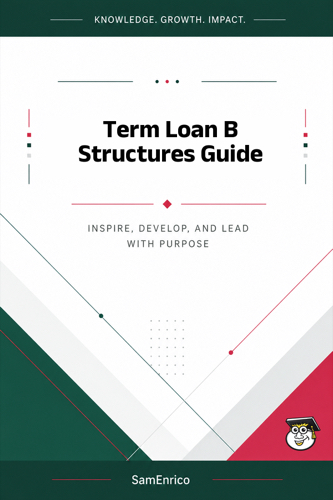
Non-FictionCapital & Valuation Register
Term Loan B Structures Guide eBook
Analyzes institutional term loans with covenant-li
Analyzes institutional term loans with covenant-lite features and call protection.
Formats
Free sample
Chapter 1: The Vanished Safety Net--–- In 2007, a regional bank named Eastern Savings held a $200 million term loan to a mid-sized manufacturing company. The bank’s credit committee met quarterly to review the borrower’s financial statements. They tracked leverage ratios, interest coverage, and cash flow maintenance covenants. When the borrower’s EBITDA dipped below the required threshold in the third quarter, the bank had the contractual right—and the operational infrastructure—to call a default, demand a cure, or seize collateral. The bank knew its borrower personally.
The borrower knew its lender by name.By 2024, that same $200 million loan would have been syndicated to forty different institutional investors within seventy-two hours of closing. The original arranger—a large investment bank—would have sold down its entire commitment before the first interest payment was due. The CLO (Collateralized Loan Obligation) manager who bought the largest tranche would never meet the borrower. The borrower’s CFO would never speak to the ultimate lenders. And when the borrower’s EBITDA deteriorated, there would be no quarterly maintenance covenant to breach—because the loan would be “covenant-lite.”The safety net had vanished.
And almost no one noticed until it was too late.This is the story of how the Term Loan B market rewrote the rules of corporate lending. It is a story of structural innovation, investor demand, regulatory arbitrage, and the slow erosion of lender protections that had existed for a century. It is also a practical guide for anyone who must navigate this new landscape: the portfolio manager buying the loan, the corporate treasurer issuing it, the lawyer drafting the credit agreement, and the distressed investor trading it when things go wrong.The Great Shift: From Hold to Distribute To understand the Term Loan B, you must first understand the banking model it replaced. For most of the twentieth century, commercial lending followed a simple pattern: a bank originated a loan, held it on its balance sheet until maturity, and monitored the borrower continuously. This “originate-to-hold” model aligned incentives perfectly.
The bank had skin in the game. It cared about long-term credit quality because it would own the loan for five, seven, or ten years. It cared about covenants because they provided early warning signals. It cared about collateral because it might need to seize it.The originate-to-hold model worked well for relationship-based lending. It failed spectacularly when banks needed to lend more than their balance sheets could accommodate.
A regional bank with $10 billion in assets could only hold so many $200 million term loans. The capital requirements alone would constrain its ability to grow its lending book.Enter the investment banks. In the 1990s and early 2000s, large banks like Goldman Sachs, Morgan Stanley, J.P. Morgan, and Credit Suisse began experimenting with a different model: originate-to-distribute. Under this model, a lead arranger would underwrite a loan—committing its own capital to the full amount—and then sell portions of that loan to institutional investors.
The arranger earned fees for underwriting and distribution. It did not earn returns from holding the loan to maturity. Its incentive was to originate as much volume as possible, structure it for syndicability, and move on to the next deal.The originate-to-distribute model unlocked enormous lending capacity. A single arranger could underwrite a $1 billion loan, sell $900 million to institutional investors, and keep only $100 million on its own balance sheet. The bank’s capital was freed up for the next deal, and the next, and the next.
By 2007, the syndicated loan market had grown to over $1 trillion in annual issuance.But the model also created a fundamental misalignment. The arranger’s underwriting standards were now driven by what institutional investors would buy, not by what the arranger would hold. And institutional investors had different priorities than relationship bankers.Defining the Term Loan BBefore we go further, let us define our subject precisely. A Term Loan B is an institutional term loan sold to non-bank investors such as CLOs, mutual funds, insurance companies, and pension funds. It is distinct from three other common lending products:Term Loan A (Pro Rata): Held by banks, amortizes heavily (10-20% per year), includes quarterly financial maintenance covenants, and is typically extended to investment-grade or near-investment-grade borrowers.
The “pro rata” name comes from the fact that all lenders share ratably in payments and collateral.Term Loan B: Held by institutional investors, amortizes minimally (typically 0.5% to 1% per year, with many recent deals having 0% amortization—a true bullet), includes few or no financial maintenance covenants (the “covenant-lite” feature), and carries wider spreads to compensate for the weaker lender protections. Maturities typically range from five to eight years.Term Loan C: Similar to Term Loan B but with a longer amortization tail (typically 5-10% per year) and even longer maturity (seven to ten years). Term Loan C is less common and typically used for larger, more complex transactions where borrowers want to push amortization further into the future.High-Yield Bonds: Unsecured debt governed by an indenture rather than a credit agreement. Bonds have no maintenance covenants whatsoever—only incurrence covenants. They have stronger call protection (make-whole provisions lasting several years) and trade through a different settlement system (DTC bond settlement rather than loan settlement).
The line between TLBs and high-yield bonds has blurred considerably, a theme we will return to throughout this book.The Term Loan B sits in the middle of this spectrum. It offers institutional investors higher yields than Term Loan A but weaker protections than traditional bank debt. It offers borrowers longer maturities and lighter covenants than bank debt but more restrictive terms than high-yield bonds. This hybrid nature is both its strength and its complexity.A Brief History: From Crisis to Cov-Lite Dominance The Term Loan B market did not emerge overnight. Its evolution can be divided into four distinct eras.Era 1: The Pre-Crisis Years (2000-2007)Before the 2008 financial crisis, Term Loan Bs existed but were a minority of the syndicated loan market.
Institutional investors held perhaps 30-40% of new issuances. Most loans included financial maintenance covenants. The term “covenant-lite” was an obscure phrase used only for the most creditworthy borrowers. In 2007, cov-lite loans represented less than 10% of institutional loan issuance.The pre-crisis market was also characterized by smaller deal sizes, simpler structures, and a more conservative investor base. CLOs existed but were not yet the dominant force they would become.
Insurance companies and pension funds were the primary buyers of institutional term loans. They demanded covenant protection and were willing to pay for it.Era 2: The Crisis and Its Aftermath (2008-2012)The financial crisis temporarily halted the originate-to-distribute model. The syndicated loan market froze. Investors fled to quality. CLOs, which had been heavily leveraged, faced forced selling as their financing facilities were withdrawn.
Term loan prices collapsed; many traded below 60 cents on the dollar. The default rate spiked to over 10%.But the crisis also planted the seeds for the modern TLB market. Regulators, seeking to reduce bank risk-taking, imposed higher capital requirements on loans held on bank balance sheets. The originate-to-hold model became more expensive for banks. Meanwhile, institutional investors—particularly CLO managers—emerged from the crisis with a renewed appetite for floating-rate credit.
Loans offered protection against rising interest rates, unlike fixed-rate bonds.By 2010, the syndicated loan market was recovering, but with a…
This is the end of the free sample. Get the eBook to keep going. Buy now
About this book
Details
- Author
- Briscoe Allegra
- Publisher
- SamEnrico
- Language
- English
- Genre
- Non-Fiction, Capital & Valuation Register
- Released
- 2026-06-06
- Pages (approx.)
- 144
- Available as
- eBook, Audiobook

Read better in the ZLOADR app
Your eBooks on your phone or tablet. Sign in with your SamEnrico account and start reading.
More by Briscoe Allegra
 Sobriety Without Shame: A Recovery PrimerBriscoe Allegra$11.99
 Healthcare Burnout GuideBriscoe Allegra$11.99
 Workaholism and Substance AbuseBriscoe Allegra$11.99
 Tangaroa and Hina: The Ocean’s Forbidden LoveBriscoe Allegra$11.99
 How to Produce Aircraft Parts and AccessoriesBriscoe Allegra$11.99
 How to Become a Mainspring Winder And OilerBriscoe Allegra$11.99
 Virtual Account Management WorkbookBriscoe Allegra$12.99
 Soil Science AnalysisBriscoe Allegra$11.99
You may also like
 Hong Kong Handover 1997Dunn Johnnie$11.99
 Zumba For Postnatal Recovery CourseNeal Christian$11.99
 Zumba for BeginnersLadner Nikia$11.99
 YouTube Comment Mining GuideHumes Pandora$12.99
 Worry Box MeditationCarlin Rudy$11.99
 Workplace Stress MeditationNguyen Lynn$11.99
 Workplace Stress and Sleep RepairHawley Ivory$11.99
 Workplace Perfectionism CureDelaney Jeffry$11.99
 Workplace Injustice Anger GuideWallen Isabelle$11.99
 Work Addiction and Burnout LinkGreenwood Ester$11.99
 Women in Yoga and WellnessBeattie Galina$11.99
 Women in Stand Up ComedyChun Evangeline$11.99