
Non-FictionHealth & WellnessErgonomics
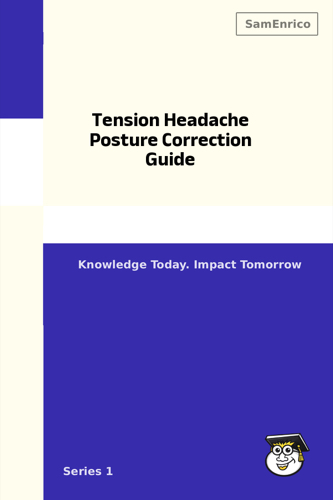
Tension Headache Posture Correction Guide eBook
Fix forward head posture and ergonomic setup to pr
by Dyer Miquel
Fix forward head posture and ergonomic setup to prevent cervicogenic headaches.
Formats
Free sample
Chapter 1: The Bowling Ball Lie--–- The headache started, as it always did, behind her right eye. By 2:00 PM, it had crawled over her scalp like a slow-motion avalanche. By 4:00 PM, she was closing her office door and turning off the lights, pretending to review documents while actually pressing her thumb into the base of her skull. By 6:00 PM, she was home, too exhausted to play with her children, too nauseated to eat dinner, and too ashamed to admit that she had canceled yet another social plan because of a headache.This is not a hypothetical patient. This is every third desk worker you know.
This is the software engineer who has been told she has "sinus issues." This is the lawyer who has spent two thousand dollars on a bite guard for teeth grinding that wasn't the real problem. This is the graduate student who has been prescribed beta-blockers, antidepressants, and three different triptans—none of which worked for more than a few weeks. And this is likely you, or someone you sit next to, reading this page right now, wondering if there is any explanation that makes sense.There is. And it has nothing to do with your brain.The Diagnosis Nobody Told You About Every year, millions of people walk into doctors' offices with a specific complaint: a headache that starts in the neck or the back of the skull, then radiates forward over the scalp, often settling behind one eye or across the forehead like a tight band. They describe the pain as "pressing" rather than throbbing.
They note that it gets worse as the workday progresses. They report that neck movement—turning the head to check a blind spot while driving, looking up at a high shelf, or even just tilting the head forward to read a phone—makes everything worse. And they have usually tried every over-the-counter pain reliever on the pharmacy shelf, often exceeding the recommended daily dose because the relief never lasts long enough.Most of these patients receive one of three diagnoses: tension-type headache, migraine without aura, or "probably just stress." A small number receive the correct diagnosis: cervicogenic headache. But even then, the treatment recommendations are often vague ("improve your posture") or invasive ("let's try nerve blocks"). The patient is sent away with a prescription and a pamphlet, neither of which addresses the mechanical reality of what is actually happening inside their neck.Here is that reality, stated as simply as possible: your headache is not a chemical imbalance in your brain.
It is not a vascular problem. It is not a psychological weakness. It is a structural problem caused by the position of your head relative to your shoulders, and it has been hiding in plain sight your entire adult life.The Anatomy of a Betrayal To understand why your neck is causing your headaches, you need to meet four small muscles that you have probably never heard of. They are called the suboccipital muscles, and they live at the very top of your cervical spine, just below the base of your skull. There are four of them on each side: the rectus capitis posterior major, the rectus capitis posterior minor, the obliquus capitis superior, and the obliquus capitis inferior.
Together, they form a small, dense triangle of muscle tissue on either side of the midline, deep beneath the larger superficial muscles that you can feel when you rub your own neck.These four muscles have a job that is both simple and impossibly demanding. They are responsible for the fine-tuned movements of your head relative to your neck: the subtle nod, the tiny rotation, the micro-adjustments that keep your eyes level with the horizon as you walk, turn, and bend. They are the precision instruments of the cervical spine, the equivalent of the small muscles in your hand that allow you to write with a pen or thread a needle. And like the small muscles of the hand, they are not designed for heavy, sustained loads.But here is where the betrayal begins. The suboccipital muscles are not just movers.
They are also connected, through a dense web of connective tissue called the myodural bridge, directly to the dura mater—the pain-sensitive outer lining of the brain and spinal cord. This means that when the suboccipital muscles are under tension, they physically pull on the lining of your central nervous system. They are not just causing muscle pain. They are literally tugging on your brain's protective covering.This anatomical fact changes everything about how we understand headaches. A migraine is a neurological event originating in the brain itself.
A tension-type headache is thought to involve central pain processing abnormalities. But a cervicogenic headache—the kind caused by forward head posture—is a mechanical problem. Something is pulling on something else. And if you can stop the pulling, you can stop the pain.The 42-Pound Bowling Ball Now let us talk about your head. An adult human head weighs, on average, between ten and twelve pounds.
That is roughly the weight of a small bowling ball or a large bag of flour. Your cervical spine—the seven vertebrae of your neck—is designed to carry that weight efficiently when your head is properly aligned. Proper alignment means that your ears are directly above your shoulders when viewed from the side. In this neutral position, the weight of your head is transmitted straight down through the spinal column, and the muscles of your neck are largely at rest, doing only the minimal work required to maintain balance.But here is what happens when your head drifts forward. For every inch that your head moves ahead of your shoulders, the effective load on your cervical spine doubles.
At one inch of forward translation, your neck is not supporting twelve pounds. It is supporting twenty-four pounds. At two inches, it is supporting thirty-six pounds. At three inches—a position that is tragically common among people who spend their days looking at smartphones, laptops, and dual monitors—your neck is supporting forty-two pounds.That is the weight of a large bowling ball. Or a five-gallon water jug.
Or a medium-sized dog. And you are asking your suboccipital muscles—those tiny precision instruments the size of your thumb—to hold that load for eight, ten, or twelve hours a day.They cannot do it. No muscle can. And so they do the only thing they can do: they tighten. They spasm.
They send distress signals to your brain in the form of pain. And because they are connected directly to the dura mater through the myodural bridge, that pain is not just a dull ache in your neck. It is a headache that feels like it is coming from inside your skull.The Great Masquerade Cervicogenic headaches are masters of disguise. They mimic almost every other type of headache, which is why they are so frequently misdiagnosed. Consider the following three patients:Patient A reports a pressing, band-like pain around the entire head, as if someone is tightening a vise.
The pain is mild to moderate, not throbbing, and is accompanied by tenderness in the neck and shoulder muscles. This patient is likely to…
This is the end of the free sample. Get the eBook to keep going. Buy now
About this book
Details
- Author
- Dyer Miquel
- Publisher
- SamEnrico
- Language
- English
- Genre
- Non-Fiction, Health & Wellness, Ergonomics
- Released
- 2026-06-11
- Pages (approx.)
- 143
- Available as
- eBook, Audiobook

Read better in the ZLOADR app
Your eBooks on your phone or tablet. Sign in with your SamEnrico account and start reading.
More by Dyer Miquel
 Telegram Channel InfluencerDyer Miquel$11.99
 Altitude Breath AdaptationDyer Miquel$11.99
 Gratitude for Birthdays GuideDyer Miquel$11.99
 Public Access AED RegistryDyer Miquel$11.99
 The Landlord's CaptiveDyer Miquel$11.99
 John Y Brown Kentucky FriedDyer Miquel$11.99
 The Equator Crossing RitualDyer Miquel$11.99
 New Parent Nap Survival GuideDyer Miquel$11.99
 The Man Who Sold the Moon: The Untold Story of Dennis TitoDyer Miquel$11.99
 The Gambler’s Tailor: How 18th-Century Fashion Fueled America’s First Sports CrazeDyer Miquel$11.99
 The Mineral Guide to MarcasiteDyer Miquel$11.99
 How to Start a Model Kit Business (Beginners Guide)Dyer Miquel$11.99
You may also like
 Hong Kong Handover 1997Dunn Johnnie$11.99
 Zumba For Postnatal Recovery CourseNeal Christian$11.99
 Zumba for BeginnersLadner Nikia$11.99
 YouTube Comment Mining GuideHumes Pandora$12.99
 Worry Box MeditationCarlin Rudy$11.99
 Workplace Stress MeditationNguyen Lynn$11.99
 Workplace Stress and Sleep RepairHawley Ivory$11.99
 Workplace Perfectionism CureDelaney Jeffry$11.99
 Workplace Injustice Anger GuideWallen Isabelle$11.99
 Work Addiction and Burnout LinkGreenwood Ester$11.99
 Women in Yoga and WellnessBeattie Galina$11.99
 Women in Stand Up ComedyChun Evangeline$11.99