
Non-FictionHealth & WellnessMuscular
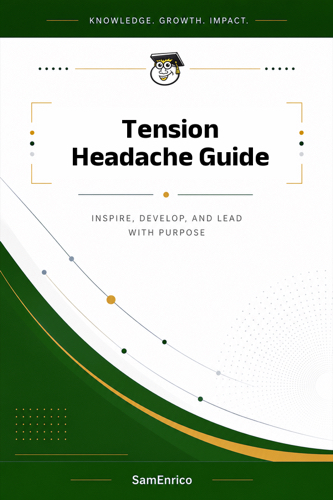
Tension Headache Guide eBook
Teaches band like pressure and muscle tightness re
Teaches band like pressure and muscle tightness relief.
Formats
Free sample
Chapter 1: The Three-Layer Lie--–- The email arrived at 2:47 PM on a Tuesday. Sarah, a 34-year-old graphic designer, had been staring at her screen for four hours straight, her shoulders creeping toward her ears like frightened animals. She felt it coming—the familiar slow squeeze, as if someone were tightening a vice around her forehead. By 3:15 PM, she would be useless. By 4:00 PM, she would cancel dinner with her partner.
By 6:00 PM, she would be in a dark room, one hand pressing on the base of her skull, the other reaching for ibuprofen. This was day 1,487 of her headache life. Not one day off in over four years.Mike, a 47-year-old litigation attorney, had a different pattern. His headaches arrived like clockwork at 2:00 PM, right after his second cup of coffee. He called them "the band." Not because he had read about tension headaches—he hadn't—but because that's exactly what they felt like: a wide, elastic band of pressure wrapped around his head, tightest at the temples.
He had three MRIs. He had seen two neurologists, a chiropractor, an acupuncturist, and a physical therapist. His brain was fine. His cervical spine was unremarkable. His blood work was perfect.
And yet, every single day at 2:00 PM, the band tightened.Dr. Patel, a 62-year-old retired pediatrician, had a different story altogether. He had treated hundreds of children with migraines. He knew the difference between a tension headache and a cluster headache. He could recite the diagnostic criteria from the International Classification of Headache Disorders from memory.
And for thirty years, he had woken up with the same dull, pressing sensation at the base of his skull. He had tried everything he had ever prescribed to his patients—muscle relaxants, tricyclic antidepressants, biofeedback, even Botox. Nothing worked. He had resigned himself to the pain. "This is just what my head feels like now," he told himself every morning as he reached for his coffee.Three different people.
Three different patterns. Three different levels of medical knowledge. And yet, they all shared the same fundamental misunderstanding—a misunderstanding shared by most of the 2.7 billion people worldwide who suffer from tension-type headaches. They all believed the same lie.The Lie That Keeps You Stuck The lie is simple, seductive, and completely wrong. It goes like this: Your headache is caused by tight muscles.
If you could just relax those muscles, the headache would go away.This lie appears everywhere. Your doctor tells you, "It's just a tension headache—try to relax." Your chiropractor says, "Your suboccipitals are tight—let me release them." Your massage therapist says, "You're holding so much tension in your neck." Your well-meaning partner says, "Maybe you should try yoga." Even the most popular books on pain—the ones that have sold millions of copies—often reinforce this lie, albeit in more sophisticated language.The lie feels true because when you press on your tight suboccipital muscles, the pain refers into your head exactly where the band sits. When you stretch your upper trapezius, you get temporary relief. When someone massages your neck, the headache sometimes fades. These experiences create powerful evidence for the muscle-tightness theory.
But here is the truth that changes everything:Muscle tightness is not the cause of your headache. It is the final output of a cascade that begins elsewhere. Treating the tightness without treating the cascade is like mopping the floor while the sink overflows.You cannot massage your way out of a headache any more than you can yell your way out of an argument. The muscles are the messengers, not the message.The Three Layers: A New Map for an Old Problem After analyzing the best-selling pain books of the past forty years—from Dr. John Sarno's Healing Back Pain to James Davies' Body Talk to Jon Kabat-Zinn's Full Catastrophe Living—a pattern emerges.
The books that work, the ones that actually change lives, all point to the same truth: chronic pain lives in three layers. Most treatments, including most of this book's competitors, only address one layer. That is why they fail.Here is the three-layer model that will guide everything you learn in this book. I want you to memorize it, not because it is complicated—it is actually quite simple—but because it will become your new map. Every time you feel the band tighten, you will run through these layers.
And for the first time, you will know exactly what to do.Layer 1: The Trigger (Emotional Content)At the deepest level, most tension headaches are triggered by unconscious emotional content. I know this sounds like psychobabble. I want you to set aside your skepticism for the next few paragraphs and just consider the possibility, because the evidence is overwhelming.Dr. John Sarno, a professor of rehabilitation medicine at New York University School of Medicine, treated over 10,000 chronic pain patients. He found that the vast majority of them—something like 80 to 90 percent—had no structural abnormality that explained their pain.
Their MRIs were clean. Their blood work was normal. Their physical exams were unremarkable. And yet, they were in agony.Sarno's conclusion, which he documented in Healing Back Pain and The Mindbody Prescription, was radical: the brain creates physical pain as a distraction from unconscious emotional states that the conscious mind finds intolerable. The most common culprits?
Rage (especially repressed anger at parents, partners, bosses, or life circumstances) and what Sarno called "the pressure of ordinary life"—the grinding, low-grade sense of being trapped in routines that feel meaningless.Here is the mechanism: your brain, which is always trying to protect you, notices that you are about to become consciously aware of some very uncomfortable emotion. Maybe you are furious at your spouse but you cannot express it because you are "supposed" to be loving. Maybe you feel trapped in your job but you cannot quit because you have a mortgage. Maybe you feel profound loneliness but you have learned that admitting vulnerability is weakness. Your brain, wanting to protect you from these unbearable feelings, creates a distraction: physical pain.
The pain pulls your attention away from the emotion and onto your body. Mission accomplished.This is not "all in your head" in the dismissive sense. The pain is real. The muscle tightness is real. The suffering is real.
But the cause is not a torn muscle or a pinched nerve. The cause is an unconscious emotional trigger that your brain has converted into a physical sensation.Layer 2: The Mechanism (Neurological)Once Layer 1 triggers are activated—often without your conscious awareness—your nervous system responds. Specifically, your sympathetic nervous system, the "fight or flight" branch of your autonomic nervous system, shifts into high gear.You have two branches of your autonomic nervous system. The parasympathetic branch is often called "rest and digest." It lowers your heart rate, relaxes your muscles, and tells your body that everything is safe. The sympathetic branch is "fight or flight." It increases your heart rate, diverts blood flow to your large muscles, and prepares you to run from a tiger or fight an attacker.The problem is that your nervous system cannot tell the difference between a tiger and a rude email.
It cannot distinguish between a physical threat (someone chasing you) and a psychological threat (your boss implying you might be…
This is the end of the free sample. Get the eBook to keep going. Buy now
About this book
Details
- Author
- Zook Vincenzo
- Publisher
- SamEnrico
- Language
- English
- Genre
- Non-Fiction, Health & Wellness, Muscular
- Released
- 2026-06-05
- Pages (approx.)
- 145
- Available as
- eBook, Audiobook

Read better in the ZLOADR app
Your eBooks on your phone or tablet. Sign in with your SamEnrico account and start reading.
More by Zook Vincenzo
 Sleep Apnea Risk in MenopauseZook Vincenzo$11.99
 Emotional Intelligence for TeensZook Vincenzo$11.99
 Compulsive Spending and HoardingZook Vincenzo$11.99
 Medicare Fraud PreventionZook Vincenzo$11.99
 The Postpartum Psychosis GuideZook Vincenzo$11.99
 10 Loci Memory Palace CourseZook Vincenzo$11.99
 Body Language for DatingZook Vincenzo$11.99
 The Silent Heist: How Hackers Froze a City’s HeartZook Vincenzo$11.99
 A Collector's Handbook to the Vauxhall J Fourteen-sixZook Vincenzo$11.99
 Macaroni Penguins: Crested PenguinZook Vincenzo$11.99
 How to Produce Cricket Bat AccessoriesZook Vincenzo$11.99
 Money Shame to WorthZook Vincenzo$12.99
You may also like
 Hong Kong Handover 1997Dunn Johnnie$11.99
 Zumba For Postnatal Recovery CourseNeal Christian$11.99
 Zumba for BeginnersLadner Nikia$11.99
 YouTube Comment Mining GuideHumes Pandora$12.99
 Worry Box MeditationCarlin Rudy$11.99
 Workplace Stress MeditationNguyen Lynn$11.99
 Workplace Stress and Sleep RepairHawley Ivory$11.99
 Workplace Perfectionism CureDelaney Jeffry$11.99
 Workplace Injustice Anger GuideWallen Isabelle$11.99
 Work Addiction and Burnout LinkGreenwood Ester$11.99
 Women in Yoga and WellnessBeattie Galina$11.99
 Women in Stand Up ComedyChun Evangeline$11.99