
Non-FictionBusiness BriefCustomer Service
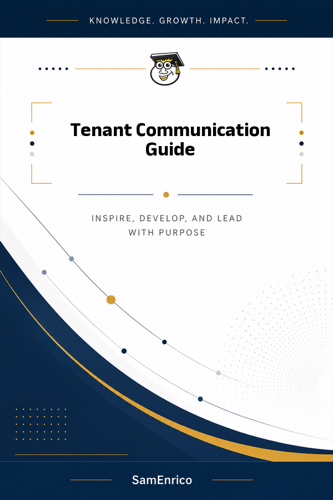
Tenant Communication Guide eBook
Handles complaints and requests professionally.
by Sam Kennith
Handles complaints and requests professionally.
Formats
Free sample
Chapter 1: The Cost of Silence--A single unreturned voicemail cost David Reynolds forty-seven thousand dollars.Not a lawsuit. Not a eviction. Not a catastrophic flood or a fire or a foundation collapse. A voicemail. Thirty-seven seconds long.
Left on a Tuesday evening at 7:13 PM.David was a small landlord with four units in a mid-sized Midwestern city. He was not a slumlord. He was not greedy or negligent or cruel. He was busy. He worked a full-time job in logistics, managed his properties on evenings and weekends, and considered himself a reasonable person who treated his tenants fairly.When his tenant, a single mother named Tanya, called to report a strange sound coming from her water heater, David was eating dinner.
He saw the call come in. He let it go to voicemail. He told himself he would listen to it after he finished eating.He forgot.The next morning, he remembered the voicemail but was running late for work. He told himself he would call back at lunch.At lunch, he was overwhelmed with work emails. He told himself he would call back after work.After work, he was exhausted.
He told himself he would call back in the morning.By the time David finally returned Tanya's call, thirty-one hours had passed since she had first reached out. His message was brief, dismissive, and—as the judge would later describe it—"professionally negligent.""I'll get to it when I can," David said. "It's probably nothing."It was not nothing.The strange sound Tanya had reported was the water heater's pressure relief valve failing. Forty-eight hours after David's return call, the water heater ruptured. Four inches of water flooded Tanya's ground-floor unit, destroying her furniture, her children's school supplies, and a wall that had to be completely rebuilt.Tanya hired a lawyer.
The lawyer didn't sue because of the water damage. Insurance would have covered most of that. The lawyer sued because David had failed to respond to an emergency notification within a reasonable timeframe. The state's implied warranty of habitability required landlords to address threats to health and safety "promptly." Thirty-one hours, the judge ruled, was not prompt.The judgment included Tanya's moving costs, temporary housing for six weeks during repairs, the full replacement value of her destroyed belongings, her legal fees, and—this was the part that made David's stomach drop—punitive damages for what the court called "deliberate indifference to a known habitability threat."Forty-seven thousand dollars.All because David did not know the difference between a casual complaint and a legal emergency. All because he had no system for categorizing tenant communications.
All because he believed that "I'll get to it when I can" was a perfectly reasonable response from a busy person doing his best.This book exists because most landlords are David. Not the forty-seven-thousand-dollar judgment part, but the busy, well-intentioned, completely unaware part. They do not know how much their communication habits are costing them. They do not know that the way they respond to a text message can be the difference between a renewing tenant and a lawsuit. They do not know that silence—even brief, well-meaning silence—has a price.This chapter will teach you what that price is, why traditional "good landlord" instincts often backfire, and the single framework you need to protect yourself starting tomorrow morning.The Hidden Math of Every Unanswered Message Let me show you something that will change how you see every tenant interaction.The Property Ombudsman, which analyzes landlord-tenant disputes across the United Kingdom, published a finding in 2023 that has been corroborated by similar data from the American Apartment Owners Association and the National Association of Residential Property Managers.
Here it is: communication breakdown is the leading cause of landlord-tenant disputes, cited in sixty-two percent of all cases that go to mediation or court.Think about that for a moment. Communication breakdown causes more disputes than non-payment of rent. More than property damage. More than lease violations. More than any single issue you probably worry about.But here is what makes that statistic devastating.
Communication breakdown is also the easiest problem to fix. You cannot control whether a tenant loses their job and stops paying rent. You cannot control whether a guest causes property damage. You can absolutely control whether you return a phone call within a reasonable timeframe.The data gets worse. The average tenant complaint that escalates to a formal dispute involves not one but 4.4 separate issues.
Not because tenants are difficult. Because by the time a landlord finally responds, the original problem has spawned related problems. The leak has damaged the tenant's furniture. The noise has disrupted the tenant's sleep for a week. The pest infestation has spread to other units.
The delay itself becomes a new complaint layered on top of the original.Each of those 4.4 issues represents a potential claim. Each represents a conversation that should have happened but didn't. Each represents money—your money—draining out of your pocket and into the pocket of a lawyer, a mediator, or a judge.Here is the hidden math. The average landlord-tenant dispute that goes to court costs $8,700 in legal fees, court costs, and lost rent. That is the average.
David's case was well above average. But even the average is devastating for a small landlord with thin margins.Now consider this. Most disputes never have to happen. They are not inevitable. They are not caused by bad tenants or bad luck or bad markets.
They are caused by a landlord who did not know how to say, "I hear you, here is my plan, here is when you will hear from me next."That is not a personality flaw. It is a skills gap. And skills gaps can be filled.Why Your "Good Landlord" Instincts Are Betraying You Before we go any further, I need to correct a dangerous misconception. It is a misconception held by almost every landlord I have ever worked with, including David, including Maria (whom you will meet in a moment), including a version of myself from ten years ago.The misconception is this: being a good landlord means being nice.It means responding to complaints with sympathy. It means giving tenants the benefit of the doubt.
It means assuming that if you are a decent human being, your tenants will be decent human beings in return. It means avoiding confrontation, keeping things informal, and handling problems with a handshake and a smile.This is a beautiful sentiment. It is also a recipe for legal disaster.Let me introduce you to Maria. Maria owned three units in a college town in Oregon. She prided herself on being the opposite of the stereotypical predatory landlord.
She was friendly. She was flexible. She let tenants pay rent a few days late without penalty. She responded to maintenance requests with, "Oh, I'm so sorry you're dealing with that. I'll get someone out there as soon as I can."She never documented these conversations.
She never set expectations about response times. She never distinguished between a dripping faucet and a leaking water heater. She was just being nice.Her tenant James was a first-year graduate student. He was meticulous, organized, and—as Maria would…
This is the end of the free sample. Get the eBook to keep going. Buy now
About this book
Details
- Author
- Sam Kennith
- Publisher
- SamEnrico
- Language
- English
- Genre
- Non-Fiction, Business Brief, Customer Service
- Released
- 2026-06-06
- Pages (approx.)
- 122
- Available as
- eBook, Audiobook

Read better in the ZLOADR app
Your eBooks on your phone or tablet. Sign in with your SamEnrico account and start reading.
More by Sam Kennith
 Dolphin Swim CompanionSam Kennith$11.99
 Growth Equity TermsSam Kennith$11.99Growth Equity TermsSam Kennith$11.99
 The Road WarriorSam Kennith$11.99
 Feedback Integration GuideSam Kennith$11.99
 Caregiver Communication SkillsSam Kennith$11.99
 Trance for Chemotherapy Side EffectsSam Kennith$11.99
 Pet Loss For Pet SittersSam Kennith$11.99
 Fibromyalgia Pain Management GuideSam Kennith$11.99
 The Deluge Unleashed: Sobieski's Charge at Vienna (1683)Sam Kennith$11.99
 The Silk Road Skies: How a Forgotten Aviator Conquered Central Asia’s Deadliest AirspaceSam Kennith$11.99
 The Last Dance of the Dream Team: 1996 Olympics and the Birth of Global BasketballSam Kennith$11.99
You may also like
 Hong Kong Handover 1997Dunn Johnnie$11.99
 Zumba For Postnatal Recovery CourseNeal Christian$11.99
 Zumba for BeginnersLadner Nikia$11.99
 YouTube Comment Mining GuideHumes Pandora$12.99
 Worry Box MeditationCarlin Rudy$11.99
 Workplace Stress MeditationNguyen Lynn$11.99
 Workplace Stress and Sleep RepairHawley Ivory$11.99
 Workplace Perfectionism CureDelaney Jeffry$11.99
 Workplace Injustice Anger GuideWallen Isabelle$11.99
 Work Addiction and Burnout LinkGreenwood Ester$11.99
 Women in Yoga and WellnessBeattie Galina$11.99
 Women in Stand Up ComedyChun Evangeline$11.99