
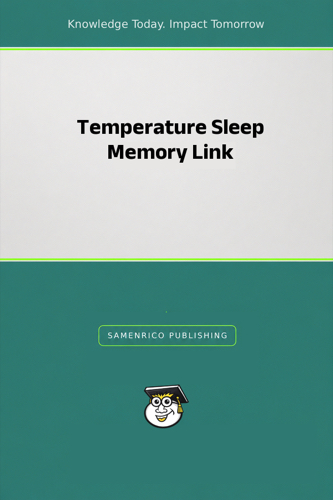
Temperature Sleep Memory Link eBook
Set your thermostat for optimal cognitive restorat
by Thomas James
Set your thermostat for optimal cognitive restoration.
Formats
Free sample
Chapter 1: The 1°C Blindspot--–- On a cool October morning in Seattle, a 34-year-old software engineer named Priya sat down for a promotion exam she had studied for over 200 hours to pass. She knew the material cold. She had aced every practice test. Her colleagues considered her the smartest person on the team. Six hours later, she walked out of the exam room in a daze.
She had failed. Not by a little—by a lot. When she reviewed her results, the feedback was baffling: "Inconsistent recall of foundational concepts. Difficulty with multi-step reasoning. Unusual number of careless errors." Priya was devastated.
She assumed she wasn't as smart as she thought. She assumed something was wrong with her memory. She assumed she needed better study habits, more sleep, or perhaps a brain supplement.What she never assumed—what almost no one ever assumes—was that the temperature of her bedroom the night before the exam had quietly destroyed her cognitive performance.Her bedroom had been at 74°F. She had felt perfectly comfortable.This chapter will show you why "comfortable" is a liar. It will introduce you to a hidden biological mechanism called Thermal Interoception, explain how your brain silently throttles its own performance when temperatures rise just one degree too high, and reveal why the thermostat is the most powerful and most ignored cognitive tool you own.
By the end of this chapter, you will never look at a temperature dial the same way again.The Most Expensive Mistake You Make Every Night Every evening, across the developed world, hundreds of millions of people perform a quiet ritual. They walk to a rectangular box on the wall, glance at a number, and either leave it alone or adjust it by a degree or two. They do this without thinking. They do this while scrolling their phones, while brushing their teeth, while mentally reviewing tomorrow's to-do list. And then they go to sleep, assuming that the number on that box has nothing to do with whether they will remember their own name in the morning.This assumption is catastrophically wrong.The number on your thermostat is not a trivial preference, like whether you like your coffee black or with cream.
It is not a matter of comfort, like choosing a soft pillow over a firm one. The temperature of your sleeping environment is a direct biological input into your brain's memory systems. It modulates the release of neurotransmitters. It controls blood flow to your hippocampus. It determines whether your brain will spend the night filing away what you learned during the day or simply fighting to keep itself cool enough to survive until morning.Here is the central claim of this book, stated clearly and backed by decades of peer-reviewed research: A sustained ambient temperature increase of just 1°C (1.8°F) above your optimal range produces a 10 percent measurable impairment in memory recall, attention, and cognitive processing speed.That is not a typo.
One degree. Ten percent.To put that in perspective, losing one hour of sleep typically impairs cognitive performance by about 5 to 8 percent, depending on the individual. Drinking a single beer impairs reaction time and working memory by roughly 10 to 15 percent, again depending on body weight and tolerance. In other words, sleeping in a room that is just 1°C too warm is biologically equivalent, in cognitive terms, to losing an hour of sleep or drinking half a beer. Sleeping in a room that is 2°C too warm?
Now you are operating at the equivalent of two hours of lost sleep or a full beer. And if your bedroom is in the mid-70s Fahrenheit—a temperature that millions of people consider perfectly normal—you are effectively showing up to work or school the next morning with the cognitive reflexes of someone who should not be behind the wheel.The Brain's Hidden Thermostat To understand why temperature has this effect, you need to meet a small, almond-shaped structure deep inside your brain called the hypothalamus. The hypothalamus is often called the brain's "fuse box" or "control center," but those metaphors undersell its importance. A better metaphor is the facility manager of a busy office building. The facility manager doesn't care whether you finish your quarterly report on time.
The facility manager cares about one thing above all else: keeping the building operational. If a pipe bursts, the facility manager shuts down the elevators to reroute power to the pumps. If a fire starts, the facility manager cuts non-essential systems to preserve the sprinklers. The facility manager is not trying to ruin your day—the facility manager is trying to keep the building from collapsing.Your hypothalamus works exactly the same way.Among its many jobs, the hypothalamus is responsible for thermoregulation—maintaining your core body temperature within a narrow, life-sustaining range of roughly 97°F to 99°F (36°C to 37°C). When your body gets too hot, the hypothalamus activates cooling mechanisms: sweating, increased blood flow to the skin, and a reduction in metabolic heat production.
When your body gets too cold, it activates warming mechanisms: shivering, reduced blood flow to extremities, and increased metabolic heat production. These are automatic, non-negotiable, and prioritized above virtually every other brain function.Here is where memory gets caught in the crossfire.Your hypothalamus does not have an unlimited budget. When it is forced to work overtime to cool an overheated body, it must divert resources—blood flow, oxygen, glucose, neural firing capacity—away from other brain regions. The first regions to lose resources are not the ones you might expect. Your brainstem (which controls breathing and heart rate) is protected.
Your motor cortex (which controls movement) is moderately protected. But your hippocampus—the seahorse-shaped structure responsible for forming new memories and transferring them to long-term storage—is extremely vulnerable to resource diversion.Think of your hippocampus as a busy librarian. During the day, it takes in new information, tags it, and prepares it for filing. At night, during deep sleep, it hands those tagged memories off to the cortex for permanent storage. This is called memory consolidation, and it is one of the most energy-intensive processes your brain performs.
When your hypothalamus is forced to prioritize cooling over consolidation, the librarian works slower. Books get misfiled. Tags fall off. Some memories never make it to the shelves at all.This is not a metaphor. This is measurable neuroscience.Thermal Interoception: The Sense You Didn't Know You Had You are familiar with the five classic senses: sight, hearing, touch, taste, and smell.
But you possess at least three additional senses that rarely make it into elementary school textbooks: proprioception (awareness of your body's position in space), nociception (the perception of pain), and thermal interoception (the perception of your own internal temperature).Thermal interoception is your brain's ability to sense not just whether the room is hot or cold, but whether your body is hot or cold. This is a different circuit than the one that tells you the air temperature. You can be in a perfectly cool room but feel overheated because you just finished a workout. Conversely, you can be in a warm room but feel chilly because you have a fever that has reset your internal…
This is the end of the free sample. Get the eBook to keep going. Buy now
About this book
Details
- Author
- Thomas James
- Publisher
- SamEnrico
- Language
- English
- Genre
- Non-Fiction, Self-Help, Sleep Temperature
- Released
- 2026-06-06
- Pages (approx.)
- 135
- Available as
- eBook, Audiobook

Read better in the ZLOADR app
Your eBooks on your phone or tablet. Sign in with your SamEnrico account and start reading.
More by Thomas James
 Kelsea Ballerini UnapologeticallyThomas James$11.99
 Name Memory for Physical TherapistsThomas James$11.99
 Low Carb Weight Loss ManualThomas James$11.99
 Detox Master ReferenceThomas James$11.99
 The Relapse Prevention PlanThomas James$11.99
 Celine Dion TitanicThomas James$11.99
 ADHD Relationship AngerThomas James$11.99
 The Cosmic Visionaries: Black Nobel Laureates Who Charted the StarsThomas James$11.99
 Shadows of the Silk Road: The Puppet Masters of Ancient PersiaThomas James$11.99
 Understanding DyslexiaThomas James$11.99
 Middle East After Sales Service GuideThomas James$12.99
 WIPO Madrid System Filing GuideThomas James$12.99