
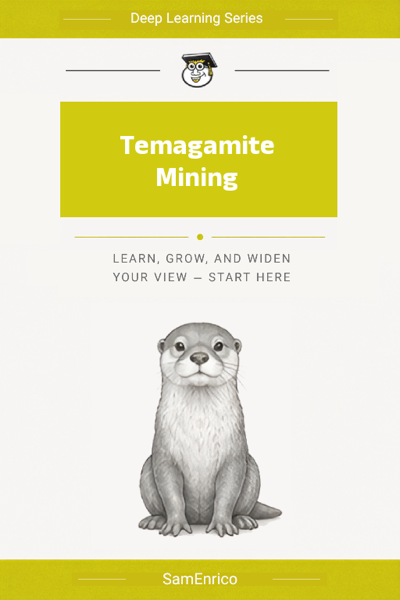
Non-FictionInformativeEducational
Temagamite Mining eBook
A Coursebook on Temagamite Mining
by Dang Tanesha
A Coursebook on Temagamite Mining
Formats
Free sample
Chapter 1: The Prospector’s Last Bet...--The old man’s hands trembled as he unrolled the stained canvas map across the pine plank table. It was August 1952, and the air inside the Temagami bush camp was thick with woodsmoke and the sour smell of wet wool. Donald Mc Kinnon had been prospecting the Canadian Shield for thirty-seven years. He had found showings of silver near Cobalt, traces of gold along the Porcupine, and enough pyrite to fill a lake. But he had never found the big one—the deposit that would let him die a rich man rather than a broke one.Outside the tent, the boreal forest stretched toward a horizon of broken rock and black water.
Lake Temagami glittered under a low overcast sky, its thousands of islands scattered like shattered pieces of a dark mirror. This was n’Daki Menan, the homeland of the Teme-Augama Anishnabai—the People of the Deep Water. Mc Kinnon knew he was a guest on their land, though in 1952, few white prospectors troubled themselves with such distinctions. He had permission to stake claims, and that was enough.What Mc Kinnon did not know—could not have known—was that he was about to stumble onto one of the strangest mineral deposits in Canadian history. He was looking for copper.
He would find copper, in quantities that would make him wealthy beyond his dreams. But hidden inside that copper, invisible to the naked eye and undetectable by the crude assays of the day, lay a mineral so rare and so chemically bizarre that it would take twenty-one years and the invention of new scientific instruments to identify it.That mineral would eventually be named temagamite, after the lake at whose shores Mc Kinnon now pitched his tent. And its discovery would force geologists to rewrite entire chapters of economic mineralogy while simultaneously exposing a dark secret: for eighteen years, miners and smelter workers had been breathing mercury vapor without knowing it, all because of a microscopic ghost hiding inside the richest copper ore ever mined in Ontario.This is the story of that ghost.The Anatomy of a Gamble Prospecting in the early 1950s was not a science. It was a faith-based enterprise conducted with a compass, a hammer, and a stomach for failure. Ninety-nine out of every hundred claims staked in the Canadian Shield amounted to nothing.
The hundredth might pay for a lifetime of the other ninety-nine. Mc Kinnon had already burned through two partnerships and three marriages. The Temagami bush was his last chance.The Temagami Greenstone Belt, where Mc Kinnon had chosen to make his final stand, is a geological anomaly. Greenstone belts are ancient volcanic sequences, typically 2.5 to 3 billion years old, that have been folded, faulted, and metamorphosed into complex structural packages. They are the recycled remnants of primordial ocean crust and island arcs, smashed together during the continent-building collisions that created the Canadian Shield.
And they are, almost without exception, rich in metals.The Abitibi Greenstone Belt to the north had already produced gold measured in tens of millions of ounces. The Wawa Belt to the west had given up copper and iron. But the Temagami Belt, in the early 1950s, remained largely unexplored. It was rugged country, dense with jack pine and black spruce, laced with lakes and muskeg, and accessible only by boat or winter trail. Few prospectors had bothered to cross the portages into its interior.Those who had, however, had noticed something peculiar.
Surface outcrops along the eastern shore of Lake Temagami showed striking copper staining—green malachite and blue azurite coating fractured rhyolite like moss on a tombstone. The old timers called it "green rock" and generally walked past it, assuming the copper had been leached out by weathering. Mc Kinnon, who had learned his trade in the Cobalt silver camp, knew that strong surface staining often meant a rich primary sulfide body at depth.He was right. But he had no idea how right.The Claim That Changed Everything On August 17, 1952, Mc Kinnon and his partner, a young surveyor named William Hughes, paddled a leaky cedar canoe into a small bay on the eastern shore of Lake Temagami. The bay was unremarkable—steep rock walls, a narrow beach of broken slate, blackflies in biblical proportions.
But the rock outcrops on the north side of the bay showed heavy copper staining over a width of nearly thirty meters.Mc Kinnon’s heart rate, already elevated by the paddle, climbed further. He pulled out his compass and began walking the boundaries of what would become claim C-3182. Hughes followed behind, hammer in hand, chipping samples from every visible outcrop. The rock was massive chalcopyrite—a brass-yellow copper-iron sulfide so rich that it looked like manufactured metal rather than natural ore. Mc Kinnon had seen chalcopyrite before, but never like this.
The stuff was almost pure.He filled a burlap sack with samples and paddled back to camp in near-darkness, his mind racing. The nearest smelter was at Noranda, nearly four hundred kilometers to the south. The nearest railhead was in North Bay, a day’s wagon haul from the lake. But if the grade held—if the ore was as rich as it looked—none of that would matter. High-grade copper could pay for its own transportation.What Mc Kinnon did not yet know was that the chalcopyrite he had just discovered was not merely high-grade.
It was, by some measures, the richest copper ore ever found in Canada. Assays would later confirm that selected samples ran as high as 28 percent copper, along with significant silver and gold values. Most copper mines operate at grades between 0.5 and 5 percent. At 28 percent, Mc Kinnon’s discovery was not a mine. It was a treasure vault.The Copperfields Mine Takes Shape News of the discovery spread quickly through the small world of Canadian mining finance.
By the spring of 1953, a syndicate had been formed to develop the property. By 1954, the Copperfields Mine—named for the obvious richness of its ore—was in full-scale production.The mine was unusual from the start. Most base metal mines require a mill: a processing plant that crushes the ore, grinds it to a fine powder, and uses froth flotation to separate the valuable sulfide minerals from the worthless gangue (the host rock that contains no economic metals). The Copperfields ore was so rich, and the chalcopyrite so pure, that a mill was deemed unnecessary. The ore was simply crushed to a manageable size at a small custom facility adjacent to the mine, then loaded directly into rail cars and shipped to the Noranda smelter.This decision was economically brilliant but scientifically blind.
Because the ore was never processed through a concentration circuit—never ground fine enough to liberate individual mineral grains—no one ever looked at it under a microscope. The mine operated as a simple extraction and shipping operation. Ore went in one end of the crusher and came out the other as fist-sized chunks of nearly pure chalcopyrite, destined for the smelting furnaces.In the first year of operation, Copperfields produced over ten million pounds of copper. By 1956, production had doubled. The mine was a cash machine, generating profits that…
This is the end of the free sample. Get the eBook to keep going. Buy now
About this book
Details
- Author
- Dang Tanesha
- Publisher
- SamEnrico
- Language
- English
- Genre
- Non-Fiction, Informative, Educational
- Released
- 2026-06-02
- Pages (approx.)
- 158
- Available as
- eBook, Audiobook

Read better in the ZLOADR app
Your eBooks on your phone or tablet. Sign in with your SamEnrico account and start reading.
More by Dang Tanesha
 Open Relationship Stress GuideDang Tanesha$11.99
 Meeting Cost Calculator GuideDang Tanesha$11.99
 Flow Success StoriesDang Tanesha$11.99
 Intuitive Eating for BingeDang Tanesha$11.99
 The Stimulus Control Eating GuideDang Tanesha$11.99
 The Labyrinth’s Last Laugh: The Minotaur’s Unfinished RevengeDang Tanesha$11.99
 Understanding Wernicke's EncephalopathyDang Tanesha$17.99
 Madrid for SMEsDang Tanesha$12.99
 Ghana Intellectual Property GuideDang Tanesha$12.99
 How to Start a Blanks Made of Aluminium Business (Beginners Guide)Dang Tanesha$11.99
You may also like
 Hong Kong Handover 1997Dunn Johnnie$11.99
 Zumba For Postnatal Recovery CourseNeal Christian$11.99
 Zumba for BeginnersLadner Nikia$11.99
 YouTube Comment Mining GuideHumes Pandora$12.99
 Worry Box MeditationCarlin Rudy$11.99
 Workplace Stress MeditationNguyen Lynn$11.99
 Workplace Stress and Sleep RepairHawley Ivory$11.99
 Workplace Perfectionism CureDelaney Jeffry$11.99
 Workplace Injustice Anger GuideWallen Isabelle$11.99
 Work Addiction and Burnout LinkGreenwood Ester$11.99
 Women in Yoga and WellnessBeattie Galina$11.99
 Women in Stand Up ComedyChun Evangeline$11.99