
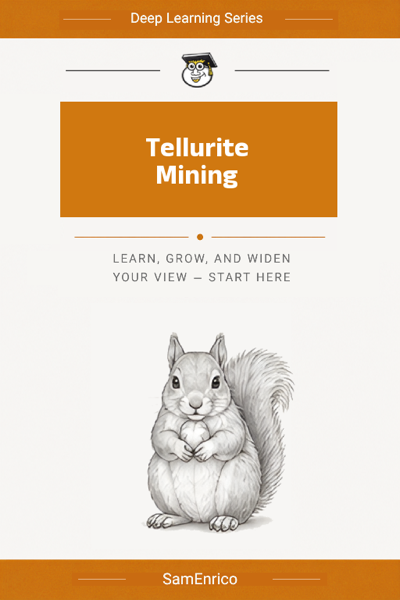
Non-FictionInformativeEducational
Tellurite Mining eBook
A Coursebook on Tellurite Mining
by Silver Adell
A Coursebook on Tellurite Mining
Formats
Free sample
Chapter 1: The Garlic Breath...--For most people, the word "mining" conjures images of coal-blackened faces, glittering gold veins, or the massive terraced pits of copper porphyries. It does not, for almost anyone, summon the image of a material so strange that its mere presence in the human body causes the breath to reek of garlic for weeks—a material that is neither a precious metal nor a base metal, but something in between; a material that is never mined for itself, yet without which the global transition to renewable energy would be severely handicapped. That material is tellurium, and the story of how it moves from obscure mineral veins deep in the earth to the thin-film solar panels on your neighbor's roof is one of geology, metallurgy, and a peculiar economic logic that defies every rule of conventional mining.This book is about tellurite mining—but as you will discover, the title is deliberately provocative. There is no such thing as a tellurite mine. There never has been, and there likely never will be.
Tellurium, element number 52 on the periodic table, sitting quietly between antimony and iodine, is what economists call a "byproduct metal." It is recovered as an afterthought, a trace impurity in copper and gold ores that would otherwise be discarded into smelter slag or lost in tailings. The very concept of "tellurite mining" is therefore a paradox: the most critical steps in tellurium production happen not in a dedicated mine, but inside a copper refinery's electrorefining tanks, where anode slimes—the dark, muddy residue that settles at the bottom—concentrate tellurium to levels that make recovery profitable. To master tellurium extraction, one must first abandon the assumption that valuable metals come from their own mines.Why does this obscure byproduct matter? The answer lies in a solar panel. Cadmium telluride (Cd Te) thin-film photovoltaics, manufactured primarily by First Solar and a handful of Chinese producers, represent the lowest-cost solar energy technology on the planet.
A Cd Te panel uses approximately 5 grams of tellurium per square meter—a tiny amount, but multiplied across the gigawatts of solar capacity being installed annually, the demand becomes staggering. Global tellurium production hovers around 500 tons per year. Global demand is roughly the same. The market is perpetually balanced on a knife's edge, and that balance depends entirely on how much copper and gold the world happens to be mining this year.The Element That History Forgot Tellurium was discovered in 1782 by Franz-Joseph Müller von Reichenstein, a Transylvanian mining official who was trying to solve a puzzle. In the gold ores of the Zlatna mine (then part of the Habsburg Empire, now in Romania), Müller kept finding a mysterious metallic substance that did not behave like any known metal.
It was brittle, like antimony, but had a distinct metallic luster. It formed compounds that smelled strangely when heated. Müller spent three years analyzing the material, publishing his findings as "metallum problematum"—the problem metal. He could not identify it.The element was finally named in 1798 by the German chemist Martin Heinrich Klaproth, who isolated it and recognized it as a new element. Klaproth named it "tellurium" from tellus, the Latin word for earth.
(He had previously named uranium after the planet Uranus, following a similar astronomical theme.) Klaproth's choice was prophetic: tellurium would prove to be an element deeply tied to the earth's geological processes, forming in the final, low-temperature stages of hydrothermal vein formation, filling the last cracks and vugs in gold-quartz systems.For the next 150 years, tellurium remained a laboratory curiosity. It found minor uses as an alloying additive to lead (improving mechanical strength and corrosion resistance) and as a vulcanization accelerator in rubber manufacturing. But it was not until the late 20th century, with the development of cadmium telluride solar cells, that tellurium's true potential—and its supply chain vulnerability—became apparent.What This Book Is (And Is Not)This is a coursebook. It is designed for mining engineers, metallurgists, exploration geologists, and students of critical minerals who need a comprehensive, practical guide to every stage of tellurium's journey from rock to refined metal. It assumes no prior knowledge of tellurium specifically, but does assume a basic familiarity with mineralogy, extractive metallurgy, and mining economics.
Where technical terms are introduced, they are defined; where advanced concepts are required, they are explained.The book is organized in three parts. Part I (Chapters 2 through 4) covers the foundations of tellurium geology: the mineralogy of telluride ores, the paragenetic sequence that places tellurides at the very end of hydrothermal systems, the deposit types that concentrate tellurium to economic levels, and the geochemical techniques used to find these deposits. Part II (Chapters 5 through 7) covers metallurgy and extraction: how tellurium is concentrated by flotation, how anode slimes are roasted and leached, and how the metal is refined to 99.99% purity. Part III (Chapters 8 through 12) covers legacy, environment, and the future: the fate of tellurium in mine tailings, the circular economy of recycling tellurium from end-of-life solar panels, the health and safety hazards of working with tellurium compounds, the byproduct economics that make tellurium uniquely vulnerable to supply shocks, and the unconventional resources—deep-sea nodules, ionic liquids, and tellurium-reducing bacteria—that could reshape tellurium supply in the coming decades.What this book is not is a collection of academic papers stitched together. It is a teaching text, written with the explicit goal of making a complex, niche topic accessible to practitioners who need to understand tellurium quickly and thoroughly.
Every chapter includes case studies from real mining operations—Boulder County, Colorado; Kennecott, Utah; Cripple Creek, Colorado; the Golden Mile of Kalgoorlie, Australia. Every technical claim is grounded in published literature, cited throughout.The Central Paradox: A Metal Without Mines Let us confront the central paradox immediately. Tellurium is a critical mineral—the European Union and United States Geological Survey both list it as such—but there is not, and has never been, a single mine that operates for the primary purpose of extracting tellurium. This is not an accident of economics; it is a fundamental consequence of tellurium's geochemistry and mineralogy.Tellurium is a chalcophile element, meaning it has an affinity for sulfur. In the earth's crust, tellurium substitutes for sulfur in sulfide minerals like chalcopyrite (Cu Fe S2Cu Fe S_2Cu Fe S2) and pyrite (Fe S2Fe S_2Fe S2).
But it does so at very low concentrations: the average crustal abundance of tellurium is a mere 0.001 parts per million (1 ppb). For context, gold—itself a rare metal—has an average crustal abundance of 0.004 ppm, four times higher. Tellurium is genuinely scarce in the earth's crust.However, geological processes can concentrate tellurium dramatically. In hydrothermal systems—hot, metal-rich fluids that circulate through the earth's crust—tellurium partitions into the fluid phase as soluble complexes. As the fluid cools and reacts with wall rocks, tellurium precipitates as discrete telluride minerals.
In epithermal gold veins (formed at temperatures between 150 and 250°C), tellurium can reach grades of hundreds or even thousands of parts per million. In porphyry copper deposits (formed at higher temperatures), tellurium substitutes into chalcopyrite at levels of 2 to 10 parts per million.The economic logic of tellurium production follows from these…
This is the end of the free sample. Get the eBook to keep going. Buy now
About this book
Details
- Author
- Silver Adell
- Publisher
- SamEnrico
- Language
- English
- Genre
- Non-Fiction, Informative, Educational
- Released
- 2026-06-02
- Pages (approx.)
- 138
- Available as
- eBook, Audiobook

Read better in the ZLOADR app
Your eBooks on your phone or tablet. Sign in with your SamEnrico account and start reading.
More by Silver Adell
 Mindfulness Based Burnout Prevention CourseSilver Adell$11.99
 The Mindful Movement GuideSilver Adell$11.99
 Ayurvedic Morning Rituals GuideSilver Adell$11.99
 Teen Self Esteem and DatingSilver Adell$11.99
 Navigating Microaggressions at WorkSilver Adell$11.99
 Peleus and Thetis: A Wedding Cursed by the FatesSilver Adell$11.99
 How to Start a Specialty Hospital BusinessSilver Adell$11.99
 Understanding MetachondromatosisSilver Adell$17.99
 Chile Data Protection Law GuideSilver Adell$12.99
 Change Request Impact PromptsSilver Adell$12.99
You may also like
 Hong Kong Handover 1997Dunn Johnnie$11.99
 Zumba For Postnatal Recovery CourseNeal Christian$11.99
 Zumba for BeginnersLadner Nikia$11.99
 YouTube Comment Mining GuideHumes Pandora$12.99
 Worry Box MeditationCarlin Rudy$11.99
 Workplace Stress MeditationNguyen Lynn$11.99
 Workplace Stress and Sleep RepairHawley Ivory$11.99
 Workplace Perfectionism CureDelaney Jeffry$11.99
 Workplace Injustice Anger GuideWallen Isabelle$11.99
 Work Addiction and Burnout LinkGreenwood Ester$11.99
 Women in Yoga and WellnessBeattie Galina$11.99
 Women in Stand Up ComedyChun Evangeline$11.99