
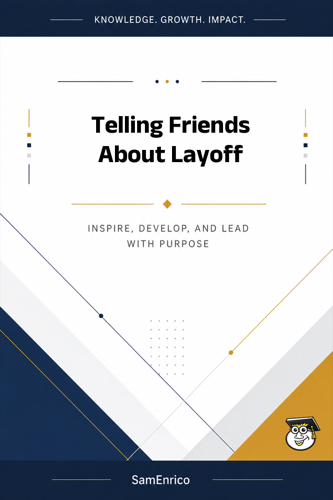
Telling Friends About Layoff eBook
undefined
undefined
Formats
Free sample
Chapter 1: The Silent Hour--The most dangerous person you will talk to after a layoff is not your boss, not your mother, and not the recruiter who ghosts you. The most dangerous person is your best friend, and the most dangerous moment is the thirty minutes between walking out of the office and sitting down alone in your car. In that half-hour window, your brain is flooded with a chemical cocktail of shock, shame, anger, and fear. Your prefrontal cortex—the part of your brain responsible for rational decision-making—is essentially offline. You are not capable of telling a coherent story.
You are not capable of assessing whether the person on the other end of the phone will help or harm. And yet, nearly every single person who has ever been laid off picks up the phone anyway. They call their best friend, their spouse, their parent, or their former colleague, and they unleash a raw, unfiltered version of events that they will spend the next six months apologizing for, walking back, or simply cringing at in the middle of the night. This chapter is designed to stop you from making that call. It will teach you how to sit alone with the news for exactly sixty minutes—not a day, not a week, just one hour—so that when you finally do speak, you speak from strategy, not from wound.The Faux-Fired Epidemic Before we can talk about what to do in the first hour, we need to talk about what actually happened to you.
This sounds obvious, but it is not. In more than a decade of coaching people through job loss, I have discovered that nearly forty percent of people cannot accurately name what happened to them in the first week. They use the word "layoff" as a catch-all for restructuring, performance dismissal, constructive dismissal, and even quiet firing. These are not the same thing. They require different emotional responses, different legal strategies, and most importantly for this book, different scripts for telling your friends.Let me introduce you to three people.
Sarah was a marketing director at a tech startup. The company ran out of funding and eliminated her entire department of twelve people. She received a severance package, a positive reference, and an offer to extend her health insurance for three months. That is a true layoff. It is economic, impersonal, and carries no performance judgment whatsoever.Marcus was a regional sales manager who missed his quota for three consecutive quarters.
His manager put him on a formal performance improvement plan, and when he failed to meet the metrics outlined in that plan, he was terminated with one week of severance. That is being fired. It is performance-based, personal, and carries a judgment about his work in that specific role.Priya was a senior product manager who clashed with her new boss. Her boss began excluding her from meetings, reassigning her projects to junior staff, and criticizing her work in public channels. After three months of this, Priya was given a choice: resign with two months of severance or be terminated for "performance issues" with no severance at all.
She resigned. That is what I call being faux-fired. It is a constructive dismissal—a situation where the employer makes conditions so unbearable that you feel you have no choice but to leave.The distinction matters enormously for the conversations you are about to have with your friends. If you were truly laid off, your script is simple and clean: "My role was eliminated due to economic reasons. It had nothing to do with my performance." If you were fired, your script requires more nuance and vulnerability: "I was let go because I wasn't meeting the expectations of the role.
I'm taking responsibility for that and figuring out what's next." If you were faux-fired, your script is the most complex and requires the most discernment about who you tell: "I left my job under circumstances that I'm still processing. For now, the important thing is that I'm moving forward."Notice that none of these scripts includes the words "they screwed me," "it was so unfair," "I can't believe they did this to me," or "I guess I'm just not good enough." Those are the scripts of the first thirty minutes—the scripts you will use if you call your friend before you have diagnosed what actually happened. The Silent Hour exists precisely to prevent you from locking in a false or self-destructive narrative that you will later regret.The Severance Illusion Let us talk about money, because money is the thing that will make you want to call someone immediately after the layoff. You have just received a severance document. It might be one page.
It might be ten pages. It almost certainly contains numbers that will determine your financial life for the next several months. Your first instinct will be to text a screenshot to your most financially savvy friend or to call your parents and ask, "Is this good?" Do not do this.Severance is a negotiation, not a value statement. This is the single most important financial insight you can have in the first hour. The number on that paper is not a reflection of your worth as an employee or a human being.
It is a business calculation made by a company that is trying to minimize its legal liability while also managing its budget. That number is almost always negotiable, especially if you have been with the company for more than two years or if you are over the age of forty. And the negotiation window is usually quite short—often between seven and twenty-one days from the date of termination.But here is the problem: you cannot negotiate from a position of panic. And you cannot get good advice from a friend who does not understand employment law in your specific jurisdiction, even if that friend is a lawyer in an unrelated field. This is why I have developed what I call the Severance Advisory Team framework.
You will need exactly three types of people to help you with severance, and none of them is your best friend from college who once took a business law class.The first member of your Severance Advisory Team is an employment lawyer. You need this person if your severance offer is complex (multiple pages, non-compete clauses, confidentiality agreements, or release of claims), if your deadline to sign is short (less than fourteen days), or if you were faux-fired and believe you may have a claim for wrongful termination. You do not need to hire a lawyer for a full review if your offer is simple and generous and you understand all of its terms. But you should at least consult one. Many employment lawyers offer a free thirty-minute consultation.
Use it.The second member of your Severance Advisory Team is a financial advisor or an accountant. You need this person if your severance includes stock options, restricted stock units, retirement account considerations, or a lump sum that exceeds three months of your salary. Even if your severance is simple, a financial advisor can help you understand the tax implications of taking a lump sum versus…
This is the end of the free sample. Get the eBook to keep going. Buy now
About this book
Details
- Author
- Vickers Sparkle
- Publisher
- SamEnrico
- Language
- English
- Genre
- Non-Fiction, Self-Help / Social
- Released
- 2026-06-10
- Pages (approx.)
- 130
- Available as
- eBook, Audiobook

Read better in the ZLOADR app
Your eBooks on your phone or tablet. Sign in with your SamEnrico account and start reading.
More by Vickers Sparkle
 Breast Health For Jewish WomenVickers Sparkle$11.99
 Stress and Diabetes Risk GuideVickers Sparkle$11.99
 Divorce Recovery TimelineVickers Sparkle$11.99
 Sleep Music Delta WavesVickers Sparkle$11.99
 The Growth Mindset for TeensVickers Sparkle$11.99
 Team Creativity for WritersVickers Sparkle$11.99
 Persuasion for ArchitectsVickers Sparkle$11.99
 The Great British Brainwash: How a Nation’s Mind Was MoldedVickers Sparkle$11.99
 The Fires of Enterprise: Black Entrepreneurs Who Built EmpiresVickers Sparkle$11.99
 How to Produce Cordless TelephonesVickers Sparkle$11.99
 Edible Frogs: The Frog Leg Industry & Species GuideVickers Sparkle$11.99
 Nostro Vostro Account OptimizationVickers Sparkle$12.99
You may also like
 Hong Kong Handover 1997Dunn Johnnie$11.99
 Zumba For Postnatal Recovery CourseNeal Christian$11.99
 Zumba for BeginnersLadner Nikia$11.99
 YouTube Comment Mining GuideHumes Pandora$12.99
 Worry Box MeditationCarlin Rudy$11.99
 Workplace Stress MeditationNguyen Lynn$11.99
 Workplace Stress and Sleep RepairHawley Ivory$11.99
 Workplace Perfectionism CureDelaney Jeffry$11.99
 Workplace Injustice Anger GuideWallen Isabelle$11.99
 Work Addiction and Burnout LinkGreenwood Ester$11.99
 Women in Yoga and WellnessBeattie Galina$11.99
 Women in Stand Up ComedyChun Evangeline$11.99