

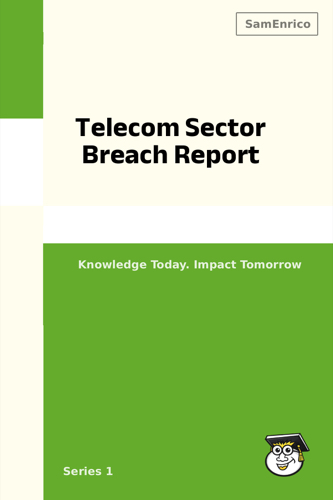
Non-FictionAnnual CheckupTelecom Security
Telecom Sector Breach Report eBook
Document SS7 attacks, SIM swapping, and network in
Document SS7 attacks, SIM swapping, and network infrastructure compromises.
Formats
Free sample
Chapter 1: The Roaming Trust Paradox...--–- The first lie your phone tells you every day is that it belongs to you.Your phone sits in your pocket, palm, or nightstand for sixteen waking hours. It knows your location, your contacts, your bank balance, your medical appointments, your private conversations, and the faces of your children. You pay for it. You insure it. You would notice if someone stole it.But someone doesn't need to steal your phone to own it.
They don't need to pick your pocket, hack your i Cloud, or install spyware. They don't need to be in the same country, or even the same continent. All they need is a phone number—your phone number—and access to a hidden network that most people have never heard of, but that connects every mobile device on Earth.This network is called the signaling system. Its job is simple: to make your phone work when you cross a border, receive a call from a different carrier, or send a text message to someone on another network. It is the invisible plumbing of global telecommunications, and it was designed in the 1980s by engineers who assumed that only trusted, state-owned telephone companies would ever touch it.
They did not build in encryption, authentication, or even basic access controls. They built a system based entirely on trust.That trust has been broken for decades. We just didn't want to admit it.The first public proof arrived in 2014, when a German security researcher named Karsten Nohl stood on stage at the Chaos Communication Congress in Hamburg and demonstrated something that should have been impossible. He showed that he could track any phone number in real time, intercept text messages, and even record phone calls—all using nothing but a laptop and a cheap software-defined radio connected to a rogue mobile network. The audience of hackers and journalists sat in stunned silence as Nohl tracked a volunteer's phone across the stage, pinpointing their location to within a few hundred meters."It's not a bug," Nohl told the room.
"It's a feature. This is how the network was designed."The room erupted. Within weeks, headlines around the world declared that every mobile phone was vulnerable. Regulators promised action. Carriers issued press releases insisting they had fixed the problems.
And then, as with most stories about invisible infrastructure, the public forgot.But the attackers did not forget. They got better.The Architecture of Invisible Trust To understand how your phone number became a weapon, you have to understand the two protocols that move your calls, texts, and location data across the planet. The first is called SS7—Signaling System No. 7—and it is the foundation of almost every mobile network built before 2015. The second is called Diameter, which was supposed to replace SS7 in 4G and 5G networks but ended up replicating most of its flaws.Imagine, for a moment, that the global telephone network is a massive hotel.
You check into this hotel by inserting a SIM card into your phone. The front desk—called the Home Location Register, or HLR—writes down your name, your room number, your preferences, and your secret key. When you travel to another country, you become a roaming guest. The hotel in that country—called the Visitor Location Register, or VLR—calls your home hotel and asks, "Is this person really a guest? What services should they have access to?"Your home hotel says yes, because it trusts the foreign hotel.
It has to. That's how roaming works.SS7 is the language these hotels use to talk to each other. It consists of dozens of commands, each designed to perform a specific task. The Send Routing Info command asks, "Where is this person right now?" The Provide Subscriber Location command asks for GPS coordinates. The Update Location command says, "This person has moved to a new hotel—update your records." The Insert Subscriber Data command says, "Here is this person's secret key and service profile—store it."None of these commands require a password.
None of them are encrypted. None of them verify that the person asking the question is actually authorized to ask it. The only security is the assumption that only legitimate hotels would ever speak the language.That assumption was broken the moment countries began privatizing their telephone monopolies in the 1990s. Suddenly, there were hundreds of hotels, not dozens. Some of them were tiny operations with minimal security.
Some were run by people with criminal connections. Some were established specifically to resell roaming access to anyone with cash.By 2015, you could rent access to a signaling gateway for a few hundred dollars a month. By 2020, you could buy a preconfigured SS7 hacking appliance on the dark web for $10,000. The appliance came with a point-and-click interface, customer support, and a money-back guarantee. One vendor even offered a referral bonus.The Deregulation Disaster The story of how SS7 became a global vulnerability is not a story about evil hackers or incompetent engineers.
It is a story about deregulation, competition, and the law of unintended consequences.Before 1984, most countries operated their telephone networks as state-owned monopolies. The engineers who designed SS7 assumed that only a small, trusted group of operators would ever connect to the network. They knew each other. They signed contracts with each other. They had legal recourse if something went wrong.
Security was built on relationships, not technology.Then the world changed. The United States broke up AT&T in 1984. The United Kingdom privatized British Telecom the same year. Japan followed in 1985. By the late 1990s, dozens of countries had opened their telecom markets to competition.
New carriers appeared overnight, eager to capture market share by offering cheaper roaming rates, international calling, and wholesale signaling services.These new carriers needed to connect to the existing network. And the existing network, designed for a closed community of trusted partners, had no mechanism to say no. If you could pay for a roaming agreement—or convince an existing carrier to peer with you—you could send SS7 commands to any other carrier in the world.The result was a sprawling, chaotic web of interconnections. A carrier in Germany might have a roaming agreement with a carrier in Turkey, which had an agreement with a carrier in Pakistan, which had an agreement with a carrier in Indonesia, which had an agreement with a carrier in the Caribbean that was run by two people in a back office with no security training and a default password on their signaling gateway.That Caribbean carrier became a backdoor into the German carrier's network. And no one noticed until the damage was done.The Attackers Who Figured It Out First The first people to weaponize SS7 were not criminals.
They were intelligence agencies.In the early 2000s, signals intelligence agencies like the NSA, GCHQ, and Israel's Unit 8200 realized that SS7 offered a treasure trove of data. They could track targets across borders without needing a warrant, a wiretap, or physical access to a device. They could intercept text messages and phone calls in real time. They could insert false location data to confuse adversaries. And because SS7 was designed without…
This is the end of the free sample. Get the eBook to keep going. Buy now
About this book
Details
- Author
- Banda Jenelle
- Publisher
- SamEnrico
- Language
- English
- Genre
- Non-Fiction, Annual Checkup, Telecom Security
- Released
- 2026-06-10
- Pages (approx.)
- 141
- Available as
- eBook, Audiobook

Read better in the ZLOADR app
Your eBooks on your phone or tablet. Sign in with your SamEnrico account and start reading.
More by Banda Jenelle
 Emergency Department NaloxoneBanda Jenelle$11.99
 Content Batching for SuccessBanda Jenelle$11.99
 The Early Career Self EsteemBanda Jenelle$11.99
 Punu White Mask LoreBanda Jenelle$11.99
 The Voice That Shaped a Nation: George Augustus Sala and the Birth of Modern JournalismBanda Jenelle$11.99
 Collaborative LawBanda Jenelle$11.99
 How to Become a Optical-glass EtcherBanda Jenelle$11.99
 GA4 Real Time Report GuideBanda Jenelle$12.99
 Car Rental GuideBanda Jenelle$12.99
 Understanding Powell–venencie–gordon SyndromeBanda Jenelle$17.99
You may also like
 Hong Kong Handover 1997Dunn Johnnie$11.99
 Zumba For Postnatal Recovery CourseNeal Christian$11.99
 Zumba for BeginnersLadner Nikia$11.99
 YouTube Comment Mining GuideHumes Pandora$12.99
 Worry Box MeditationCarlin Rudy$11.99
 Workplace Stress MeditationNguyen Lynn$11.99
 Workplace Stress and Sleep RepairHawley Ivory$11.99
 Workplace Perfectionism CureDelaney Jeffry$11.99
 Workplace Injustice Anger GuideWallen Isabelle$11.99
 Work Addiction and Burnout LinkGreenwood Ester$11.99
 Women in Yoga and WellnessBeattie Galina$11.99
 Women in Stand Up ComedyChun Evangeline$11.99