
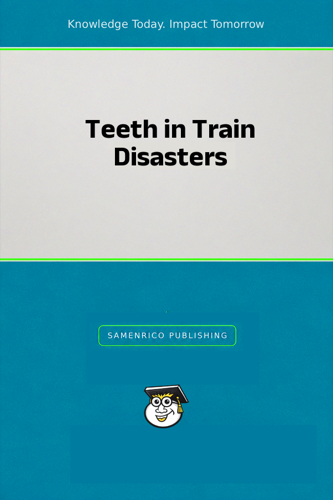
Teeth in Train Disasters eBook
undefined
undefined
Formats
Free sample
Chapter 1: The Last Witnesses--The human body is a fragile thing, but it hides secrets in places we rarely think about. When a train collapses at speed—when carriages telescope into one another like crumpled paper, when fire sweeps through twisted metal, when bodies are reduced to fragments scattered across kilometers of track—the soft tissues fail first. Skin melts. Muscle chars. Organs liquefy or vaporize.
Fingerprints disappear. Faces become unrecognizable. DNA degrades in the heat. Families wait, sometimes for years, for answers that may never come.But teeth remain.They are the last witnesses to the worst moments of human existence. Enamel, the outer layer of every tooth, is the hardest substance the human body produces—harder than bone, harder than steel on a microhardness scale.
A single molar can withstand temperatures that turn the rest of a body to ash. It can survive impacts that shatter skulls into dozens of fragments. It can be thrown fifteen meters from its owner, buried in mud, soaked in jet fuel, baked in a fire that reaches 1,000 degrees Celsius, and still, when a forensic odontologist picks it up with gloved hands, that tooth holds answers.This book is about those answers. It is about a small, highly specialized group of forensic professionals—dentists who have crossed over into the world of death investigation—who have made it their life's work to read the stories written in enamel, dentin, and pulp. And it is about a specific kind of catastrophe that presents unique challenges unlike any other: the train disaster.I have spent more than twenty years working rail mass fatalities across three continents.
I have stood inside crushed carriages while structural engineers told me I had twenty minutes before the wreck shifted. I have reassembled shattered jaws on stainless steel tables, piece by piece, like three-dimensional puzzles with stakes that cannot be measured in anything less than human grief. I have testified in courtrooms, faced down defense attorneys who wanted to dismantle my conclusions, and watched families receive the one thing they needed more than justice: a name to put on a grave.This chapter is not a technical manual. Those will come later. This chapter is an answer to a question I have been asked, in one form or another, by every journalist, every law student, every curious stranger who has ever learned what I do for a living.
The question is always the same, delivered with a mixture of horror and fascination: Why teeth?Why do teeth survive when almost nothing else does? How can a structure so small, so seemingly fragile, outlast bone and tissue and sometimes even the steel of the train itself? And what, exactly, can a tooth tell you about how a person died, who they were, and where they came from?The answers begin with evolution, move through physics, and end in the cold, fluorescent-lit rooms where the dead are identified. This is the foundation upon which everything else in this book is built.The Unbreakable Envelope To understand why teeth are the forensic gold standard in mass disasters, you must first understand what a tooth actually is. Most people think of teeth as simple white pegs embedded in bone.
This is like thinking of a smartphone as a piece of glass and plastic. The reality is far more complex, and far more remarkable.A human tooth consists of four distinct tissue types, each with its own properties and each contributing to the tooth's extraordinary survivability. The outermost layer is enamel, and it is a biological marvel. Enamel is composed of approximately ninety-six percent hydroxyapatite—a crystalline calcium phosphate mineral—by weight. The remaining four percent is water and organic material, but that tiny fraction of organic content is what gives enamel its resilience.
Pure mineral would be brittle, like glass. The organic matrix within enamel acts as a shock absorber, allowing the crystal structure to flex slightly under impact rather than shattering catastrophically.The hardness of enamel is measured on the Mohs scale, which ranks minerals from one (talc) to ten (diamond). Enamel ranks between five and six. For comparison, pure iron ranks at four. Your teeth are harder than iron.
This is not an accident of evolution. Our ancestors spent millions of years grinding plant material, cracking nuts, and occasionally using their teeth as tools. Natural selection favored individuals with tougher enamel, and over deep time, human teeth became something extraordinary: biological ceramic armor.Below the enamel lies dentin, a yellowish tissue that makes up the bulk of the tooth's structure. Dentin is less hard than enamel—ranking about three on the Mohs scale—but it is significantly tougher. It has a higher organic content, approximately twenty percent by weight, which gives it flexibility.
When a force strikes a tooth, the hard enamel cracks or chips first, absorbing energy. The dentin beneath deforms slightly, distributing the remaining force across a wider area. This two-layer system—hard shell over tough core—is the same design principle used in ceramic body armor. Evolution solved the problem of impact resistance millions of years before humans invented bulletproof vests.At the center of the tooth lies the pulp chamber, a small cavity filled with soft tissue: blood vessels, nerves, and specialized cells called odontoblasts. The pulp is the living part of the tooth.
It is also, from a forensic perspective, the most valuable part. The pulp chamber is a sealed environment, protected by dentin and enamel. When a body burns, the soft tissues of the pulp may be destroyed, but the chamber itself remains intact. More importantly, the pulp contains DNA. And because the pulp chamber is sealed, that DNA is often preserved even when the rest of the body has been reduced to fragments.Finally, surrounding the root of the tooth is cementum, a bonelike tissue that anchors the tooth into the jaw via the periodontal ligament.
Cementum has the remarkable property of growing incrementally throughout life, depositing annual layers much like tree rings. These layers, visible under a microscope, can be counted to estimate age at death with surprising accuracy—a technique called cementum annulation that we will explore in detail in Chapter 8.This four-part structure—enamel, dentin, pulp, cementum—makes the tooth a unique biological artifact. It is hard enough to survive mechanical trauma. It is tough enough to absorb impact without complete destruction. It contains a sealed DNA repository.
And it records biological information over time, like a tiny, personal archive. No other part of the human body offers this combination of durability and information density.The Physics of Disaster Understanding the tooth is only half the equation. To understand why teeth are so valuable in rail disasters specifically, you must also understand what happens to the human body when a train crashes.Consider the physics of a high-speed rail collision. A modern passenger train traveling at 130 kilometers per hour (approximately 80 miles per hour) has enormous kinetic energy. The formula is simple: kinetic energy equals one-half mass times velocity squared.
A single fully loaded passenger carriage might weigh 40,000 kilograms. At 130 kilometers per hour, that carriage carries approximately 26 million joules of kinetic energy. For perspective, a .50 caliber machine gun round carries…
This is the end of the free sample. Get the eBook to keep going. Buy now
About this book
Details
- Author
- Macklin Spring
- Publisher
- SamEnrico
- Language
- English
- Genre
- Non-Fiction, True Crime / Rail
- Released
- 2026-06-07
- Pages (approx.)
- 149
- Available as
- eBook, Audiobook

Read better in the ZLOADR app
Your eBooks on your phone or tablet. Sign in with your SamEnrico account and start reading.
More by Macklin Spring
 Self Hypnosis for Interstitial CystitisMacklin Spring$11.99
 Kayaker Hypnosis WorkbookMacklin Spring$11.99
 Water Before CoffeeMacklin Spring$11.99
 Group Creative Resistance GuideMacklin Spring$11.99
 The Dubai Student Exit GuideMacklin Spring$11.99
 Remote Feedback DeliveryMacklin Spring$11.99
 Acupuncture for Postpartum RecoveryMacklin Spring$11.99
 The Minstrels of Camelot: How Medieval Troubadours Shaped Arthurian LegendMacklin Spring$11.99
 The Green War: Agent Orange and the Poisoning of VietnamMacklin Spring$11.99
 How to Produce Pillowcases and ShamsMacklin Spring$11.99
 How to Produce DenturesMacklin Spring$11.99
 Kenyan Entrepreneurial Culture GuideMacklin Spring$12.99
You may also like
 Hong Kong Handover 1997Dunn Johnnie$11.99
 Zumba For Postnatal Recovery CourseNeal Christian$11.99
 Zumba for BeginnersLadner Nikia$11.99
 YouTube Comment Mining GuideHumes Pandora$12.99
 Worry Box MeditationCarlin Rudy$11.99
 Workplace Stress MeditationNguyen Lynn$11.99
 Workplace Stress and Sleep RepairHawley Ivory$11.99
 Workplace Perfectionism CureDelaney Jeffry$11.99
 Workplace Injustice Anger GuideWallen Isabelle$11.99
 Work Addiction and Burnout LinkGreenwood Ester$11.99
 Women in Yoga and WellnessBeattie Galina$11.99
 Women in Stand Up ComedyChun Evangeline$11.99