
Non-FictionSelf-HelpTeen Development
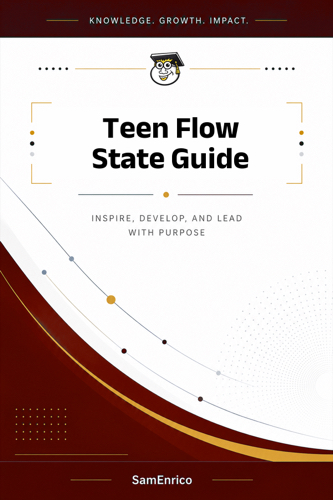
Teen Flow State Guide eBook
Helps adolescents find flow in school and hobbies.
Helps adolescents find flow in school and hobbies.
Formats
Free sample
Chapter 1: Your Brain’s Secret Superpower...--You know that feeling when you’re playing a video game and suddenly you look up and three hours have vanished? Or when you’re sketching something, lost in the lines, and you don’t even hear your mom call you for dinner? Or when you’re practicing a guitar riff over and over, and for one perfect minute, your fingers just know where to go without you thinking about it?That feeling isn’t luck. It isn’t hyperfocus. It isn’t even just “having fun.”That feeling is your brain operating at peak performance.
Psychologists call it flow. I call it your secret superpower.And here’s the thing most adults won’t tell you: your teenage brain is actually built for this. You’re not broken, distracted, or lazy. You’re a flow-seeking missile that hasn’t been taught how to aim.This chapter is going to show you what flow actually is (and what it definitely isn’t), why your brain craves it like a reward, and how to stop accidentally wasting that craving on things that leave you feeling empty. By the end, you’ll have a completely new way of understanding why you love what you love — and how to do more of it.The Great Switcheroo: What Adults Get Wrong About Teens Let me start with a prediction.
Sometime in the last week, an adult told you one of the following things:“You need to focus more.”“Get off your phone.”“You have so much potential if you’d just apply yourself.”“Stop multitasking.”“Why can’t you concentrate like you do when you’re gaming?”Sound familiar?Here’s what’s actually happening. Adults look at you and see distraction. They see a brain that jumps from Tik Tok to homework to texting to You Tube in sixty seconds. They see someone who can spend six hours building a world in Minecraft but can’t spend twenty minutes on math homework without checking their phone.And they conclude: Teens have broken attention spans.They are wrong.What they’re seeing isn’t a broken brain. It’s a brain that’s desperately searching for flow and not finding it in the places they’re demanding you look.So What Actually IS Flow?Flow is a state of total immersion in an activity.
When you’re in flow:Time distorts. Hours feel like minutes. Or sometimes ten minutes feels like an hour because you’re packing so much into it.Self-consciousness disappears. You’re not thinking about how you look, what people think, or whether you’re doing it right. You’re just doing.Effort feels effortless.
Not because the activity is easy — often it’s very hard — but because your brain has stopped wasting energy on self-criticism, distraction, and decision fatigue.You get immediate feedback. You know instantly whether you succeeded or failed, and that feedback tells you what to adjust next.The activity is its own reward. You’re not doing it for a grade, a trophy, or likes. You’re doing it because the doing feels good.Psychologist Mihaly Csikszentmihalyi (say “chick-sent-me-high-ee” — yes, really) spent decades studying this state. He called it “flow” because people described it as feeling like they were being carried by a current, effortless and inevitable.Here’s what he discovered: flow is available to everyone, in almost any activity, as long as the conditions are right.And your teenage brain is exquisitely sensitive to those conditions.The Teenage Flow Advantage (Yes, You Have One)Let me geek out on brain science for a minute — but I promise it’s relevant.Your brain is still under construction.
The prefrontal cortex — the part responsible for planning, impulse control, and long-term thinking — won’t be fully finished until you’re about twenty-five. Adults hear this and think, “Aha! That’s why teens are impulsive and distracted.”But here’s what they miss.The same unfinished wiring that makes it hard for you to sit through a boring lecture also makes you insanely good at flow — if you know how to trigger it.Reason one: Your reward system is on fire. The brain’s reward pathway (technically the mesolimbic pathway, but you don’t need the fancy name) is hyperactive during adolescence. You feel pleasure more intensely than adults do.
That’s why music sounds more emotional, victories feel more exhilarating, and crushes feel like the end of the world. It’s also why flow feels absolutely electric when you find it.Reason two: Your brain is more plastic. Neuroplasticity — the brain’s ability to rewire itself based on experience — peaks during your teen years. Every time you enter flow, your brain physically changes to make that skill easier next time. Adults have to work much harder to build new pathways.
You get them for free, basically.Reason three: You haven’t been fully “trained” out of flow yet. Little kids are flow machines. They lose themselves in play constantly. Then school happens. Then grades happen.
Then the constant evaluation happens. Many adults have lost the ability to enter flow entirely — they’re too self-conscious, too distracted, too worried about productivity. You still have the wiring. You just need to protect it.So no, you’re not broken. You’re a flow athlete who’s been asked to play a different sport without being told the rules.The Dopamine Trap: Why Your Phone Tricks Your Brain Now for the hard truth.If your brain is so good at flow, why do you spend hours doomscrolling, watching You Tube shorts, or jumping between apps, only to feel worse afterward?Because your phone hijacks the same brain systems that flow uses — but it gives you the junk food version.Let’s talk about dopamine.Dopamine is a neurotransmitter (a chemical messenger in your brain) that’s often called the “reward molecule.” But that’s misleading.
Dopamine isn’t really about pleasure. It’s about anticipation and motivation. It’s the signal that says, “Keep going — a reward might be coming.”Every time you check your phone and see a new notification, you get a tiny dopamine hit. Every time you refresh your feed and see something new, dopamine. Every time you scroll to the next short video, dopamine.
Every time you win a match in a mobile game, dopamine.Your brain loves this. It’s designed to seek rewards. And the phone companies have designed their products to deliver rewards on an unpredictable schedule — which is the most addictive pattern possible. (That’s why slot machines are addictive, too.)Here’s the difference between phone-dopamine and flow-dopamine:Phone Dopamine Flow Dopamine Tiny, shallow hits Deep, sustained release Leaves you depleted afterward Leaves you energized and satisfied Requires no skill Requires increasing skill over time No lasting meaning Builds self-esteem and mastery You feel worse after stopping You feel proud after stopping Flow gives you the same dopamine that your phone gives you — plus norepinephrine (focus) and endorphins (pleasure/pain relief) — but in a way that builds you up instead of wearing you down.The problem is that phone-dopamine is easier to get. It’s always there.…
This is the end of the free sample. Get the eBook to keep going. Buy now
About this book
Details
- Author
- Sheets Karina
- Publisher
- SamEnrico
- Language
- English
- Genre
- Non-Fiction, Self-Help, Teen Development
- Released
- 2026-06-10
- Pages (approx.)
- 152
- Available as
- eBook, Audiobook

Read better in the ZLOADR app
Your eBooks on your phone or tablet. Sign in with your SamEnrico account and start reading.
More by Sheets Karina
 Quadrant One Crisis ManagementSheets Karina$11.99
 The 90 Minute Focus CycleSheets Karina$11.99
 Morning Dew WalkSheets Karina$11.99
 Stress Libido Sexual HealthSheets Karina$11.99
 Bowling Hypnosis GuideSheets Karina$11.99
 Self Talk for WritersSheets Karina$11.99
 Lighthouse Keeper CalmSheets Karina$11.99
 Love, Lies, and a Royal Scandal: The Untold Story of Princess Margaret and Roddy LlewellynSheets Karina$11.99
 The Silent Uprising: How a Librarian Defied the NazisSheets Karina$11.99
 White Tigers: Genetic AnomalySheets Karina$11.99
 Cooperatives Value Addition GuideSheets Karina$12.99
 Chinese Supplier Relationship BlueprintSheets Karina$12.99
You may also like
 Hong Kong Handover 1997Dunn Johnnie$11.99
 Zumba For Postnatal Recovery CourseNeal Christian$11.99
 Zumba for BeginnersLadner Nikia$11.99
 YouTube Comment Mining GuideHumes Pandora$12.99
 Worry Box MeditationCarlin Rudy$11.99
 Workplace Stress MeditationNguyen Lynn$11.99
 Workplace Stress and Sleep RepairHawley Ivory$11.99
 Workplace Perfectionism CureDelaney Jeffry$11.99
 Workplace Injustice Anger GuideWallen Isabelle$11.99
 Work Addiction and Burnout LinkGreenwood Ester$11.99
 Women in Yoga and WellnessBeattie Galina$11.99
 Women in Stand Up ComedyChun Evangeline$11.99