
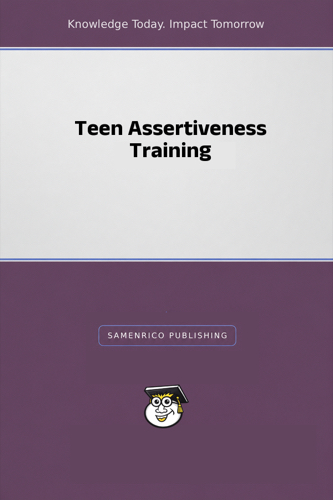
Non-FictionSelf-HelpAssertiveness
Teen Assertiveness Training eBook
Speak up for needs without aggression.
Speak up for needs without aggression.
Formats
Free sample
Chapter 1: The Four Faces...--Every single day, you walk into rooms carrying a secret weapon you don't know how to use. It's not your phone, your GPA, your looks, or your athletic ability. It's your voice. Not the sound that comes out of your mouth when you're alone in the shower rehearsing what you should have said. Not the mumbled "fine" you give when someone pushes you too far.
Not the explosion that makes you feel powerful for three seconds and ashamed for three days. Your actual voice. The one that knows what you need, what you won't tolerate, and who you are when nobody is watching.Here's the problem that every teenager discovers somewhere between middle school and graduation: speaking up feels impossible when it matters most. You have a million clever comebacks in the shower. You have perfect boundary-setting scripts in your head at 2 AM.
But when your friend "jokingly" insults you in front of everyone, when your parent announces a curfew that makes zero sense, when someone you like puts pressure on you that makes your stomach turn — the words disappear. Your throat closes. Your face gets hot. And you say nothing. Or worse, you say something that makes everything worse.This chapter is not about fixing you.
You are not broken. This chapter is about naming something that has a name but nobody told you. You have been reacting to the world in one of four ways. None of them make you a bad person. But three of them are making your life harder than it needs to be.
And once you see them — really see them, like seeing your own reflection for the first time in a mirror that isn't lying — you can never unsee them. That's when everything changes.Let's start with a story about twenty dollars.The Twenty-Dollar Test Imagine this. You lend a friend twenty dollars at lunch on Monday. They promise to pay you back on Friday. Friday comes.
Then Saturday. Then Monday again. They sit next to you in class. They laugh at your jokes. They ask to borrow your notes.
They do not mention the twenty dollars.Now freeze the frame. In that moment — right before you say anything, right after you realize they've "forgotten" for the seventh time — your body is already choosing how to respond. You don't even know you're choosing. It feels like instinct. But it's not.
It's a pattern. A habit. A face you've been wearing for years.Here is what happens next, depending on which face you're wearing.Face Number One: The Ghost The Ghost says nothing. Not a word. Not a hint.
Inside your head, a storm is building. You think: They know they owe me. They should just pay me back. I shouldn't have to ask. If I ask, I'll look desperate.
Or cheap. Or poor. Or weird. What if they get mad? What if they tell people I'm obsessed with money?
What if they stop being my friend over twenty dollars?So you say nothing. You smile. You laugh at their jokes. You lend them your notes again. And every time you see them, something hard and cold settles in your chest.
It feels like resentment, but resentment is too simple. It's heavier than that. It's the weight of your own voice, swallowed.The Ghost tells themselves they are being nice. They are keeping the peace. They are not causing drama.
And on the surface, that's true. Nobody is fighting. Nobody is yelling. But inside the Ghost, a war is happening every single day. The Ghost is the most common face teenagers wear.
It's also the most expensive, because the Ghost pays for peace with pieces of themselves.Face Number Two: The Monster The Monster says everything. And then some. When the Monster realizes the twenty dollars isn't coming back, they don't wait. They don't wonder. They erupt."Are you seriously going to steal from me?
You're such a thief. I can't believe I ever trusted you. You're dead to me."The words come out hot and fast. They feel good for about three seconds. The Monster feels powerful.
They said the thing. They didn't hold back. They won.Then the three seconds end. The friend walks away. Other people stare.
The Monster is alone, heart pounding, replaying the explosion and feeling something worse than anger. Shame. Because the Monster didn't just ask for their money back. They burned the bridge. They lost a friend.
They became the person everyone avoids.The Monster tells themselves they are just being honest. They are standing up for themselves. They aren't going to be a doormat. And on the surface, that sounds right. But honesty without kindness isn't assertiveness.
It's aggression with a costume. And aggression always, always costs you more than you think it will.Face Number Three: The Sneaky One (Passive-Aggressive)This face is the trickiest, because it doesn't look like anger. It looks like... nothing. Or everything, depending on how you're paying attention.The Sneaky One says "fine" when the friend forgets the twenty dollars.
But they say it with a sigh. Or a shrug. Or eyes that roll just slightly. They say "don't worry about it" in a tone that means worry about it forever. Then they go silent.
They stop laughing at the friend's jokes. They "forget" to save them a seat at lunch. They post vague things on social media — "some people don't deserve your trust" — that everybody knows is about the friend, even though they never said a name.The Sneaky One never has a fight. They also never have a resolution. They create a fog of confusion where nobody knows what's actually wrong, but everybody feels bad.
And here's the cruelest part: the Sneaky One often thinks they're being the bigger person. They didn't yell. They didn't call names. But they poisoned the air anyway. And the friendship doesn't end with a bang or a conversation.
It just... dissolves. Slowly. Painfully. With nobody understanding why.Face Number Four: The Human The Human takes a breath.
Not a dramatic one. Just a breath that says: I am allowed to exist. I am allowed to want my money back. I am also allowed to keep my friend.The Human says: "Hey, I need to ask you about the twenty dollars from last week. I know you probably forgot, but I really need it back by Friday.
Can you make that work?"The Human doesn't yell. Doesn't whisper. Doesn't post about it. Doesn't fume in silence. They just...
say it. Directly. Calmly. Without apology and without attack.The friend might say: "Oh my god, I'm so sorry. Yes, absolutely.
I'll bring it tomorrow." Or they might say: "Actually, I'm really tight right now. Can I give you ten this week and ten next?" Or they might say: "Wait, I paid you back already. Remember?"Whatever the answer, the Human can handle it. Because the Human didn't put their whole self-worth on the line for twenty dollars. They just asked for what they wanted.
And that's it. That's the whole secret. That's the thing that takes years to learn and seconds to do.The Mirror Test Now. Be honest with yourself.…
This is the end of the free sample. Get the eBook to keep going. Buy now
About this book
Details
- Author
- Bernier Jesusita
- Publisher
- SamEnrico
- Language
- English
- Genre
- Non-Fiction, Self-Help, Assertiveness
- Released
- 2026-06-07
- Pages (approx.)
- 129
- Available as
- eBook, Audiobook

Read better in the ZLOADR app
Your eBooks on your phone or tablet. Sign in with your SamEnrico account and start reading.
More by Bernier Jesusita
 My Lucky Life In ComedyBernier Jesusita$11.99
 MDD Crisis Plan GuideBernier Jesusita$11.99
 CASA Volunteer LifelineBernier Jesusita$11.99
 The Daily Sunscreen Prevention GuideBernier Jesusita$11.99
 The Trickster’s Grail: Merlin’s African ApprenticeBernier Jesusita$11.99
 Minority Firm Electronic SubcontractingBernier Jesusita$12.99
 CTO Termination GuideBernier Jesusita$12.99
 Program OfficerBernier Jesusita$11.99
 A Beginners Guide to Hare coursing (Volume 1)Bernier Jesusita$11.99
 The Breeder's Guide to Silver Fox RabbitsBernier Jesusita$11.99
You may also like
 Hong Kong Handover 1997Dunn Johnnie$11.99
 Zumba For Postnatal Recovery CourseNeal Christian$11.99
 Zumba for BeginnersLadner Nikia$11.99
 YouTube Comment Mining GuideHumes Pandora$12.99
 Worry Box MeditationCarlin Rudy$11.99
 Workplace Stress MeditationNguyen Lynn$11.99
 Workplace Stress and Sleep RepairHawley Ivory$11.99
 Workplace Perfectionism CureDelaney Jeffry$11.99
 Workplace Injustice Anger GuideWallen Isabelle$11.99
 Work Addiction and Burnout LinkGreenwood Ester$11.99
 Women in Yoga and WellnessBeattie Galina$11.99
 Women in Stand Up ComedyChun Evangeline$11.99