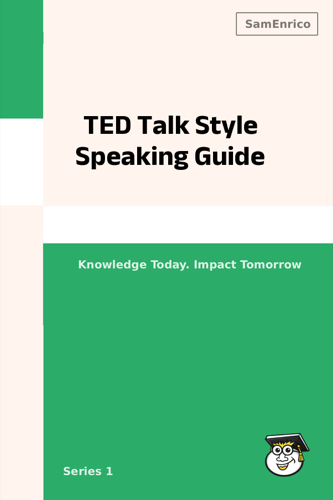
TED Talk Style Speaking Guide Audiobook
Emulates short, powerful, idea driven formats.
by Fong Malcom
Emulates short, powerful, idea driven formats.
Formats
Free sample
Chapter 1: The Data Dump Delusion--–- Imagine you are in the audience. The speaker walks to the podium, adjusts the microphone, and clicks to the first slide. It is a title slide with their name and the words “Q3 Sales Performance.” They click again. A bullet point appears: “Revenue up 12 percent.” They click again. Another bullet: “Customer acquisition cost down 8 percent.” Click.
“Retention improved 3 percent.” Click. “New product launch on track.” Click. Click. Click.For forty-five minutes, the speaker reads bullet points from slides that the audience could have read in five minutes. People check their phones.
Someone in the third row closes their eyes. The speaker seems unaware of the disengagement, plowing forward slide after slide. By the end, no one remembers anything except that they are hungry and want to leave.This scene plays out thousands of times every day in conference rooms, auditoriums, and boardrooms around the world. It is the data dump delusion—the mistaken belief that more information makes for a better presentation. The speaker confuses thoroughness with effectiveness.
They think that if they include every fact, every number, every insight, the audience will be impressed by their expertise. Instead, the audience is overwhelmed, bored, and resentful.The data dump delusion is the single most common mistake in public speaking. It is also the most fixable. This chapter introduces the foundational principle of TED-style speaking: one talk, one idea. It will teach you how to find the single powerful idea at the heart of your message and how to cut everything that does not serve it.
By the end of this chapter, you will never give a data dump presentation again.The Myth of More Why do speakers cram so much into their talks? The reasons are understandable, even sympathetic. They want to seem knowledgeable. They are afraid of leaving something important out. They have spent weeks or months working on a topic, and it feels wasteful to discard most of what they know.
They have been rewarded in the past for thoroughness—in school, in reports, in written documents—and they assume the same approach works for speaking.It does not.The human brain has limited processing capacity. When you present information, the audience’s brain must decode your words, interpret your meaning, connect new information to existing knowledge, and store what matters for later recall. This takes cognitive energy. And cognitive energy is finite.Research on cognitive load theory…
This is the end of the free sample. Get the Audiobook to keep going. Buy now
About this book
Details
- Author
- Fong Malcom
- Publisher
- SamEnrico
- Language
- English
- Genre
- Non-Fiction, Self-Help, TED Style
- Released
- 2026-06-12
- Pages (approx.)
- 112
- Available as
- eBook, Audiobook

Listen in the VoxFlicks app
Audiobooks and audio dramas wherever you go. Sign in with your SamEnrico account and press play.
More by Fong Malcom
 Menstrual Health for DancersFong Malcom$11.99
 Loneliness And Coaching GuideFong Malcom$11.99
 Personal Ing For Success SalaryFong Malcom$11.99
 Exam Anxiety Management GuideFong Malcom$11.99
 The First Sanitarians: How Early Humans Tamed Disease in AfricaFong Malcom$11.99
 Embers of the Phoenix: The Great Fire of London’s Hidden ArsonistFong Malcom$11.99
 How to Become a Cargo InspectorFong Malcom$11.99
 Cyber Security AnalystFong Malcom$11.99
 US State Breach Notification GuideFong Malcom$12.99
 Voiceover Editing SoftwareFong Malcom$12.99
 Understanding Dystrophic Epidermolysis BullosaFong Malcom$17.99