
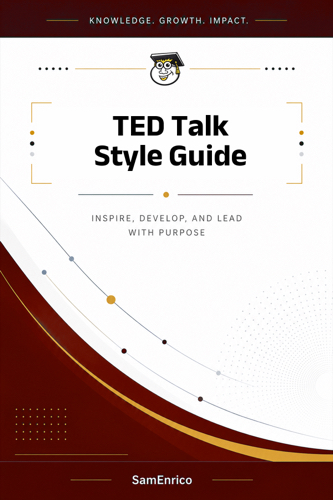
TED Talk Style Guide eBook
Model your presentations after iconic short talks
by Bostick Hye
Model your presentations after iconic short talks using this workbook.
Formats
Free sample
Chapter 1: The Graveyard Shift--–- Most presentations fail before the speaker says a single word. The failure happens in the quiet of a planning session, over coffee and a laptop, when a well-intentioned person makes a list. They write down everything they know. They organize it into bullet points. They feel productive.
They are, in fact, committing a quiet act of violence against their audience.The problem is not that the information is wrong. The problem is that there is too much of it. The human brain is not a hard drive. It is a bottleneck. And every great TED Talk in history has been built on a single, counterintuitive insight that most speakers never learn: if you say everything, you say nothing.This chapter is about finding the one thing.
The one idea that will survive the journey from your mouth to their memory. The one gift you are giving that the audience did not have when they walked through the door. It is, quite simply, the most important chapter in this book. Because without a throughline, the next eleven chapters are just decoration.Welcome to the Graveyard Shift.The Anatomy of a Throughline Chris Anderson, the curator of TED, has watched thousands of talks fail. He has sat in the front row while brilliant scientists, Nobel laureates, and CEOs self-destructed in eighteen minutes.
And he noticed a pattern. The failures were not failures of expertise. They were failures of focus.Anderson developed a concept he calls the "throughline." Think of it as a rope that runs from the beginning of your talk to the end. Every word, every slide, every gesture must tie back to that rope. If something does not serve the throughline, it does not belong in the room.Here is the most important sentence in this chapter: Your throughline is not your topic.Your topic is a category.
"Climate change" is not a throughline. It is a filing cabinet. Inside that cabinet are a thousand possible throughlines: "Three small changes in urban infrastructure that could reduce emissions by forty percent." "Why despair is a luxury the climate movement cannot afford." "The one molecule that changed everything and why you have never heard of it."A throughline is specific. It is arguable. It is a gift.
And it can be written on the back of a business card.Try this right now. Take out your phone or a piece of paper. Write down what you think your talk is about. Be honest. Most people will write something like "I want to talk about leadership" or "I want to share my journey as an entrepreneur" or "I want to explain my research on neural networks."Now burn that sentence.
It is killing you.Instead, ask yourself three questions. First, what is the single change I want to create in my audience? Second, what do they need to understand to make that change possible? Third, what is the smallest version of that idea that still contains all its power?The answer to those three questions is your throughline.Why Your Brain Hates Options There is a famous study in behavioral psychology. Researchers set up a jam-tasting booth in a grocery store.
On some days, they offered twenty-four varieties of jam. On other days, they offered only six. You would think that more options would lead to more sales. It did not. The booth with six varieties sold ten times more jam than the booth with twenty-four.Choice paralyzes.
The human brain, faced with abundance, shuts down. This is true for jam. It is true for ideas.When you stand on stage with twenty good points, you are offering your audience twenty-four jams. They will taste nothing. They will buy nothing.
They will leave with empty bags and a vague sense that you knew a lot but said nothing at all.The throughline is your six-jam booth. It forces you to kill your darlings. It forces you to admit that not every insight deserves oxygen. It forces you to make the one decision that separates amateurs from professionals: what to leave out.Simon Sinek understood this. His TED Talk, "How Great Leaders Inspire Action," has been viewed more than sixty million times.
It is not a long talk. It does not cover twenty leadership principles. It covers exactly one idea: the Golden Circle.Sinek draws three concentric circles. The outer circle is "What." The middle circle is "How." The center circle is "Why." Most organizations know what they do. Some know how they do it.
Very few can articulate why they do it. And that "why" is the difference between a commodity and a movement.Here is what Sinek did not do. He did not explain the history of leadership theory. He did not summarize the academic literature on organizational behavior. He did not list the fifteen habits of highly effective CEOs.
He talked about one thing. He repeated it three times. He drew the same circles three times. And sixty million people remembered.Repetition is not redundancy. Repetition is architecture.The Machine That Eats Ideas There is a villain in this story.
Its name is the Curse of Knowledge.The Curse of Knowledge is a cognitive bias discovered by economists Colin Camerer, George Loewenstein, and Martin Weber. In their experiments, people who knew a piece of information could not imagine what it was like not to know it. Once you know the melody, you cannot hear the song without hearing it. Once you understand a concept, you cannot remember the confusion you felt before you understood it.This is the single greatest enemy of the TED-style speaker.You are an expert. You have spent years, maybe decades, learning your craft.
The things that seem obvious to you are not obvious to your audience. The connections that feel intuitive to you feel like leaps to them. The jargon that saves you time confuses them.The Curse of Knowledge makes you add. It whispers: "They need to understand the background. They need to see the full context.
They need to know the exceptions and the caveats and the footnotes."The Curse of Knowledge is a liar.Your audience does not need the full context. They need the sharp point of the spear. They do not need the history of every failed experiment. They need the one experiment that worked. They do not need the list of fifteen features.
They need the one feature that changes everything.Killing the Curse of Knowledge requires ruthlessness. It requires you to look at your carefully prepared slide deck and delete half of it. It requires you to take your twenty-page handout and throw it in the trash. It requires you to trust that less is not less. Less is more.
Less is the only path to more.The Graveyard Spitball (The Lab)Now we work.This chapter is called The Graveyard Shift for a reason. You are going to kill most of your ideas. You are going to bury them in a digital or physical grave. And you are going to walk away with only the survivor.Here is what you need: twenty sticky notes (physical or digital), a pen, and an envelope or folder labeled "GRAVEYARD."Step One…
This is the end of the free sample. Get the eBook to keep going. Buy now
About this book
Details
- Author
- Bostick Hye
- Publisher
- SamEnrico
- Language
- English
- Genre
- Non-Fiction, Self-Help, TED Style
- Released
- 2026-06-06
- Pages (approx.)
- 136
- Available as
- eBook, Audiobook

Read better in the ZLOADR app
Your eBooks on your phone or tablet. Sign in with your SamEnrico account and start reading.
More by Bostick Hye
 Self Esteem After FallsBostick Hye$11.99
 Call Protection and Make WholeBostick Hye$11.99
 Trace Minerals Deficiency HandbookBostick Hye$11.99
 Family Guy Voice MemoirBostick Hye$11.99
 Boomer Travel PreferencesBostick Hye$11.99Boomer Travel PreferencesBostick Hye$11.99
 Creative Habits for LawyersBostick Hye$11.99
 Pelvic Floor Workout LogBostick Hye$11.99
 The Wind in Their Sails: How the Dutch Conquered the SeasBostick Hye$11.99
 The Phantom of the Grand Hotel: The Unsolved 1929 Disappearance of Agnes DriscollBostick Hye$11.99
 How to Produce Counterfeit Electronic ComponentsBostick Hye$11.99
 Greenland Dogs: Arctic Sled DogBostick Hye$11.99
You may also like
 Hong Kong Handover 1997Dunn Johnnie$11.99
 Zumba For Postnatal Recovery CourseNeal Christian$11.99
 Zumba for BeginnersLadner Nikia$11.99
 YouTube Comment Mining GuideHumes Pandora$12.99
 Worry Box MeditationCarlin Rudy$11.99
 Workplace Stress MeditationNguyen Lynn$11.99
 Workplace Stress and Sleep RepairHawley Ivory$11.99
 Workplace Perfectionism CureDelaney Jeffry$11.99
 Workplace Injustice Anger GuideWallen Isabelle$11.99
 Work Addiction and Burnout LinkGreenwood Ester$11.99
 Women in Yoga and WellnessBeattie Galina$11.99
 Women in Stand Up ComedyChun Evangeline$11.99