
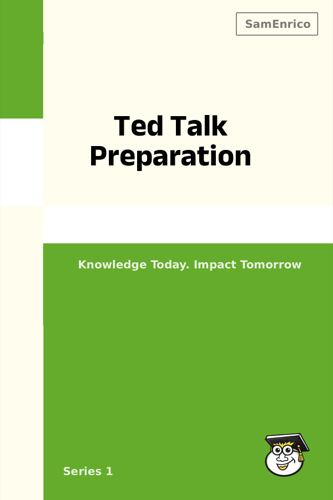
Free sample
Chapter 1: The Graveyard of Good Ideas--–- Before you write a single word of your talk, before you open Power Point, before you practice your opening gesture in the mirror—you must first walk through a graveyard. It is a quiet place, this graveyard. It is filled with the tombs of perfectly good ideas. Excellent ideas, even. Ideas that made perfect sense on paper.
Ideas that your colleagues loved. Ideas that were smart, logical, well-researched, and utterly forgettable.Every year, thousands of speakers step onto TED and TEDx stages. They have prepared for months. They have memorized their lines. They have beautiful slides.
And yet, seventy-two hours later, no one in the audience can remember a single thing they said. Their talk did not fail because it was wrong. It failed because it was too much. It failed because it tried to be a library when it should have been a single, sharp arrow.This chapter is about the single hardest thing you will do in your entire preparation process: killing your darlings. It is about learning why less is always more, why your audience’s brain is actively working against you, and how to pass the only test that matters before you write a single sentence of your script.The One-Idea Rule: Why Your Brain Forgets Almost Everything Let us begin with a hard truth.
The human brain is not designed to remember lectures. It is designed to remember threats, rewards, and stories—in that order. Everything else is noise.The cognitive science is unforgiving. The average adult working memory can hold approximately four discrete chunks of information at once. That is it.
Four. Not forty. Not fourteen. Four. The psychologist George Miller famously described this as “The Magical Number Seven, Plus or Minus Two” in 1956, but more recent research has narrowed that range down to three to five items for most people under real-world conditions.
When you exceed that limit, the brain does not work harder to retain the excess information. It simply shuts down. It engages in what cognitive load theorists call “information triage”—it discards whatever seems least immediately relevant and holds onto the bare minimum needed to survive the moment.Now consider what most aspiring TED speakers do. They sit down with a lifetime of expertise—ten years of research, twenty case studies, thirty published papers, fifty client success stories—and they try to cram it into eighteen minutes. They build a talk with six main points, each with three sub-points, each illustrated with a data slide.
By minute twelve, the audience is not learning. They are drowning. And by minute eighteen, they have retained nothing except perhaps the speaker’s tie color and the vague sense that they should probably recycle more.This is the graveyard of good ideas. It is filled with talks that were factually correct, passionately delivered, and completely useless to the audience because they violated the One-Idea Rule.What is the One-Idea Rule? It is brutally simple.
Your entire talk—all eighteen minutes, all thirty slides, all your expertise, all your passion—must be reducible to a single, coherent idea that an average person can explain to another average person in under sixty seconds. Not a summary. Not an abstract. An idea. A gift.
A thing the audience can take home and use.Let me repeat that because it is the most important sentence in this chapter: If a stranger cannot explain your talk to another stranger at a water cooler in under sixty seconds, your talk is broken. Not flawed. Not in need of polish. Broken.The Water Cooler Test: Your First and Most Brutal Editor I want you to imagine something. Imagine that you have just delivered your talk.
You step off the stage. A woman named Sarah—she works in marketing, she has no background in your field, she was scrolling Instagram during the first three minutes—walks to the water cooler. A colleague named James asks her, “Hey, what was that talk about?”Sarah has fifteen seconds before she loses interest in answering. Maybe thirty if she is feeling generous. What does she say?This is the Water Cooler Test.
It is the single most useful diagnostic tool in the history of public speaking. It was popularized by Carmine Gallo in Talk Like TED and endorsed by Chris Anderson, the curator of TED itself, in TED Talks: The Official TED Guide. And it is devastatingly effective at revealing the difference between a talk and a lecture.A lecture sounds like this: “It was about quantum entanglement and its implications for blockchain-verified supply chain logistics, with case studies from three different industries and a deep dive into the mathematical foundations of entanglement entropy.”A TED Talk sounds like this: “It was about how to trust people you’ve never met.”Do you feel the difference? The first explanation is accurate. It is also dead.
No one will repeat it. No one will act on it. The second explanation is not complete—it leaves out all the nuance, all the data, all the caveats—but it is alive. It is a seed. It can be planted in someone’s mind and grow into action.The Water Cooler Test has three hidden rules.
First, the explanation must be spoken aloud, not written. Written language is compressed; spoken language is expanded. If you can say it in under sixty seconds, you can write it in under thirty. Second, the listener must not have seen your talk. You cannot rely on shared context.
Third, the explanation must be repeatable. If your colleague James then walks to another water cooler and tells a third person, that third person should understand the idea just as clearly.Here is the painful part. Most speakers fail this test on their first attempt. They fail because they have not yet killed their darlings. They try to keep all six points, all ten years of expertise, all the nuance.
And the test reveals the truth: the audience will remember nothing.The Grabby Concept: From Clutter to Arrow So how do you pass the Water Cooler Test? You need what I call the Grabby Concept. The term comes from viral media theory—a “grabby” headline or idea is one that compels attention and replication. But in the context of a TED Talk, the Grabby Concept is something more specific. It is your entire talk distilled into a single, sticky, shareable sentence of ten words or fewer.Ten words.
That is the limit. Not because ten is a magic number, but because the average English sentence is fifteen to twenty words, and you need to be shorter than average to be memorable. Ten words forces you to strip every adjective, every caveat, every qualifier. Ten words forces you to find the verb. Ten words forces you to choose.Here are examples of real Grabby Concepts from famous TED Talks:“Your body language shapes who you are.” (Amy Cuddy, 6 words)“The paradox of choice is making us miserable.” (Barry Schwartz, 7 words)“Vulnerability is the birthplace of courage.” (Brené Brown, 5 words)“Schools kill creativity in children.” (Ken Robinson, 5 words)Notice what these sentences do not contain.
They do not contain data. They do not contain caveats (“in some cases,” “may potentially,” “under certain conditions”). They do…
This is the end of the free sample. Get the eBook to keep going. Buy now
About this book
Details
- Author
- Wallis Judi
- Publisher
- SamEnrico
- Language
- English
- Genre
- Non-Fiction, Self-Help / Ted
- Released
- 2026-06-08
- Pages (approx.)
- 142
- Available as
- eBook, Audiobook

Read better in the ZLOADR app
Your eBooks on your phone or tablet. Sign in with your SamEnrico account and start reading.
More by Wallis Judi
 DoorDash Peak Hour NavigationWallis Judi$11.99
 Chronic Pain Anger RestructuringWallis Judi$11.99
 Canadian Arctic ExpeditionWallis Judi$11.99
 The Rescripting ScriptbookWallis Judi$11.99
 HAES Principles GuideWallis Judi$11.99
 Peg System For TaxesWallis Judi$11.99
 Ragnar Lothbrok: The Wolf of the NorthWallis Judi$11.99
 The Dark Money Mirage: How a 1996 Law Reshaped American PoliticsWallis Judi$11.99
 How to Start a Performing Arts Schools (except Academic) Business (Beginners Guide)Wallis Judi$11.99
 How to Produce Aluminum StripsWallis Judi$11.99
 A Collector's Handbook to the Singer Gazelle IiaWallis Judi$11.99
 Africa Franchise Expansion GuideWallis Judi$12.99
You may also like
 Hong Kong Handover 1997Dunn Johnnie$11.99
 Zumba For Postnatal Recovery CourseNeal Christian$11.99
 Zumba for BeginnersLadner Nikia$11.99
 YouTube Comment Mining GuideHumes Pandora$12.99
 Worry Box MeditationCarlin Rudy$11.99
 Workplace Stress MeditationNguyen Lynn$11.99
 Workplace Stress and Sleep RepairHawley Ivory$11.99
 Workplace Perfectionism CureDelaney Jeffry$11.99
 Workplace Injustice Anger GuideWallen Isabelle$11.99
 Work Addiction and Burnout LinkGreenwood Ester$11.99
 Women in Yoga and WellnessBeattie Galina$11.99
 Women in Stand Up ComedyChun Evangeline$11.99