
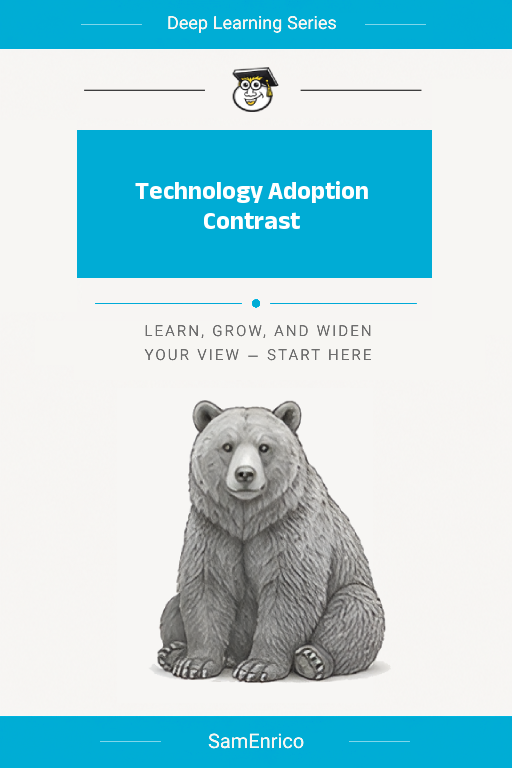
Non-FictionConsumer Mind ReportTech Marketing
Technology Adoption Contrast eBook
Examines smart home, wearable, AI tool, and upgrad
by Fish Twana
Examines smart home, wearable, AI tool, and upgrade cycles between Boomers and Gen Z for electronics.
Formats
Free sample
Chapter 1: The Motivation Gap...--The Christmas morning that broke the Williams family Wi-Fi began, as most modern family disputes do, not with a raised voice but with a notification. Frank Williams, seventy-two years old, a retired civil engineer who had once manually calculated load-bearing capacities on graph paper, stared at his smartphone with the particular confusion of a man who had just watched a hologram materialize on his kitchen table. His granddaughter Jade, twenty-three, a UX designer who had never owned a printer and considered voicemail a violation of basic human rights, had just sent him a request to join her "smart home sharing network." Frank did not know what that meant. He did not know why his toaster needed to talk to his granddaughter's apartment. And he definitely did not know why accepting the request required him to remember a password he had last reset during the Obama administration.Jade, meanwhile, was three hundred miles away, watching her phone buzz with the notification that Frank had declined the invitation.
Not just declined—blocked. He had somehow, through a series of taps that he could not later reconstruct, permanently severed the digital bridge she had spent twenty minutes configuring. Her response was immediate and, to her, perfectly reasonable: she screenshot the rejection, added a single crying-laughing emoji, and posted it to her close-friends Instagram story with the caption "Boomers gonna boomer." Within an hour, seventeen of her friends had replied with their own horror stories: the grandfather who refused to use a password manager and had been hacked four times, the mother who still paid AOL for email, the uncle who printed out Google Maps directions before every road trip.What neither Frank nor Jade understood, in that moment of mutual bafflement, was that they were not experiencing a failure of intelligence or willingness. They were experiencing a failure of motivation. They wanted different things from technology, not different levels of competence.
And until they understood that difference, every smart device they ever bought together would become another battlefield in a war neither had agreed to fight.This book is about that war and, more importantly, about the ceasefire that becomes possible once you understand what each side is actually fighting for.The Great Misunderstanding For the past decade, almost every conversation about generational technology differences has started from the wrong premise. The premise is that older people are slower to adopt technology because they are scared of it, or bad at it, or stuck in their ways. The premise is that younger people adopt technology effortlessly because they were born with smartphones in their hands and therefore possess some innate digital intuition that their elders lack. Both premises are wrong, and both have caused incalculable damage to family relationships, workplace productivity, and product design.The truth, which emerged from analyzing dozens of surveys, behavioral studies, and ethnographic interviews across the development of this book, is far simpler and far more useful: Boomers and Gen Z adopt technology for fundamentally different reasons. They are not separated by a skill gap.
They are separated by a motivation gap.Understanding this gap requires abandoning the language of technological literacy altogether. A Boomer who refuses to set up a smart speaker is not necessarily incapable of doing so. The same Boomer who cannot figure out how to pair Bluetooth headphones has, in all likelihood, successfully navigated more complex systems than any Gen Z user will ever encounter: manual transmissions, analog control panels, tax preparation without software, and physical maps that required spatial reasoning rather than turn-by-turn voice commands. The issue is not ability. The issue is that the Boomer does not see a compelling reason to learn Bluetooth pairing because the marginal benefit over wired headphones does not justify the friction.Similarly, a Gen Z user who seems to master a new app in thirty seconds is not demonstrating superior intelligence.
They are demonstrating a different tolerance for trial and error, shaped by a lifetime of interfaces designed to be forgiving. The same Gen Z user who navigates a complex project management tool with ease may be entirely unable to read an analog clock without pausing to count the ticks, not because they are stupid but because they have never needed to. The issue is not intelligence. The issue is that the Gen Z user has been trained to expect that technology will adapt to them, rather than the other way around.This reframing—from skill to motivation, from ability to purpose—is the foundation upon which everything else in this book rests.The Preservationist vs. The Identity Architect The most useful framework for understanding the motivation gap comes from observing what people actually do with technology after they acquire it, not just whether they acquire it at all.
After analyzing hundreds of case studies and consumer behavior reports, a clear pattern emerges: Boomers approach technology as preservationists, while Gen Z approaches technology as identity architects.The preservationist mindset views technology as a tool for protecting and extending the lifespan of existing assets and relationships. When a Boomer buys a smart doorbell, they are thinking about package theft, home insurance discounts, and the ability to see who is at the door without getting up from their chair. When a Boomer buys a wearable, they are thinking about fall detection, heart rate monitoring, and medication reminders. When a Boomer considers upgrading their phone, they ask: "Does my current phone still work? Can I repair it?
How much will a new one cost, and what will I lose in the transition?" The preservationist seeks durability, reliability, and cost-per-use value. They want technology to disappear into the background of their lives, solving problems without creating new ones.The identity architect mindset, by contrast, views technology as a material for constructing and signaling a self. When a Gen Z user buys a smart fridge, they are not primarily thinking about food preservation. They are thinking about how the appliance looks in their kitchen, how it photographs for social media, and what it signals about their values (energy efficiency, tech-forward living, aesthetic coherence). When a Gen Z user buys a wearable, they are tracking sleep cycles, mood logs, and menstrual health—not because a doctor told them to but because data-driven self-optimization is a core component of their identity.
When a Gen Z user considers upgrading their phone, they ask: "Does the new camera produce better content? Does the new color signal that I am current? Will my peers notice if I don't upgrade?" The identity architect seeks novelty, customization, and social signaling. They want technology to be visible, expressive, and integrated into the ongoing project of becoming who they are.Neither approach is wrong. Neither approach is superior.
But they are fundamentally incompatible in ways that create predictable conflicts, and understanding those conflicts is the first step toward resolving them.The Statistic That Demands Explanation Consider one number: 96 percent of Gen Z adults own at least one smart home device. This statistic, drawn from the Nationwide 2025 Homeowners Survey, is astonishing not because it is high but because it coexists with another set of facts about Gen Z: they carry record levels of student debt, they have…
This is the end of the free sample. Get the eBook to keep going. Buy now
About this book
Details
- Author
- Fish Twana
- Publisher
- SamEnrico
- Language
- English
- Genre
- Non-Fiction, Consumer Mind Report, Tech Marketing
- Released
- 2026-05-30
- Pages (approx.)
- 141
- Available as
- eBook, Audiobook

Read better in the ZLOADR app
Your eBooks on your phone or tablet. Sign in with your SamEnrico account and start reading.
More by Fish Twana
 Stage Fright Rewiring BlueprintFish Twana$11.99
 The Jodie Foster Career MasterclassFish Twana$11.99
 Assertive I Statements GuideFish Twana$11.99
 Experiencing Joy Through BreathFish Twana$11.99
 The Menopause Relationship Stress GuideFish Twana$11.99
 The Ghost of the Bataclan: Forensics and the Paris SiegeFish Twana$11.99
 Field Operations CoordinatorFish Twana$11.99
 Understanding Long Qt Syndrome Type 1Fish Twana$17.99
 How to Start a Taxi Service BusinessFish Twana$11.99
 Non Resident LLC Asset ProtectionFish Twana$12.99
You may also like
 Hong Kong Handover 1997Dunn Johnnie$11.99
 Zumba For Postnatal Recovery CourseNeal Christian$11.99
 Zumba for BeginnersLadner Nikia$11.99
 YouTube Comment Mining GuideHumes Pandora$12.99
 Worry Box MeditationCarlin Rudy$11.99
 Workplace Stress MeditationNguyen Lynn$11.99
 Workplace Stress and Sleep RepairHawley Ivory$11.99
 Workplace Perfectionism CureDelaney Jeffry$11.99
 Workplace Injustice Anger GuideWallen Isabelle$11.99
 Work Addiction and Burnout LinkGreenwood Ester$11.99
 Women in Yoga and WellnessBeattie Galina$11.99
 Women in Stand Up ComedyChun Evangeline$11.99