
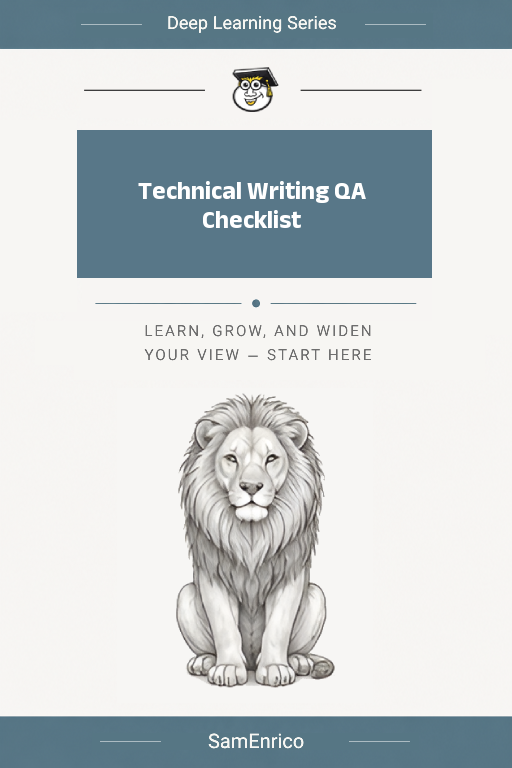
Technical Writing QA Checklist eBook
Use AI to generate quality assurance checklists fo
Use AI to generate quality assurance checklists for technical documentation review.
Formats
Free sample
Chapter 1: The Checklist Lie--–- Every technical writer has felt it: the quiet panic when you realize the 47-page QA checklist you just spent three hours reviewing was never actually used. The engineers ignored it. The product manager overrode it. And now, a user has discovered that your “Delete Account” documentation forgot to mention the irreversible data loss that follows. Your weekend is ruined.
Someone posts on Hacker News: “Acme Corp’s docs are actively dangerous.” The thread goes viral. Your boss schedules a “lessons learned” meeting. The lesson, of course, is that your checklist failed. But no one says that out loud.This chapter reveals the uncomfortable truth that bestselling technical writing handbooks—from Developing Quality Technical Information to The Microsoft Manual of Style—dance around but rarely state directly: Static checklists are fundamentally broken for modern technical documentation. They were designed for an era when a 200-page software manual was considered large.
Today, API documentation sets routinely exceed 5,000 pages, update multiple times per day, and serve audiences ranging from first-time bootcamp graduates to seasoned cloud architects. Your checklist cannot adapt to these realities. Your AI can.Here is the complete transformation you will undergo by the end of this chapter: You will stop thinking of QA as a list of rules to check off and start thinking of it as a dynamic, context-aware conversation between human intent and machine scale. You will learn why “linting” (enforcing rules like “no passive voice”) is necessary but wildly insufficient. You will understand the difference between checking for typos and auditing for meaning.
And you will walk away with the Automation Spectrum—a three-tier framework that lets you choose exactly how much autonomy to give your AI reviewer, from conservative recommendation engines to fully autonomous documentation patching.By the time you finish this chapter, you will never look at a static checklist the same way again. More importantly, you will have the language and the framework to convince your team, your manager, and even your skeptical engineering lead that AI-powered QA is not a luxury—it is the only way to scale quality across thousands of pages without burning out your best writers.The Birth of the Checklist (And Why It Worked… Once)The technical QA checklist has noble origins. In the early 2000s, when books like Developing Quality Technical Information (often called “The IBM Book”) synthesized decades of documentation practice into five core characteristics—Accuracy, Completeness, Clarity, Organization, and Retrievability—the checklist was a revolution. For the first time, technical writers had a shared vocabulary for quality. You could hand a junior writer a 10-page checklist and reasonably expect them to produce documentation that didn’t embarrass the company.The checklist worked because the world was simpler.
Documentation was shipped on CDs or as massive PDFs. Updates happened quarterly, not hourly. The audience was relatively homogenous: system administrators and developers who had time to read. A static list of rules— “Is each step numbered?” “Does every screenshot have alt text?” “Have you defined all acronyms on first use?”—could genuinely catch 80% of errors.But the checklist had hidden assumptions that no one questioned:Assumption 1: Humans will actually use it. They won’t.
Under deadline pressure, the checklist is the first thing tossed overboard. A study from the University of California, Irvine (2019) found that technical writers skip an average of 37% of checklist items when shipping under “high urgency” conditions. The checklist becomes a post-hoc CYA document (“Yes, I totally reviewed all 47 items”) rather than a quality tool.Assumption 2: All documents are the same. They aren’t. A checklist designed for a hardware setup guide is actively harmful when applied to an API reference.
The former needs warnings about electrical safety; the latter needs warnings about rate limits and authentication. Static checklists have no mechanism to know which rules apply to which document.Assumption 3: The checklist can keep up with the product. It can’t. When your product ships new features every two weeks, updating the checklist becomes a full-time job. Most teams update their checklists quarterly—which means for ten weeks out of twelve, the checklist is referencing deprecated terminology, missing new error conditions, and enforcing rules that no longer make sense.Assumption 4: The checklist can judge meaning, not just form.
This is the killer. A checklist can tell you that every step is numbered. It cannot tell you that step 3 is missing entirely, or that the steps are in the wrong order, or that the document assumes knowledge the user doesn’t have. Checklists are blind to intent.The result is a crisis of confidence. Technical writers know their checklists are inadequate.
Engineers mock documentation QA as “busywork.” Users suffer the consequences of missing steps, inaccurate examples, and inconsistent terminology. And the people who care most—the writers themselves—are left with an impossible choice: spend all their time maintaining an ever-growing checklist that no one follows, or abandon QA altogether and hope for the best.There is a third path. But to see it, you need to understand the difference between two very different kinds of automated review: linting and intent-based QA.Linting vs. Intent: The Critical Distinction You Must Understand If you come from a software engineering background, you already know what a linter is. Tools like ESLint for Java Script or Pylint for Python scan your code for rule violations: missing semicolons, unused variables, inconsistent indentation.
Linters are fast, deterministic, and completely incapable of understanding what your code actually does. They enforce style, not substance.Most technical writing “QA tools” today are linters for prose. They check for passive voice, long sentences, forbidden words, and inconsistent heading hierarchies. These are useful. They catch the low-hanging fruit.
But they are not quality assurance. They are spell-check on steroids.Linting (rule-based enforcement) asks: “Does this sentence break rule #47 of our style guide?”Intent-based QA asks: “Does this sentence help the user accomplish their goal?”The gap between these two questions is the entire universe of meaningful documentation quality. A document can pass every linting rule and still be useless. Consider this example:“The user will be required to authenticate via the OAuth2 endpoint prior to the invocation of the data retrieval method.”A linter will flag the passive voice (“will be required”), suggest changing “prior to” to “before,” and complain about the long noun phrase. It will miss the real problem: this sentence is incomprehensible to a novice and insulting to an expert.
The intent—to explain how to get data from an API—is buried under jargon.Here is the same intent, rewritten:“Before you can get data, you must authenticate. Call the /auth/token endpoint with your API key.”Both sentences pass a linter (once the passive voice is fixed). But only the second satisfies intent-based QA. The difference is not rules. The difference is understanding who the reader is and what the reader needs to do next.AI, unlike linters, can understand intent.
Not perfectly—but well enough to be useful. When you feed a document to a large language model (LLM) like GPT-4, Claude, or Gemini, it does not just scan for rule violations. It reads the document as a human would, inferring meaning, detecting logical gaps…
This is the end of the free sample. Get the eBook to keep going. Buy now
About this book
Details
- Author
- Crittenden Lida
- Publisher
- SamEnrico
- Language
- English
- Genre
- Non-Fiction, AI Operator, QA Docs
- Released
- 2026-05-29
- Pages (approx.)
- 146
- Available as
- eBook, Audiobook

Read better in the ZLOADR app
Your eBooks on your phone or tablet. Sign in with your SamEnrico account and start reading.
More by Crittenden Lida
 Eritrean Canadian Return To Asmara WorkbookCrittenden Lida$11.99
 Overcoming Self Doubt for High AchieversCrittenden Lida$11.99
 Metta for Body Image IssuesCrittenden Lida$11.99
 Breath Awareness For TinnitusCrittenden Lida$11.99
 Tanzania Ujamaa Socialism GuideCrittenden Lida$11.99
 The Architect of Dreams: Archibald Leitch and the Birth of Modern Football StadiumsCrittenden Lida$11.99
 Understanding Monoamine Oxidase a DeficiencyCrittenden Lida$17.99
 Amazon Fulfillment Evolution GuideCrittenden Lida$12.99
 Gmelinite MiningCrittenden Lida$11.99
 How to Become a Door AssemblerCrittenden Lida$11.99
You may also like
 Hong Kong Handover 1997Dunn Johnnie$11.99
 Zumba For Postnatal Recovery CourseNeal Christian$11.99
 Zumba for BeginnersLadner Nikia$11.99
 YouTube Comment Mining GuideHumes Pandora$12.99
 Worry Box MeditationCarlin Rudy$11.99
 Workplace Stress MeditationNguyen Lynn$11.99
 Workplace Stress and Sleep RepairHawley Ivory$11.99
 Workplace Perfectionism CureDelaney Jeffry$11.99
 Workplace Injustice Anger GuideWallen Isabelle$11.99
 Work Addiction and Burnout LinkGreenwood Ester$11.99
 Women in Yoga and WellnessBeattie Galina$11.99
 Women in Stand Up ComedyChun Evangeline$11.99