
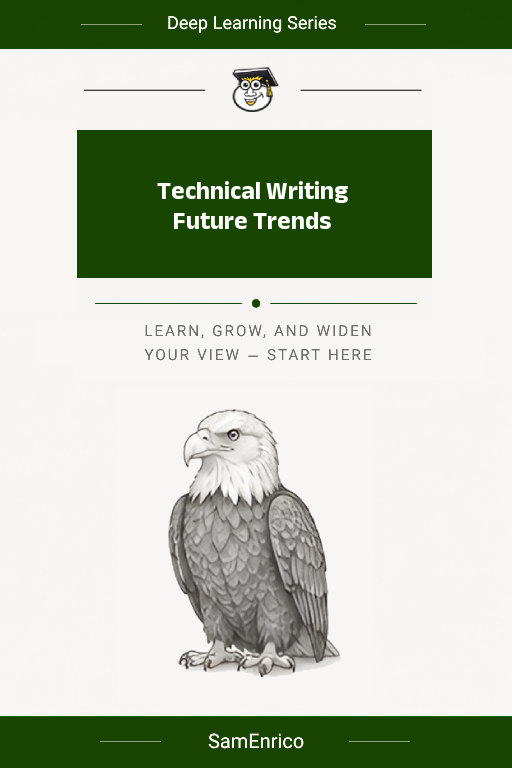
Non-FictionAI OperatorFuture Trends
Technical Writing Future Trends eBook
Prepare for emerging AI capabilities in technical
Prepare for emerging AI capabilities in technical writing including autonomous documentation.
Formats
Free sample
Chapter 1: The 50/50 Reader...--–- On a Tuesday morning in March 2026, a senior technical writer named Priya watched something that made her question everything she had built over fifteen years. She had just finished a meticulously crafted troubleshooting guide for a complex cloud deployment tool—fourteen pages of step-by-step instructions, warnings, edge cases, and carefully annotated screenshots. She published it to her company’s documentation portal, received approving nods from her manager, and went to lunch feeling satisfied. When she returned, she checked the analytics dashboard out of habit. Page views were fine.
Time on page was respectable. But the support ticket data told a different story: customers were still failing at step three. Not just failing—failing in exactly the same way, over and over, as if they had never seen her beautiful documentation at all.The truth, which Priya discovered only after three more weeks of fruitless revisions, was that her human readers were not the only ones failing. The company’s AI-powered support agent—a tool management had quietly deployed to handle routine customer questions—was also reading her documentation. And it was failing too.
But unlike a human, the AI did not skip confusing steps. It did not scroll past ambiguous phrases. It did not call the help desk when something was unclear. Instead, it hallucinated. It invented plausible-sounding answers that were catastrophically wrong.
It told customers to click buttons that did not exist, to run commands with missing flags, to check logs in directories that had been deprecated months ago. Every hallucination traced back to a single source: Priya’s documentation, which she had written exclusively for human eyes, had become a liability in the age of machine readers.This chapter is about how Priya’s story became the new normal. It is about the fundamental shift that has already happened in technical communication—a shift that most technical writers do not yet fully understand. And it begins with a simple but profound realization: you no longer have one reader. You have two.
And the second one is not human.The End of the GUI Era For thirty years, the graphical user interface defined how humans interacted with software. You pointed, you clicked, you read, you typed. Documentation was a companion to that experience—a static reference that users consulted when the screen alone was insufficient. The FAQ page became the backbone of support. The user guide was a badge of professionalism.
Technical writers measured success in page views, search clicks, and the polite silence of customers who found answers without needing to escalate.That era is ending. Not slowly, not gradually, but with the accelerating force of a technological shift that has no precedent in our professional lifetimes. By 2027, according to research consolidated from multiple industry analysts, voice commands, gesture controls, ambient intelligence, and autonomous AI agents will supplement—and in many cases replace—the GUI as the primary interface between humans and machines. Your users will not click through a help menu. They will ask a question aloud, or an agent will anticipate their need, or documentation will appear contextually without any search action at all.This is the ambient interface.
It is seamless. It is invisible. And it is devastating to traditional documentation because traditional documentation assumes a screen, a search bar, and a human being with time to read.Consider what happens to a static FAQ in an ambient world. A user encounters an error. Before they can type a single character, an AI agent has already scanned the available documentation, retrieved the most relevant chunk, and presented a solution.
If the documentation is structured for machine readability, the agent succeeds. If the documentation is written only for human eyes—with narrative flow, implicit assumptions, and ambiguous phrasing—the agent fails. But here is the cruel irony: the user never sees the failure. They only see an incorrect answer delivered confidently by an agent they have been trained to trust. The documentation remains unread, unrevised, and untouched, while the damage compounds with every interaction.This is not a future problem.
This is a present problem. The agents are already here, and they are already reading your documentation. The question is whether your documentation is ready for them.The 50/50 Rule: Your Two Audiences Let me state this as clearly as I can. Approximately half of your documentation readers today are human beings. The other half are Large Language Models and autonomous agents parsing your text as data.
This is not a metaphor. This is not a prediction. This is an empirical observation from telemetry data collected across thousands of documentation sites, support systems, and AI deployments.Call it the 50/50 Rule.If you write only for humans—with narrative flair, contextual assumptions, ambiguous instructions like “click the button usually located near the top right,” and unstructured prose—you fail the machine half. If you write only for machines—with raw metadata, stripped of all narrative, optimized solely for retrieval—you fail the human half. Your job, starting now, is to write for both simultaneously, with machine readability as the foundation because machines are less forgiving than humans.A human reader encountering confusion will pause, re-read, search for context, or ask a colleague.
A machine encountering confusion has no such resilience. It will retrieve the wrong chunk, generate a hallucinated answer, and present that answer with the same confidence as a correct one. The machine does not know it is confused. It has no metacognition about its own understanding. It will simply produce text, and that text will be trusted by users who do not know that the underlying documentation was written for the wrong audience.This is why the 50/50 Rule is not a technical nuance.
It is an existential requirement. If you ignore the machine half, you are not just producing suboptimal documentation. You are actively harming your users by feeding bad data into systems that will confidently deliver that bad data as truth.A Case Study in Two Audiences Let me show you what this looks like in practice. Consider a simple instruction: “Save the file to your documents folder, usually located in your user directory.”For a human reader, this is fine. Most humans know what “your documents folder” means.
Most humans understand that “usually located” is a hedge against edge cases. Most humans can resolve the ambiguity through experience and context.For an AI agent, this instruction is a disaster. The agent cannot resolve “usually.” It cannot infer the exact path. It cannot guess that “your documents folder” might be ~/Documents on Linux, C:\Users\[username]\Documents on Windows, or /Users/[username]/Documents on mac OS. The agent will attempt to parse the instruction, fail to find deterministic data, and either abandon the task or—worse—invent a plausible path that does not exist.Now consider the same instruction written for machine readability: “Save the file to the following path: ~/Documents/ for Linux and mac OS, C:\Users\%USERNAME%\Documents for Windows.
If the Documents folder does not exist, create it before proceeding.”This version serves both audiences. The human reader gets clear, explicit instructions. The machine reader gets deterministic data that can be executed without interpretation. The machine half succeeds…
This is the end of the free sample. Get the eBook to keep going. Buy now
About this book
Details
- Author
- Strauss Eilene
- Publisher
- SamEnrico
- Language
- English
- Genre
- Non-Fiction, AI Operator, Future Trends
- Released
- 2026-06-01
- Pages (approx.)
- 147
- Available as
- eBook, Audiobook

Read better in the ZLOADR app
Your eBooks on your phone or tablet. Sign in with your SamEnrico account and start reading.
More by Strauss Eilene
 Metta for ShameStrauss Eilene$11.99
 Mauritania Independence GuideStrauss Eilene$11.99
 Religious Affiliation Fitness PatternsStrauss Eilene$11.99
 Meadow Rest GuideStrauss Eilene$11.99
 The Imposter Syndrome Self Compassion GuideStrauss Eilene$11.99
 Whispers of the Vanished: The Last Speakers of SumerianStrauss Eilene$11.99
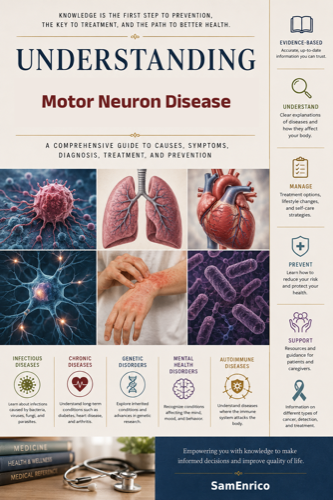 Understanding Motor Neuron DiseaseStrauss Eilene$17.99
 LeathercraftingStrauss Eilene$11.99
 Porsche GuideStrauss Eilene$12.99
 How to Become a Clothing-pattern PreparerStrauss Eilene$11.99
You may also like
 Hong Kong Handover 1997Dunn Johnnie$11.99
 Zumba For Postnatal Recovery CourseNeal Christian$11.99
 Zumba for BeginnersLadner Nikia$11.99
 YouTube Comment Mining GuideHumes Pandora$12.99
 Worry Box MeditationCarlin Rudy$11.99
 Workplace Stress MeditationNguyen Lynn$11.99
 Workplace Stress and Sleep RepairHawley Ivory$11.99
 Workplace Perfectionism CureDelaney Jeffry$11.99
 Workplace Injustice Anger GuideWallen Isabelle$11.99
 Work Addiction and Burnout LinkGreenwood Ester$11.99
 Women in Yoga and WellnessBeattie Galina$11.99
 Women in Stand Up ComedyChun Evangeline$11.99