
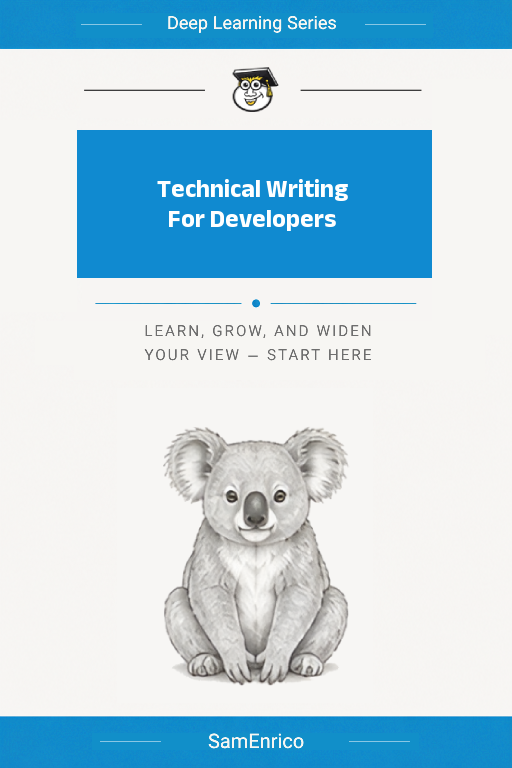
Non-FictionAI OperatorDev Docs
Technical Writing For Developers eBook
Use AI to write developer-focused documentation in
Use AI to write developer-focused documentation including SDKs and integration guides.
Formats
Free sample
Chapter 1: The Documentation Tax--You have just shipped a new SDK. The code is clean, the tests are passing, and the API is elegant. You push to production, close your laptop, and feel the quiet satisfaction of a job well done. Then Monday morning arrives. Your inbox contains seventeen support tickets.
Four are from frustrated developers who cannot get the authentication flow to work. Three are from users who say your documentation "doesn't match the actual SDK behavior." Two are from people who gave up entirely and just want a refund.This is the documentation tax. It is the hidden cost of shipping code without equally rigorous documentation. It comes due in support tickets, lost users, bad reviews, and the slow erosion of trust in your product.The tax is invisible on your balance sheet. No line item says "documentation debt." No executive asks for your documentation velocity.
But the tax is real. For every hour you spend writing code, you will spend another hour explaining it to users who cannot figure it out on their own. Or worse, you will not spend that hour, and those users will simply leave.I have watched this pattern play out across dozens of SDKs and API products. The companies that take documentation seriously grow faster, retain more users, and spend less on support. The companies that treat documentation as an afterthought bleed customers and burn out their engineering teams.This book exists because the old way of writing documentation is broken.
It asks developers to do something their brains are not wired to do: translate precise, logical code into friendly, narrative prose. Then it asks them to keep that translation accurate as the code changes weekly. Then it asks them to do it all over again for every language binding, every use case, and every version.The result is not just bad documentation. The result is suffering. Your suffering.
Your users' suffering. The suffering of the support engineer who answers the same question for the hundredth time because the answer is buried on page forty-seven of a PDF that no one reads.AI changes this equation. Not by replacing you. Not by magically understanding your business logic. But by handling the parts of documentation that are repetitive, mechanical, and mind-numbingly boring.
The parts that make you close your laptop and check Twitter. The parts that turn a Friday afternoon into a four-hour slog of formatting tables and rewriting sentences that somehow sound wrong no matter how many times you adjust them.Before we get to the how, we need to understand the why. Why does documentation feel so painful? Why do developers hate writing it so much? And what, exactly, is the tax you are paying right now without realizing it?The Two Brains Problem Your brain is not one machine.
It is a collection of specialized modules that evolved to solve different problems. The module that writes code is not the same module that writes prose. They use different circuits, different memories, and different error-checking systems.When you write code, you are using what cognitive scientists call procedural reasoning. You are thinking in sequences, conditionals, and state changes. Your brain is tracking variables, types, and execution paths.
The feedback loop is immediate: you write a line, the compiler or linter tells you if it works, and you adjust.When you write prose, you are using narrative reasoning. You are thinking in stories, explanations, and cause-effect relationships. Your brain is tracking audience knowledge, tone, clarity, and flow. The feedback loop is slow and ambiguous: you write a paragraph, you read it back, you are not sure if it is clear, and you have no way to know until a user tells you they are confused.Switching between these two modes is expensive. Psychologists have studied context switching for decades, and the findings are consistent: each switch costs you time, energy, and accuracy.
The more complex the tasks, the higher the cost.Now consider the typical developer workflow. You write code for forty-five minutes. Then you realize you need to document a function. You open your documentation file. Your brain starts the painful process of switching from procedural to narrative mode.
You write two sentences, realize they are terrible, delete them, and try again. Fifteen minutes later, you have a paragraph that is barely adequate. You switch back to code. Your brain reverses the process. You have lost momentum, focus, and the thread of what you were doing.This is not a skill issue.
It is not about learning to write better. It is about the fundamental architecture of the human brain. You are fighting biology every time you switch from code to prose.AI offers a way out. When you use AI to generate the first draft of your documentation, you are not asking your brain to switch modes. You are asking the AI to do the initial translation from code to prose.
Your job becomes editing, not creating. Editing uses a different cognitive mode—one that is closer to code review than to creative writing. You are checking for correctness, clarity, and completeness. This is a much smaller cognitive leap from coding.The developers who succeed with AI documentation are not the best writers. They are the best editors.
They know what good documentation looks like, and they can spot when the AI has gone off the rails. But they do not waste hours staring at a blank page, fighting their own brain.The Myth of "Just Write It"There is a cruel phrase that circulates in engineering organizations. When someone complains about documentation, a more senior engineer will say: "Just write it. It is not that hard."This phrase is toxic. It assumes that writing documentation is easy and that anyone struggling with it is lazy or incompetent.
It ignores the cognitive tax we just discussed. It dismisses the very real difficulty of translating technical knowledge into accessible prose."Just write it" also ignores the maintenance problem. Writing documentation is not a one-time event. It is an ongoing commitment. Every time your SDK changes, your documentation must change too.
Every time you discover a new edge case, your documentation must explain it. Every time a user gets confused, your documentation must be updated to prevent that confusion from happening again.The maintenance cost of documentation is invisible to the person who says "just write it." They imagine a static document, written once and forever useful. The reality is a living artifact that requires constant attention. If you do not pay that attention, your documentation rots. Examples stop working.
Explanations become outdated. The trust you built with users evaporates.I have seen SDKs with beautiful documentation that was two years out of date. The examples referenced functions that had been renamed. The setup instructions used an old version of the authentication flow. The tutorials assumed dependencies that were no longer required.
New users would follow the docs, hit an error, and assume the SDK was broken. They would not check the documentation's last update date. They would just leave.This is the documentation tax compounding. The longer you ignore maintenance, the higher the tax becomes. Eventually, you face a choice: rewrite all the…
This is the end of the free sample. Get the eBook to keep going. Buy now
About this book
Details
- Author
- Shook Candyce
- Publisher
- SamEnrico
- Language
- English
- Genre
- Non-Fiction, AI Operator, Dev Docs
- Released
- 2026-05-30
- Pages (approx.)
- 130
- Available as
- eBook, Audiobook

Read better in the ZLOADR app
Your eBooks on your phone or tablet. Sign in with your SamEnrico account and start reading.
More by Shook Candyce
 Single Parent Fitness ChallengesShook Candyce$11.99
 Yahoo Marissa Mayer's LeadershipShook Candyce$11.99
 Uganda Obote Kabaka GuideShook Candyce$11.99
 Loving Kindness for Financial StressShook Candyce$11.99
 Overcoming Self Doubt for ParentsShook Candyce$11.99
 The Rose and the Lion: Love and Betrayal in the Wars of the RosesShook Candyce$11.99
 Target Supply GuideShook Candyce$12.99
 A Beginners Guide to Cushion caroms (Volume 1)Shook Candyce$11.99
You may also like
 Hong Kong Handover 1997Dunn Johnnie$11.99
 Zumba For Postnatal Recovery CourseNeal Christian$11.99
 Zumba for BeginnersLadner Nikia$11.99
 YouTube Comment Mining GuideHumes Pandora$12.99
 Worry Box MeditationCarlin Rudy$11.99
 Workplace Stress MeditationNguyen Lynn$11.99
 Workplace Stress and Sleep RepairHawley Ivory$11.99
 Workplace Perfectionism CureDelaney Jeffry$11.99
 Workplace Injustice Anger GuideWallen Isabelle$11.99
 Work Addiction and Burnout LinkGreenwood Ester$11.99
 Women in Yoga and WellnessBeattie Galina$11.99
 Women in Stand Up ComedyChun Evangeline$11.99