
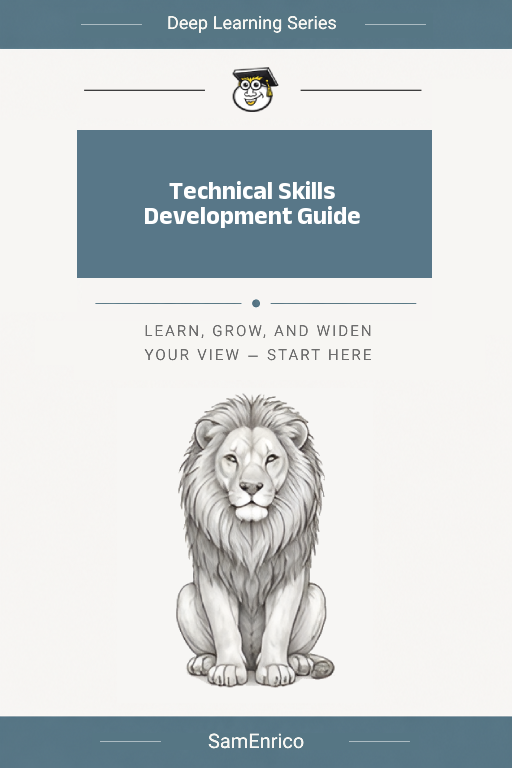
Non-FictionProfessional's Cheat SheetTechnical SkillsCertification
Technical Skills Development Guide eBook
Plan technical skill acquisition for your PDP incl
Plan technical skill acquisition for your PDP including certification roadmaps and hands on project timelines.
Formats
Free sample
Chapter 1: The Passion Trap--–- You have been lied to. The lie arrived wrapped in beautiful language, spoken by well-meaning teachers, repeated in commencement speeches, and printed on inspirational posters in office break rooms. The lie says: "Follow your passion, and success will follow you." It sounds wise. It feels true. It is the most dangerous career advice you will ever receive.This chapter will dismantle that lie.
Not because passion is bad—passion is wonderful, electric, and essential. But because the "follow your passion" framework has the cause and effect exactly backwards. Passion is not the fuel that launches a great career. Passion is the exhaust that emerges from a great career. You do not find your passion and then build skills around it.
You build rare and valuable skills, and passion finds you.If you are reading this book, you are likely an early-to-mid-career technical professional, a career-changer, or an engineering student. You have been told that your Personal Development Plan (PDP) should align with your "authentic self" or your "true calling." You have been encouraged to search inside yourself for that one thing that makes your heart sing. And if you haven't found it yet, you feel vaguely defective—like everyone else has a map and you are lost.This chapter will free you from that burden. By the time you finish reading, you will understand why the "passion first" model fails, what actually drives career satisfaction, and how to build a skill stack that makes you undeniable—whether you currently "love" the topic or not. You will learn to replace the vague, paralyzing question "What am I passionate about?" with the sharp, actionable question "What rare and valuable skill can I build next?"Let us begin by examining the wreckage of the passion economy.The Great Passion Experiment In the early 2000s, a Canadian psychologist named Robert Vallerand conducted a longitudinal study of college students.
He asked them one question: "Are you pursuing this field because you are passionate about it, or because you believe it will lead to a stable career?" Then he followed them for ten years.The results were startling. The students who pursued "passionate" fields—art, music, philosophy, creative writing—had higher rates of unemployment, lower median incomes, and significantly lower career satisfaction after five years than their "pragmatic" peers who pursued accounting, engineering, or computer science. But here is the kicker: after ten years, the surviving passionate students—the ones who had persisted through the struggle—reported higher satisfaction than anyone else. What separated the successful passionate students from the failures? They had one thing in common: they had stopped asking whether they were passionate and started asking whether they were getting good.The successful artists had treated their craft like a trade.
They practiced scales when they did not feel like it. They studied anatomy when they wanted to paint landscapes. They learned business skills when they wanted to be pure creators. The unsuccessful artists had waited for inspiration. They had followed their feelings.
And their feelings had led them nowhere.This pattern appears across every field. The engineers who love their jobs are not the ones who entered the field because of a childhood fascination with computers. They are the ones who became good—so good that they gained autonomy, mastery, and purpose. The passion followed the competence, not the other way around.The Passion Trap Defined Let us give this problem a name: The Passion Trap.The Passion Trap is the belief that you must discover a pre-existing passion before you can commit to building skills. It manifests as a voice in your head that says: "I can't study for this certification because I'm not sure I'm passionate about cloud architecture." Or: "I should wait until I find something I truly love before I invest time in learning it." Or: "What if I spend six months learning Python and then realize I don't actually enjoy programming?"The Passion Trap feels like wisdom.
It feels like self-awareness. It is actually paralysis disguised as introspection.Here is what the research says about people who fall into the Passion Trap. They switch majors more frequently. They change jobs more often. They accumulate more student debt for degrees they never complete.
They report higher rates of anxiety and depression. And they are no more likely to end up in a "dream job" than people who simply picked a practical field and got good at it.The reason is simple: passion is not a reliable guide because passion is not a stable trait. Your feelings about a topic change dramatically as you move from novice to competent to expert. Almost no one loves the early stages of learning a difficult skill. The syntax is confusing.
The error messages are cryptic. The first ten projects you build will be ugly, broken, and embarrassing. If you need passion to sustain you through that phase, you will quit. And everyone who is good at anything went through that phase.The Craftsman Mindset vs. The Passion Mindset Cal Newport, in his book So Good They Can't Ignore You, draws a critical distinction between two ways of approaching work: the Passion Mindset and the Craftsman Mindset.The Passion Mindset asks: "What can the world offer me?
What job aligns with my authentic self? What work will make me happy?" These are natural questions, but they are also traps. They focus your attention on external validation and internal feelings—both of which are largely outside your direct control. You cannot control whether the market values your passion. You cannot control whether your feelings remain consistent from month to month.
The Passion Mindset leads to constant evaluation: "Am I happy yet? Is this the right fit? Should I leave?" It is exhausting.The Craftsman Mindset asks a different question: "What can I offer the world? What rare and valuable skills can I build? How can I become so good that people cannot ignore me?" These questions are entirely within your control.
You can decide to learn a skill. You can practice it. You can get feedback. You can improve. The Craftsman Mindset does not care whether you feel passionate today.
It only cares whether you are getting better.Here is the paradox: people who adopt the Craftsman Mindset almost always end up more passionate about their work than people who adopt the Passion Mindset. Why? Because competence creates autonomy. Autonomy creates enjoyment. Enjoyment creates passion.
The Craftsman builds skill, skill brings freedom, freedom brings joy, and joy is misremembered as "passion I had all along."The Science of Emergent Passion Psychologists distinguish between two types of interest: individual interest (a stable, pre-existing preference) and situational interest (an interest that emerges from the characteristics of a situation). Individual interest is what most people mean by "passion." Situational interest is what you feel when you solve a hard problem, receive positive feedback, or experience a moment of flow.Here is the crucial finding: situational interest reliably transforms into individual interest over time. In other words, you can grow passion for almost anything, provided you have the right conditions: challenge, feedback, and a sense of progress.Think about the last time you learned something difficult. At…
This is the end of the free sample. Get the eBook to keep going. Buy now
About this book
Details
- Author
- Sykes Bronwyn
- Publisher
- SamEnrico
- Language
- English
- Genre
- Non-Fiction, Professional's Cheat Sheet, Technical Skills, Certification
- Released
- 2026-06-01
- Pages (approx.)
- 143
- Available as
- eBook, Audiobook

Read better in the ZLOADR app
Your eBooks on your phone or tablet. Sign in with your SamEnrico account and start reading.
More by Sykes Bronwyn
 Indian Green Incentives HandbookSykes Bronwyn$11.99
 TM Documentary Watch GuideSykes Bronwyn$11.99
 Men's Ventricular Assist Device GuideSykes Bronwyn$11.99
 The 4 Month Sleep Regression GuideSykes Bronwyn$11.99
 Workplace Stress First Aid TechniquesSykes Bronwyn$11.99
 Ragnarok’s Last Light: The Doomed Prophecy of the Sun’s EclipseSykes Bronwyn$11.99
 Shadows Over the Silk Road: The KGB's Lost AgentSykes Bronwyn$11.99
 Windsurfing InstructorSykes Bronwyn$11.99
 How to Become a Camp TenderSykes Bronwyn$11.99
 Medical Exam for Express EntrySykes Bronwyn$12.99
 Understanding Chromosome 16, Uniparental DisomySykes Bronwyn$17.99
You may also like
 Hong Kong Handover 1997Dunn Johnnie$11.99
 Zumba For Postnatal Recovery CourseNeal Christian$11.99
 Zumba for BeginnersLadner Nikia$11.99
 YouTube Comment Mining GuideHumes Pandora$12.99
 Worry Box MeditationCarlin Rudy$11.99
 Workplace Stress MeditationNguyen Lynn$11.99
 Workplace Stress and Sleep RepairHawley Ivory$11.99
 Workplace Perfectionism CureDelaney Jeffry$11.99
 Workplace Injustice Anger GuideWallen Isabelle$11.99
 Work Addiction and Burnout LinkGreenwood Ester$11.99
 Women in Yoga and WellnessBeattie Galina$11.99
 Women in Stand Up ComedyChun Evangeline$11.99