
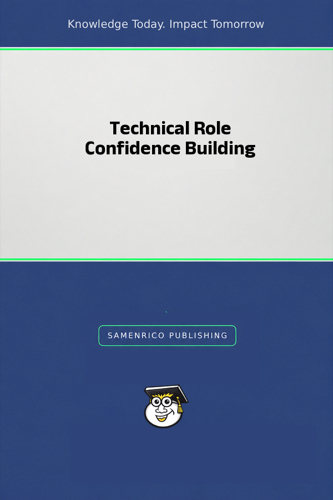
Non-FictionSelf-HelpTech Careers
Technical Role Confidence Building eBook
Trust your coding, engineering, or data skills des
by Quiroz Rona
Trust your coding, engineering, or data skills despite complex challenges.
Formats
Free sample
Chapter 1: The Imposter’s Stack Trace--–- You stare at the green checkmark next to your latest deployment. The metrics look good. The users are happy. Your team lead gave you a “Nice work” in Slack. And yet, somewhere beneath your ribs, a familiar cold knot is forming.
You feel it every time you close your laptop. Every time someone asks, “How did you solve that?” Every time you get a promotion you didn’t ask for.The feeling whispers: You got lucky. They don’t know you like I know you. Sooner or later, they will find out.Welcome to the imposter’s stack trace. Unlike a segmentation fault or a null pointer exception, this error does not crash your program.
It crashes your peace of mind. And it is one of the most pervasive, least-discussed bugs in the engineering psyche.If you have ever shipped working code, solved a complex problem, received positive feedback, and yet felt convinced you will be “found out” any day now—this chapter is your diagnostic log. We are going to trace the origin of that feeling, separate it from actual incompetence, and give you the first tools you need to stop treating your own doubt as evidence.The Infinite Complexity Paradox Let us start with a hard truth: you cannot know everything. This is not a personal failing. It is a structural feature of modern technical work.Consider what “knowing your stack” actually means in 2026.
A backend engineer might need working knowledge of Python, Go, or Rust; two or three cloud providers; container orchestration; SQL and No SQL databases; authentication protocols; CI/CD pipelines; infrastructure as code; observability tooling; and security best practices. That is before we add domain-specific knowledge—finance, healthcare, logistics, machine learning—or the particular quirks of your company’s ten-year-old monolith.No human being holds all of that in working memory. The engineers you admire are not walking encyclopedias. They are skilled at finding answers, not at already possessing them.The paradox: The more you learn, the more you become aware of what you do not know. A junior engineer might confidently say, “I know Python.” A senior engineer says, “I know enough Python to be dangerous, but I still look up the itertools documentation every single time.” The senior is more accurate.
The junior feels more confident.This is the Infinite Complexity Paradox. Technology expands faster than any individual can master it. The moment you feel competent in one area, three new frameworks emerge. The goalpost is always moving. And if your sense of self-worth depends on reaching a stationary goalpost, you will spend your entire career feeling perpetually behind.But here is the reframe that changes everything: you are not supposed to know everything.
Your value is not measured by the size of your internal knowledge cache. Your value is measured by what you can do with the tools you have, the problems you can unstick, and the systems you can keep running. Those are different metrics entirely.The Genius Myth and Its Body Count The second major contributor to technical imposter syndrome is what I call the Genius Myth. You know the archetype: the lone coder in a dark room, headphones on, fingers flying across the keyboard at midnight, producing perfect, elegant, bug-free code on the first try. No documentation consulted.
No Stack Overflow tabs open. No second-guessing.This person does not exist.Or rather, this person exists only in movies, in marketing materials, and in the fever dreams of non-technical founders. Real engineering is messy. Real engineers:Google syntax they have used a thousand times Write code that works, then refactor it when they realize a better approach Introduce bugs (many bugs) and fix them Ask colleagues for help Read documentation constantly Copy-paste from their own previous projects The Genius Myth is dangerous because it sets an impossible standard. You look at your own workflow—the Googling, the debugging, the moments of staring at a blank editor—and conclude that you are not a “real” engineer.
But that workflow is not evidence of fraud. It is evidence that you are human.I once asked a staff engineer at a FAANG company how often she looked up basic syntax. She laughed and said, “Every day. I have a terminal alias that opens the Python itertools docs because I cannot remember zip_longest versus zip under pressure.” This is a person who has designed systems handling billions of requests. She still Googles.The Genius Myth does not just cause self-doubt.
It also causes harm. Engineers who believe they should never need help stay silent in meetings, waste hours stuck on problems a colleague could solve in five minutes, and burn out trying to maintain the fiction of omniscience. The myth has a body count: talented people leaving the field because they believed they were not “natural” coders.Your counter-myth: Great engineering is not about flawless recall. It is about robust retrieval—knowing where to look, how to ask, and how to adapt what you find to your specific problem. That is a skill.
And you already have it.Subjective Doubt vs. Objective Incompetence Before we go any further, we need to make a critical distinction. This distinction is the foundation of everything that follows in this book.Subjective doubt is a feeling. It says: “I feel like I don’t belong. I feel like I’m faking it.
I feel like everyone else knows more than me.” Subjective doubt can exist in the complete absence of evidence. You can be objectively competent—highly competent, even—and still feel like a fraud.Objective incompetence is a fact. It says: “I genuinely lack the required skills for this specific role or task.” Objective incompetence is measurable. If you cannot write a for loop in the language your team uses, that is objective incompetence. If you do not understand basic database normalization, that is objective incompetence.
These are gaps you can close with learning and practice.Here is the crucial insight that most imposter syndrome resources get wrong: Feeling like a fraud does not mean you are incompetent. And being incompetent does not necessarily cause the fraud feeling.I have worked with engineers who were genuinely underqualified for their roles. They did not have imposter syndrome. They were blissfully unaware of their gaps. Conversely, I have worked with brilliant, accomplished engineers who felt like complete frauds every single day.
Their feeling had no relationship to their actual ability.This distinction matters because the solutions are different:If you have...The solution is...Subjective doubt (feeling)Psychological tools, evidence tracking, cognitive reframing (this book)Objective incompetence (actual gap)Skill acquisition, training, mentorship, practice Many people have both. But many people only have subjective doubt. They spend years trying to close skill gaps that do not exist, thinking that more certifications, more courses, more side projects will finally make them feel legitimate. They are treating the wrong problem.Your first diagnostic: Take out a piece of paper (or a new note). Draw a line down the middle.
On the left, write “Things I feel insecure about.” On the right, write “Evidence that actually matters for my role.” Then ask yourself: for…
This is the end of the free sample. Get the eBook to keep going. Buy now
About this book
Details
- Author
- Quiroz Rona
- Publisher
- SamEnrico
- Language
- English
- Genre
- Non-Fiction, Self-Help, Tech Careers
- Released
- 2026-06-09
- Pages (approx.)
- 139
- Available as
- eBook, Audiobook

Read better in the ZLOADR app
Your eBooks on your phone or tablet. Sign in with your SamEnrico account and start reading.
More by Quiroz Rona
 RLS And Antihistamine Warning GuideQuiroz Rona$11.99
 The Koresh FBI FilesQuiroz Rona$11.99
 Almodovar Color WorldQuiroz Rona$11.99
 Macmillan HaroldQuiroz Rona$11.99
 Cleopatra's Military Logistics ManualQuiroz Rona$11.99
 Parenting Anger Cognitive ToolsQuiroz Rona$11.99
 Emergency Radio and CommunicationQuiroz Rona$11.99
 Cash Flow for CateringQuiroz Rona$11.99
 The Ballad of the Black Cowboy: Nat Love's Untold FrontierQuiroz Rona$11.99
 Frozen Secrets: The First Antarctic Climate Pioneers (1838-1843)Quiroz Rona$11.99
 Bottled Time: The 100-Year-Old Mystery of the Lost Champagne CellarsQuiroz Rona$11.99
 How to Become a Brilliandeer-lopperQuiroz Rona$11.99
You may also like
 Hong Kong Handover 1997Dunn Johnnie$11.99
 Zumba For Postnatal Recovery CourseNeal Christian$11.99
 Zumba for BeginnersLadner Nikia$11.99
 YouTube Comment Mining GuideHumes Pandora$12.99
 Worry Box MeditationCarlin Rudy$11.99
 Workplace Stress MeditationNguyen Lynn$11.99
 Workplace Stress and Sleep RepairHawley Ivory$11.99
 Workplace Perfectionism CureDelaney Jeffry$11.99
 Workplace Injustice Anger GuideWallen Isabelle$11.99
 Work Addiction and Burnout LinkGreenwood Ester$11.99
 Women in Yoga and WellnessBeattie Galina$11.99
 Women in Stand Up ComedyChun Evangeline$11.99