
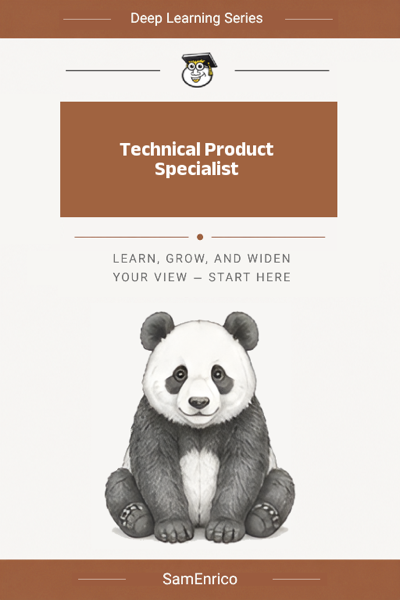
Non-FictionInformativeEducational
Technical Product Specialist eBook
A Coursebook on Technical Product Specialist
by Bou Adeline
A Coursebook on Technical Product Specialist
Formats
Free sample
Chapter 1: You Are Not a Demo Monkey...--The first time someone called me a “demo monkey,” I laughed.It was a Tuesday afternoon. I had just finished my third product walkthrough of the day for a prospect who had already decided to buy from a competitor but wanted free consulting disguised as a “final comparison.” My sales counterpart clapped me on the back and said, “Great job, monkey. Banana after the show.”I laughed because I was exhausted. I laughed because I did not know what else to do. And I laughed because, deep down, I was afraid he was right.For two years, I had been a Technical Product Specialist at a mid-sized Saa S company.
I knew the product cold. I could recite API endpoints from memory, troubleshoot integration failures in my sleep, and answer any question about configuration flags without opening documentation. My calendar was a solid wall of back-to-back calls: demos, discovery calls, implementation handoffs, and the occasional training session for customers who had already signed.I was busy. I was “valuable.” And I was completely replaceable.Because here is the truth no one tells you when you first step into this role: Being a walking encyclopedia of product knowledge is not a career. It is a trap.The trap works like this.
You get hired because you know things other people do not know. The sales team cannot answer technical questions, so they pull you in. The support team cannot handle complex troubleshooting, so they escalate to you. The customer success team does not understand the architecture, so they ask you to explain it. You become the go-to person for everything technical.
And because you are always putting out fires, you never have time to work on anything strategic. You never have time to build assets that scale your impact. You never have time to learn the business context that would make your technical knowledge valuable.You are too busy being a hero. And heroes, in most organizations, burn out and get replaced by the next hero.This chapter is the intervention I wish someone had given me on that Tuesday afternoon.The Lie You Have Been Told Somewhere along the way, you absorbed a dangerous assumption: that technical expertise is enough. That if you just know the product better than anyone else, you will be indispensable.
That your value is measured in how many questions you can answer and how many problems you can solve.This is a lie.Technical expertise is table stakes. It is the minimum price of admission to this role, not the differentiator. Every one of your peers knows the product. Every one of them can troubleshoot. Every one of them can answer basic questions.
If your only competitive advantage is knowing one more API endpoint than the next person, you are in a race to the bottom—and you will lose to someone younger, cheaper, and just as willing to memorize documentation.The real differentiator is not what you know. It is what you do with what you know.Consider two specialists. Both know the same product cold. Both have the same technical background. Both work for the same company.Specialist A spends her days in back-to-back calls.
She answers every question, fixes every problem, and never says no. She is exhausted by 3 PM. She has no time to document anything. When she takes vacation, her absence is a crisis. Her manager loves her because she “gets things done.” But she has no leverage.
Her impact is linear: one specialist, one conversation at a time. She cannot scale. And when the company grows, she will be promoted into irrelevance—or burned out and replaced.Specialist B also takes customer calls. But she also blocks four hours every week to build assets: email templates, troubleshooting guides, demo scripts, and internal wikis. When someone asks her the same question twice, she writes an answer that everyone can use.
She trains customer champions to answer questions before they reach her. She says no to low-value calls so she can say yes to high-impact projects. Her manager sometimes worries that she is “not busy enough.” But her impact is exponential. One of her assets can help a hundred customers. When she takes vacation, nothing breaks.
She gets promoted because she has proven she can do more than one person’s job.Specialist B is not smarter than Specialist A. She is not more technical. She has simply rejected the lie that technical expertise is enough. She has embraced a broader, more strategic definition of what a Technical Product Specialist can be.Role Confusion: Who Are You, Really?Part of why we fall into the demo monkey trap is that no one has clearly defined what we are supposed to be. Look at the job titles adjacent to ours:Sales Engineer: Owns the technical side of the sales process.
Runs discovery, builds proof-of-concepts, and closes deals. Measured on revenue. Usually carries a quota.Solution Architect: Owns the technical design of complex implementations. Maps customer requirements to product capabilities. Designs integrations and data flows.
Measured on successful deployments.Technical Support Engineer: Owns post-sale issue resolution. Troubleshoots bugs, answers “how-to” questions, and escalates to engineering. Measured on ticket resolution time and customer satisfaction.Customer Success Manager: Owns the business relationship post-sale. Ensures adoption, manages renewals, and identifies expansion opportunities. Measured on retention and net revenue retention.Where do you fit?The honest answer is that the Technical Product Specialist role is the bridge between all of these functions.
You sit between engineering and sales, between support and customer success, between the product roadmap and the market. You are the person who can talk to an engineer about database schemas in the morning and talk to a C-level executive about ROI in the afternoon.This ambiguity is both your curse and your superpower.It is a curse because no one has told you exactly what to do. You are measured on vague metrics like “subject matter expertise” and “customer engagement.” You are pulled in a dozen directions because everyone needs you. You are expected to be technical enough for engineers, persuasive enough for sales, patient enough for support, and strategic enough for product management.But it is a superpower because no one else can do what you do. The sales engineer is too focused on closing this quarter’s deals to think about next year’s roadmap.
The solution architect is too deep in implementation details to see the pattern across multiple customers. The support engineer is too busy fighting fires to build the assets that would prevent them. The customer success manager does not have the technical depth to distinguish between a real product gap and a training issue.You have the technical depth. You have the customer exposure. And if you are smart, you have the strategic awareness to connect the two.The question is not whether you have value.
The question is whether you are leveraging that value strategically—or burning it reactively.The T-Shaped Professional: Your Blueprint for Growth There is a framework that has helped thousands of technical professionals escape the demo monkey trap. It is called the T-Shaped Professional.Imagine the letter T. The…
This is the end of the free sample. Get the eBook to keep going. Buy now
About this book
Details
- Author
- Bou Adeline
- Publisher
- SamEnrico
- Language
- English
- Genre
- Non-Fiction, Informative, Educational
- Released
- 2026-05-11
- Pages (approx.)
- 149
- Available as
- eBook, Audiobook

Read better in the ZLOADR app
Your eBooks on your phone or tablet. Sign in with your SamEnrico account and start reading.
More by Bou Adeline
 Alcoholism Recovery for Chefs and RestaurateursBou Adeline$11.99
 Minimalism Burnout ShieldBou Adeline$11.99
 Add On Acquisition DBBou Adeline$11.99
 Shopping Addiction Relapse PlanBou Adeline$11.99
 Operation: The Phantom of the Opera Down Under - How a Forgotten Composer Staged a Musical RevolutionBou Adeline$11.99
 Customer Reviews Translation HandbookBou Adeline$12.99
 How to Produce AnemometersBou Adeline$11.99
 Ultimate Handbook Guide to Duisburg : (Germany) Travel GuideBou Adeline$11.99
You may also like
 Hong Kong Handover 1997Dunn Johnnie$11.99
 Zumba For Postnatal Recovery CourseNeal Christian$11.99
 Zumba for BeginnersLadner Nikia$11.99
 YouTube Comment Mining GuideHumes Pandora$12.99
 Worry Box MeditationCarlin Rudy$11.99
 Workplace Stress MeditationNguyen Lynn$11.99
 Workplace Stress and Sleep RepairHawley Ivory$11.99
 Workplace Perfectionism CureDelaney Jeffry$11.99
 Workplace Injustice Anger GuideWallen Isabelle$11.99
 Work Addiction and Burnout LinkGreenwood Ester$11.99
 Women in Yoga and WellnessBeattie Galina$11.99
 Women in Stand Up ComedyChun Evangeline$11.99